Last updated 2026-07-25
TL;DR
Yes, in most US cities and counties, dogs over a certain age (often 4 or 6 months) must be licensed with proof of rabies vaccination, typically costing $10 to $25 a year. A handful of states set the requirement statewide; most leave it to county or city ordinance, so check your local animal control page before assuming you're covered.
do dogs have to be licensed everywhere in the US?
No single federal law requires dog licensing. It's almost always a state, county, or city rule, and the details (age cutoff, fee, renewal period) shift depending on where you live. Some states set licensing requirements at the state level. Ohio, for example, requires every dog over three months old to be registered with the county auditor, with fees set by county but capped by statute at $20 for an annual license or $150 for a permanent one [1]. Other states leave it entirely to local government, so a city like New York requires its own license through the Department of Health while a rural county two hours away might not require one at all. The honest answer is: check your city clerk's site and your county's animal control or auditor page before you assume either way. If you operate a boarding or daycare facility, this matters even more, because you're often responsible for confirming a dog's license and rabies status before you accept it, and some county zoning permits for kennels require proof that resident dogs are licensed. A good rule of thumb: if your area requires rabies vaccination by law (nearly all do, since rabies control is a public health issue), it usually also requires licensing, because the license is often how the county tracks vaccination compliance.
how do you register a dog for a license?
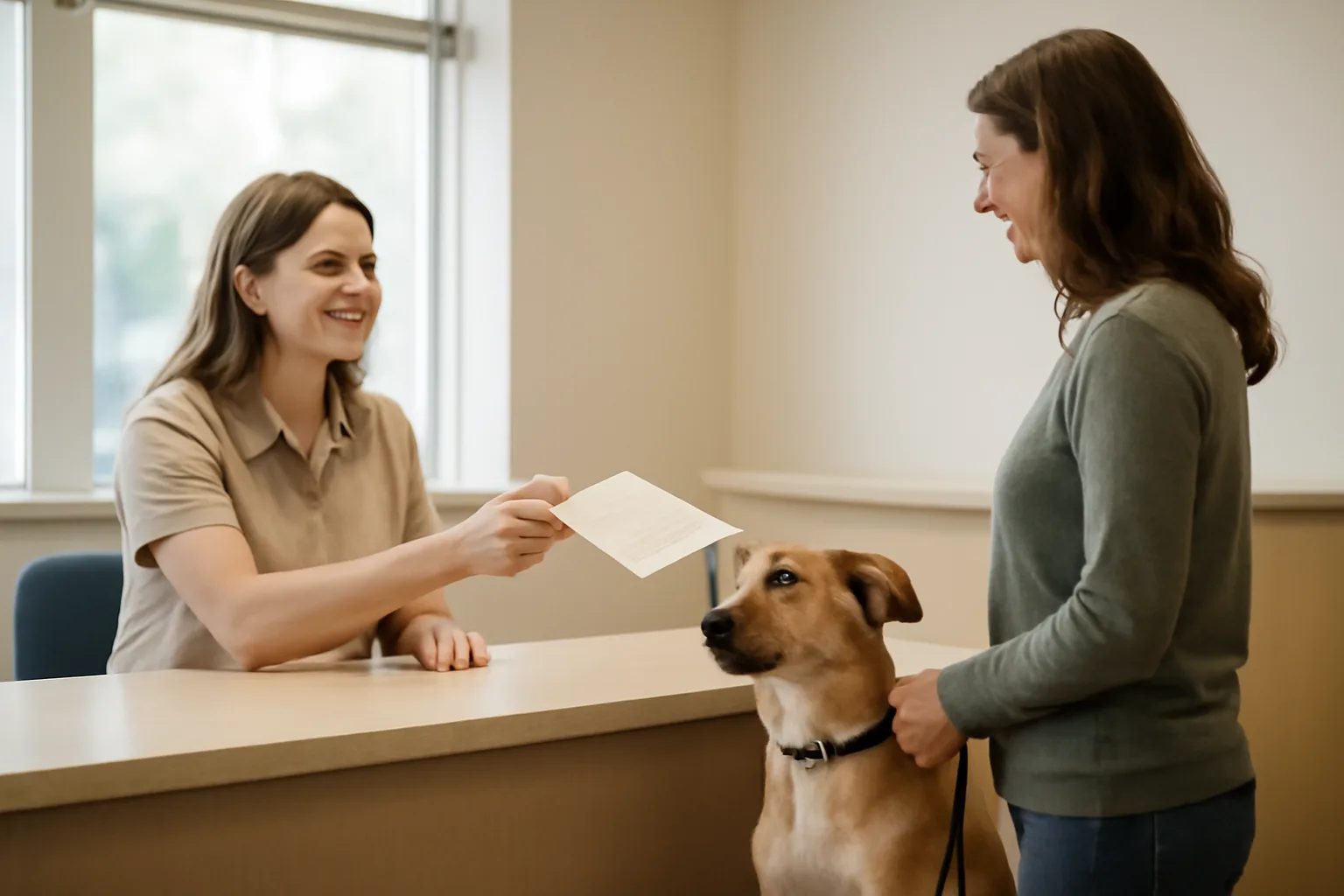
Registering a dog for a license usually takes four things: proof of rabies vaccination, proof of spay/neuter status (many places charge less for altered dogs), your dog's basic info (breed, color, age), and the fee itself. You can typically do it online through the county auditor or animal control office, by mail, or in person at the courthouse or animal shelter. Most jurisdictions want a current rabies certificate from a licensed veterinarian, more than a receipt. Ohio law, for instance, ties license issuance directly to a valid rabies vaccination on file [1]. If your dog's rabies shot has lapsed, you'll usually need to get it renewed before the license goes through. Renewal periods vary. Some counties issue lifetime licenses tied to a microchip number; most issue annual licenses that expire on a fixed date (often December 31 or the dog's birthday month) regardless of when you first registered. Missing the renewal window often triggers a late fee, and in some counties, an unlicensed dog can result in a citation if animal control picks the dog up or a neighbor complains.
how much is dog licensing? what does it actually cost?
| Altered dog, annual | $10-$20 | Common county rate | |
|---|---|---|---|
| Unaltered dog, annual | $20-$50+ | Varies, often 2-4x altered rate | |
| Lifetime license | $100-$150 | Ohio cap: $150 [1] | |
| Late renewal penalty | +50-100% of base fee | Varies by county | Note this is a completely separate cost from dog boarding, which is a service fee, not a government fee. More on that below. |
Dog license fees generally run $10 to $25 a year for a spayed or neutered dog, with unaltered dogs often costing double or more in places that use the fee to nudge spay/neuter compliance. Ohio counties are capped by state law at $20 annually or $150 for a lifetime license, though many counties charge less [1]. Fee schedules for altered versus unaltered dogs are common nationwide, and county boards typically set the exact number within whatever state cap applies. Senior citizen and disability discounts are common. Some counties waive fees entirely for service dogs. If you're late renewing, expect a penalty, sometimes doubling the base fee, on top of the standard cost. | Fee type | Typical range | Example |
how much does dog boarding cost, and is that the same as a license?
No, dog boarding cost and dog licensing cost are unrelated. A license is a government registration fee, usually under $25 a year. Dog boarding is a paid service, what you pay a kennel or daycare facility to care for your dog while you're away, and it typically runs $25 to $85 a night depending on your region, the facility's amenities, and whether your dog needs a private room versus a shared run. Luxury boarding facilities with webcams, play yards, and one-on-one attention can charge $60 to $120+ a night in major metro areas. Basic kennel boarding in a rural area might run $20 to $35 a night. Add-ons like medication administration, extra playtime, or grooming before pickup usually cost extra, often $5 to $15 per service. If you're a facility operator setting your own rates, your county zoning approval and any required kennel license (a business permit, different from a per-dog license) factor into your fixed costs, and those get baked into what you charge per night. For background on typical facility pricing structures, see our guides on dog boarding and pet boarding rates.
is a dog license the same as papers?
No, and this trips people up constantly. A dog license is a government registration, proof your dog is vaccinated and accounted for in your county's records. "Papers" almost always means breed registration papers, like AKC registration, which has nothing to do with any government body and everything to do with a private kennel club's pedigree records. A license doesn't prove your dog is purebred, and papers don't satisfy your county's licensing requirement. You need both if you own a purebred dog in a licensing jurisdiction: the license for legal compliance, papers if you want to show, breed, or prove pedigree for resale value.
how do you get papers for a dog?
To get AKC papers, your dog's litter needs to come from two AKC-registered parents, and the breeder registers the litter with the American Kennel Club, who then issues individual registration certificates for each puppy. If you bought a purebred puppy from a registered breeder, you should receive either a completed registration application or the papers directly at pickup, per AKC's registration process. If you already own an adult dog with no papers and you're sure of its pedigree, options are limited. AKC does allow enrollment in its Purebred Alternative Listing (PAL) program for spay/neuter and companion purposes if you can't get full registration, but it does not confer breeding rights or full pedigree status [2]. If you bought a dog from a breeder who never registered the litter, you generally cannot retroactively get full AKC papers without the breeder's cooperation. Mixed breed dogs can't get AKC papers at all, since AKC registration is specifically for recognized purebred dogs. Some owners confuse a microchip registration or a rescue's adoption paperwork with "papers," but neither of those is a breed pedigree document.
how do you become a dog breeder, legally?
Becoming a legal dog breeder means clearing three separate hurdles: state or local breeder licensing (if your state or county requires it), possible USDA licensing if you sell wholesale or exceed federal thresholds, and zoning compliance if you're breeding on a property zoned residential. The federal threshold is the one people miss most often. Under the Animal Welfare Act regulations, if you have more than four breeding females and sell puppies sight unseen (online, through a broker, or to a pet store) you generally need a USDA license, administered by APHIS, per the dealer definition at 9 CFR 1.1 [3]. Breeders who sell directly, face-to-face, are typically exempt regardless of how many females they have, under the retail pet store exemption in the same regulation [3]. That distinction, sight-unseen versus face-to-face, is the whole ballgame for USDA purposes. State-level rules vary widely. Ohio, through the Ohio Revised Code chapter governing commercial dog breeders, requires a state kennel license once you exceed a set number of breeding females or annual litters, independent of USDA status [4]. Pennsylvania's Dog Law similarly requires kennel licensing for commercial breeding operations . County zoning is the third layer, and it's often the one new breeders skip entirely: many residential zones cap the number of dogs allowed per household, or require a conditional use permit for a "kennel" use, regardless of how small your operation is. If you're planning to breed and sell across state lines, or you're not sure whether your volume crosses the USDA threshold, this is exactly the gap our $149 Kennel License & Zoning Packet is built for: it walks you through the state, county, and federal layers so you don't find out about a missing permit after your first litter is already sold.
how do i know if my breeding operation needs a USDA license?
You likely need a USDA license if you have more than four intact adult female dogs used for breeding and you sell puppies without the buyer physically visiting your premises before purchase, per the Animal Welfare Act regulations' definition of a regulated "dealer" at 9 CFR 1.1 [3]. Selling exclusively face-to-face at your own home generally keeps you in the retail exemption, no matter your female count. The regulation defines a retail pet store exemption for anyone selling animals only at retail, in person, where buyers physically observe the animal before purchase [3]. This is a federal floor, not a ceiling. Your state can (and often does) impose licensing at a lower threshold. Ohio's commercial dog breeder statute, for instance, requires a state license for anyone with nine or more female dogs used for breeding and who sells 60 or more puppies a year, a different number than the federal test [4]. Don't assume county rules match either standard. It's common for a breeder to be exempt federally, still need a state kennel license, and still need a county zoning variance, all at the same time, three different agencies, three different thresholds.
how do you get a dog license as an operator running a boarding or daycare facility?
If you're running a kennel, boarding facility, or daycare, you typically need two separate things: a business kennel license (sometimes called a commercial kennel permit) issued by the county or state, and you're often responsible for verifying that every dog in your care carries an individual, current pet license and rabies certificate before intake. A business kennel license is different from the per-dog license an individual pet owner gets. It usually requires a facility inspection, proof of liability insurance, a fire and safety walkthrough, and confirmation that your property is zoned for kennel or commercial animal care use. Zoning is frequently the slowest part, because many counties classify boarding kennels as a conditional use requiring a hearing, not a use permitted by right, even in commercially zoned areas. Requirements differ enough county to county that giving a single number here would be misleading. Contact your county zoning office and state department of agriculture directly, or use a structured packet like ours to organize the paperwork before your hearing date, since a missing document is the single most common reason zoning hearings get continued rather than approved.
what happens if you don't license your dog?
Penalties for an unlicensed dog usually start with a fine, often in the $25 to $250 range depending on the jurisdiction, and repeat violations or a dog picked up by animal control without a license can escalate to impound fees on top of the fine. Some counties also use license fee revenue to fund the local shelter or animal control budget, so licensing is partly a funding mechanism, more than a tracking tool. More practically: an unlicensed, unvaccinated dog that bites someone or gets loose creates a much bigger legal and financial problem than the license fee ever would have. Insurance claims, liability disputes, and rabies quarantine requirements all get harder to resolve cleanly if there's no paper trail showing current vaccination and registration.
are any dogs exempt from licensing?
Yes, common exemptions include service dogs, dogs under a certain age (often under 4 or 6 months, before rabies vaccination is typically required), dogs owned by nonresidents visiting temporarily, and in some places, dogs kept exclusively indoors on a property with fewer than a set number of total dogs. Exact exemptions are set locally, so the list above is a general pattern, not a guarantee for your specific county. Working dogs used for herding or hunting sometimes get a reduced agricultural rate rather than a full exemption. If you think your dog qualifies for an exemption, get it in writing from your county's animal control office rather than assuming, since an incorrect assumption here is exactly the kind of thing that turns into a fine later.
Frequently asked questions
How much does dog boarding cost per night?
Dog boarding typically costs $25 to $85 a night depending on region and amenities, with basic kennel boarding on the low end and upscale daycare-and-boarding combo facilities with private suites running $60 to $120+ in major metro areas. This is a service fee paid to a private business, unrelated to any government dog license fee.
How do I register my dog for a license?
Bring proof of rabies vaccination, spay/neuter status if applicable, and your dog's basic details to your county auditor, city clerk, or animal control office, either online, by mail, or in person, along with the license fee (usually $10 to $25 a year for altered dogs).
How do I get papers for my dog?
If your dog's litter came from two AKC-registered parents, the breeder registers the litter and you receive registration papers at pickup. If you already own an adult dog with no litter registration on file, full AKC papers generally aren't obtainable retroactively without the original breeder's cooperation; AKC's PAL program is a limited alternative for spay/neuter dogs.
Is a dog license the same as AKC papers?
No. A dog license is a government registration proving rabies vaccination and residency, issued by your city or county. AKC papers are private pedigree registration documents proving purebred lineage, issued by the American Kennel Club. Neither substitutes for the other, and most jurisdictions require the license regardless of whether your dog has papers.
How do you become a licensed dog breeder?
Check three layers: USDA licensing if you have more than four breeding females and sell sight unseen, state breeder licensing if your state sets its own threshold (Ohio requires it at nine-plus females and 60-plus puppies sold yearly), and county zoning approval for a kennel or breeding use on your property.
What's the federal threshold for needing a USDA breeder license?
Under the Animal Welfare Act regulations at 9 CFR 1.1, anyone with more than four breeding female dogs who sells puppies sight unseen to the public generally needs a USDA license through APHIS. Selling face-to-face at your own home typically qualifies for the retail exemption regardless of how many females you keep.
Do puppies need to be licensed too?
Most jurisdictions exempt puppies from licensing until they reach the minimum rabies vaccination age, commonly 4 to 6 months, and require licensing shortly after that first rabies shot. Check your specific city or county ordinance, since the exact age cutoff and grace period vary.
What documents do I need to register a dog?
You'll typically need a current rabies vaccination certificate from a licensed vet, proof of spay/neuter status if you want the discounted rate, and basic identifying information (breed, age, color, microchip number if applicable). Some counties also require proof of residency.
Can I get my dog's license online?
Many counties now offer online registration through the county auditor, city clerk, or animal control website, where you upload your rabies certificate and pay the fee by card. Some smaller jurisdictions still require in-person or mailed applications, so check your specific county's page first.
What's the difference between a kennel license and a dog license?
A dog license covers one individual pet owned by a resident. A kennel license (or commercial kennel permit) is a business license covering a facility that boards, breeds, or houses multiple dogs, usually requiring a facility inspection, zoning approval, and separate fees on top of any per-dog licensing.
Do service dogs need to be licensed?
In most jurisdictions, yes, service dogs still need standard rabies vaccination and licensing like any other pet, though many counties waive the license fee itself for documented service or assistance dogs. Check your local animal control ordinance, since fee waivers are set locally, not federally.
How much does it cost to license an unaltered (not spayed/neutered) dog?
Unaltered dogs typically cost two to four times more to license than spayed or neutered dogs, since higher fees are used to encourage spay/neuter. Ohio's statutory cap, for example, allows up to $20 a year for a standard annual license regardless of altered status, but many counties structure a separate, higher unaltered rate within that cap.
Sources
- Ohio Revised Code 955.01 and 955.06 (dog registration and fee caps): Ohio requires dogs over three months old to be registered, with fees capped by statute at $20 annually or $150 for a permanent license
- Ohio Revised Code 955.11 (dog license fee schedule and county auditor authority): County auditors set license fees within the statutory cap, with common practice of charging different rates or discounts based on spay/neuter status
- 9 CFR 1.1, Animal Welfare Act regulations, definitions of "dealer" and retail pet store exemption: Breeders with more than four breeding female dogs who sell sight unseen must be licensed under the Animal Welfare Act, while face-to-face sellers are generally exempt
- Ohio Revised Code Chapter 956, Commercial Dog Breeders: Ohio requires state breeder licensing for operators with nine or more breeding females who sell 60 or more puppies annually
- Pennsylvania Dog Law, 3 P.S. Section 459-201 (kennel license requirement): Pennsylvania's Dog Law requires state kennel licensing for commercial breeding operations independent of federal USDA status