Last updated 2026-07-24
TL;DR
Dogtopia Owings Mills offers daycare, boarding, and grooming for dogs in Baltimore County, Maryland. Boarding generally runs $40-$60 per night and daycare $30-$40 per day, in line with national chain averages. If you're researching the location to open a similar facility yourself, the real work is Baltimore County zoning approval and Maryland kennel licensing, not the franchise fee.
What is Dogtopia Owings Mills and what services does it offer?
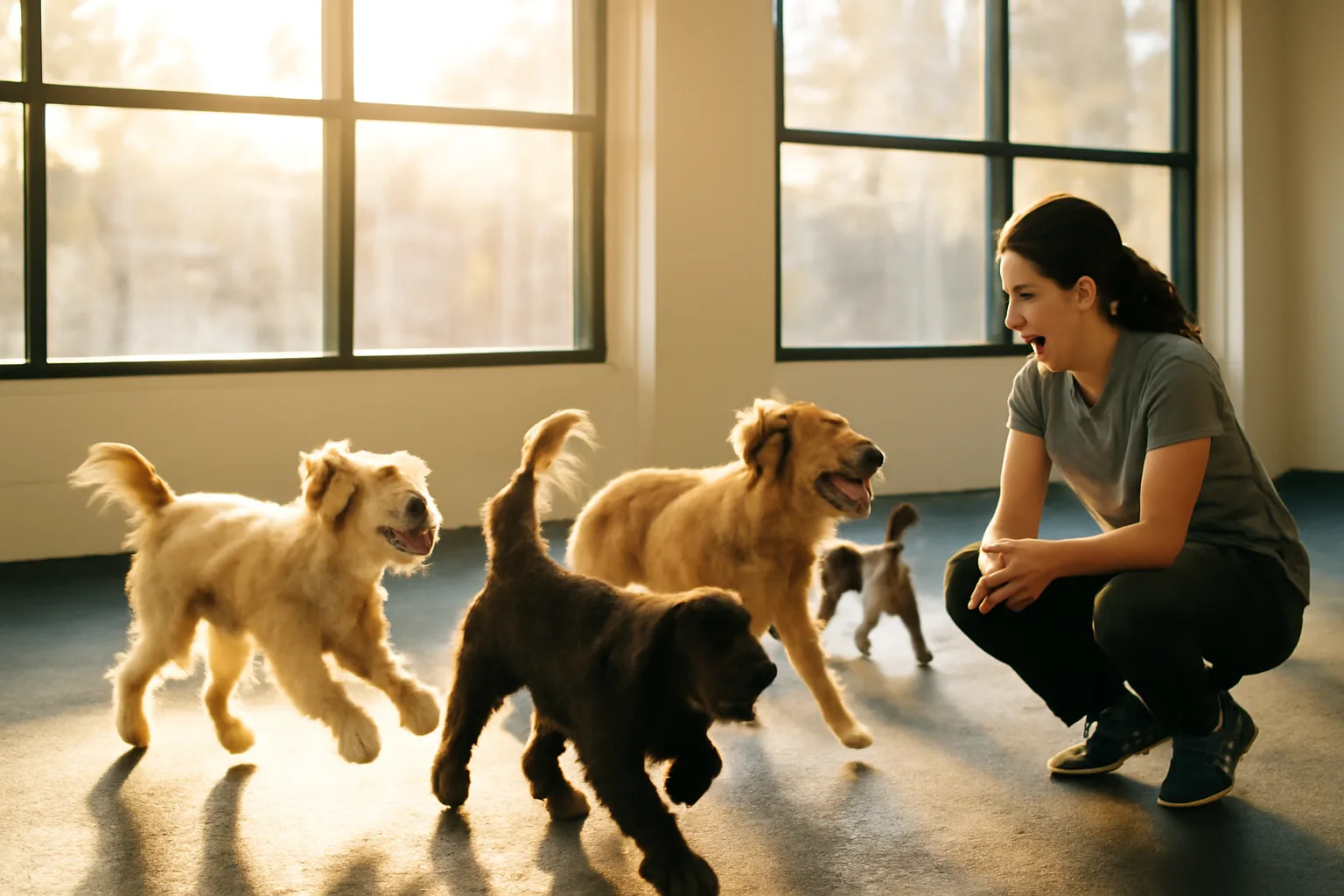
Dogtopia Owings Mills is a franchise location of the national Dogtopia chain, based in Owings Mills, Maryland, inside Baltimore County. Like other Dogtopia locations, it typically offers daycare, overnight boarding, and spa/grooming add-ons (baths, nail trims, teeth brushing) built around open-play daycare rooms rather than individual runs. The Dogtopia model leans hard on daycare as the core product, with boarding sold as an extension of daycare (dogs boarding overnight usually still get daytime playgroup access). This is different from a traditional boarding kennel model where dogs spend most of the day in a private run or suite. If you're comparing facility types, it helps to understand the difference between a dog boarding operation built on individual kennels versus a daycare-centric model like Dogtopia's. Exact hours, staff-to-dog ratios, and specific add-on menus vary by franchise location and can change, so always confirm current details directly with the Owings Mills location rather than relying on chain-wide averages. One caution worth naming plainly: prices, hours, and even which services a specific location offers are set at the franchisee level and change often. Anything you read online, including this article, should be treated as a starting point for your own call to the facility, not a locked-in quote.
How much does dog boarding cost at a place like Dogtopia?
| Budget/rural kennel | $20-$35 | Private run, limited playtime | |
|---|---|---|---|
| Suburban daycare-boarding hybrid (Dogtopia-style) | $40-$65 | Daycare playgroup + overnight stay | |
| Upscale "pet hotel" | $60-$120+ | Private suite, webcam, premium amenities | If you're shopping around, always ask what's actually included in the quoted rate. A $45/night boarding fee that includes full-day playgroup access is a different value proposition than a $45/night fee for a dog that sits in a crate 20 hours a day. For more on how these facility types differ, see our overview of pet boarding options. |
Dog boarding costs vary a lot by region, but national industry data gives a useful range. According to IBISWorld's Pet Boarding and Grooming Services industry report, the sector generates over $2 billion in the U.S. annually, and typical nightly boarding rates across the industry commonly fall between $35 and $85 depending on region, dog size, and amenities [1]. For a Baltimore County suburb like Owings Mills, expect nightly boarding in the neighborhood of $40 to $65, with premium suites, holiday surcharges, and add-on services (grooming, extra playtime, medication administration) pushing the total higher. Daycare-centric chains like Dogtopia often price boarding as a daycare day plus an overnight fee, rather than a flat kennel rate, so the sticker price can look different from a traditional kennel down the street. Here's a rough comparison of what boarding costs look like across common facility types (these are general industry ranges, not fees quoted by any specific business): | Facility type | Typical nightly rate | What's included |
How much is dog daycare, and is it worth it compared to boarding?
Daycare typically runs cheaper than boarding because the dog goes home at night. Expect somewhere between $25 and $45 per day at a suburban daycare-boarding hybrid, with multi-day packages (10-pack, 20-pack) usually discounting the per-day rate by 10-20%. Whether daycare is "worth it" depends entirely on why you're using it. If your dog has real separation anxiety or destructive behavior alone, structured daycare with supervised play can genuinely help burn energy and reduce problem behavior at home. If your dog is perfectly happy solo and you're just trying to avoid guilt, that's a different calculation, and a dog walker or shorter daycare stint might be cheaper and just as effective. For operators building a facility, daycare margins usually beat boarding margins because you're not staffing overnight and you're turning the same square footage over every single day rather than holding it for a multi-night guest. That's part of why chains like Dogtopia lean so heavily on daycare as the anchor product. If you're researching the doggy day care model for your own business plan, daycare-first economics are worth studying closely before you commit to a boarding-heavy layout.
How do you register a dog, and how is that different from getting a dog license?
Registering a dog usually means recording ownership with a kennel club (like the American Kennel Club) for pedigree purposes. Getting a dog license means registering the dog with your local government, almost always at the county or city level, for public health and animal control purposes. These are two completely different things and people mix them up constantly. AKC registration is optional and has nothing to do with the law. It's a paperwork trail proving a dog's parentage traces back to AKC-registered dogs, and it's mostly relevant if you're planning to show, breed, or sell puppies as purebred with papers. County dog licensing, on the other hand, is often legally required. Baltimore County, for example, requires dog licenses for dogs over a certain age, with fees and rabies vaccination proof as part of the process, administered through the county's Animal Services division [2]. If you just adopted a dog and someone says "you need to register your dog," ask them which kind they mean. If they mean the legal kind, that's your county license. If they mean the paperwork kind, that's AKC or a similar registry, and it's not required to legally own a dog anywhere in the U.S.
How do you get a dog license?
Getting a dog license is a county or municipal process, not a state or federal one, and it usually takes four things: proof of rabies vaccination, proof of spay/neuter status (sometimes affects the fee), a completed application, and a fee, typically ranging from $10 to $30 annually depending on the jurisdiction and whether the dog is altered. In Baltimore County, Maryland, dog licenses are administered by Baltimore County Animal Services, and the county code requires owners to license dogs over four months of age, with licenses renewable annually [2]. Fees are typically lower for spayed/neutered dogs, a structure common across many U.S. counties as an incentive. The process usually looks like this: get your rabies certificate from your vet, fill out the county's license application (often available online or at the animal shelter/animal control office), pay the fee, and receive a tag to put on your dog's collar. Some counties mail the tag, others let you pick it up. Renewal reminders usually come by mail or email if you're on file. If you move to a new county, you generally need to re-register there too, since dog licenses aren't portable across county lines the way a driver's license is across states.
How do you get papers for a dog, and what does that actually mean?
"Getting papers" for a dog means getting an official pedigree registration, most commonly through the American Kennel Club (AKC), that documents the dog's breed and lineage. This is a private registry system, not a government requirement, and it exists to support breed standards, dog shows, and buyers who want documented purebred ancestry. Here's the catch: you can't just decide to get papers for a dog you already own if its parents weren't registered. AKC registration works forward from breeder to litter to puppy, using a system where the breeder registers the litter and then the individual puppies. If your dog's parents were never registered, there's no retroactive way to get "papers" for it, regardless of how purebred it looks. If you bought a puppy from a breeder who said "papers available," that means the breeder had registered the litter with AKC (or a similar registry like UKC), and you should receive a registration application or the completed registration transferring ownership to you. If a breeder promises papers but never delivers them, that's a red flag worth pushing back on before you finalize the sale. Mixed-breed dogs and dogs of unknown parentage can't get standard AKC papers, though AKC does run a Canine Partners program for mixed-breed dogs to participate in some AKC events without full pedigree registration.
How can I get papers for my dog if I don't know the breeder?
If you don't know the breeder or the dog's parents weren't registered, you generally cannot get official AKC papers after the fact. This surprises a lot of people who assume papers are like a birth certificate you can request anytime. Your realistic options are limited. You can try to track down the breeder through whoever sold you the dog, since AKC registration paperwork should have been transferred at the point of sale if the litter was registered. You can use a DNA breed test (Embark and Wisdom Panel are the two most commonly cited by veterinary sources) to get a genetic breed estimate, which is useful information but is not equivalent to registration papers and won't be accepted by AKC as a substitute [3]. Or you can accept that some dogs simply won't have papers, which has zero bearing on whether they're a good dog, a healthy dog, or a dog you can show in non-breed-restricted events. If your goal is to breed the dog and sell puppies as registered/papered, and your dog itself isn't registered, that's a real obstacle. AKC has a Purebred Alternative Listing (PAL) program for dogs that appear purebred but lack registration paperwork, which allows participation in some companion events, but PAL dogs and their puppies still cannot be registered as if they came from a fully documented pedigree line [4].
How do you become a dog breeder, legally?
Becoming a legal dog breeder involves layers most first-timers underestimate: local zoning rules about how many dogs you can keep, state breeder licensing (in states that have it), and potentially federal USDA licensing if you sell wholesale or exceed certain thresholds. There's no single "become a breeder" license that covers everything. At the federal level, the USDA's Animal Welfare Act requires a license for breeders who sell dogs "wholesale" or sight-unseen to buyers, which in practice usually means anyone selling through pet stores, brokers, or online sales without the buyer meeting the dog and puppy in person. Under 9 CFR 2.1, a "dealer" who sells dogs sight-unseen and owns more than four breeding female dogs generally needs a USDA license under the Animal Welfare Act [5]. Breeders who sell all puppies through direct, in-person, retail transactions are typically exempt from federal licensing, though this exemption has specific conditions worth reading carefully rather than assuming you qualify. At the state level, many states have their own commercial breeder licensing laws with lower thresholds than USDA's, often triggered by the number of intact females or litters produced per year, so check your state department of agriculture's breeder licensing rules even if you're under USDA thresholds. At the local level, county zoning and kennel ordinances often cap how many dogs you can keep on a residential property before you're classified as a "kennel" requiring a separate permit, sometimes as low as 3-4 adult dogs depending on the jurisdiction. This is the part most new breeders miss entirely, because they're focused on state and federal rules and don't realize their own county has a hard cap that kicks in first. If you're planning a breeding operation that could cross any of these thresholds, mapping out zoning, state licensing, and USDA rules together before you start is the difference between building a legitimate business and getting a violation notice six months in. Our license-packet-builder walks through the county zoning and state licensing side of that process for a flat $149, though it doesn't replace reading your specific state and county rules yourself or getting legal advice for your situation.
What's the difference between a hobby breeder and a commercial breeder?
The line between hobby and commercial breeding is drawn differently by every regulator, and that inconsistency causes real confusion. USDA draws its line partly around the sight-unseen sales test and the four-breeding-female threshold described in 9 CFR 2.1, not simply around the number of litters produced [5]. States often draw the line by a specific number of intact females or annual litters (common thresholds in various state laws range from 3 to 20+ dogs or a set number of litters per year), and counties draw it by however many dogs their local kennel ordinance defines as needing a permit. A breeder producing one or two litters a year from a single family pet, selling puppies to people who visit the home, is almost universally treated as a hobby breeder exempt from USDA licensing and often exempt from state commercial breeder rules too. A breeder with multiple breeding females producing several litters a year, especially if any sales happen sight-unseen or through a third party, starts tripping wires at the state and federal level simultaneously. The honest answer for anyone unsure which category they fall into: call your state department of agriculture's animal welfare or breeder licensing division and ask directly, and separately check USDA APHIS's own licensing regulations for the sight-unseen sales test. Guessing wrong here isn't a paperwork inconvenience, it can mean operating without a required license, which carries real penalties in most states.
What do Baltimore County zoning rules mean for a facility like Dogtopia?
Baltimore County, where Owings Mills sits, regulates kennels and animal-related businesses through its zoning code, and commercial dog daycare/boarding facilities generally need to operate in properly zoned commercial or business districts, not standard residential zones. Franchise locations like Dogtopia typically open in retail or light-industrial corridors specifically because those zones already permit animal care businesses without a special exception process. If you're researching Dogtopia Owings Mills because you're considering opening your own facility in Baltimore County or a similar Maryland jurisdiction, the zoning question comes before almost everything else. Baltimore County's zoning regulations and permitted-use tables are maintained by the county's Department of Permits, Approvals and Inspections, and specific zoning classifications determine whether a kennel or animal daycare use is permitted by right, permitted with conditions, or requires a special exception hearing [6]. A special exception hearing means public notice, a hearing date, and the possibility of neighbor objections, which can add months to your opening timeline even after you've found a location and signed a lease. This is the single most common surprise for new operators: they assume that because a location is zoned "commercial," any commercial use is automatically fine, when in fact many commercial zones still separate retail uses from animal-boarding uses and require the latter to get extra approval. Before signing a lease anywhere, get written confirmation from the county zoning office (more than a real estate agent's assurance) that dog daycare/boarding is a permitted use for that specific parcel's zoning classification.
Does a facility like Dogtopia need a state kennel license too?
Yes, in most states, commercial dog boarding and daycare facilities need a state or local kennel license separate from zoning approval, and Maryland is no exception in principle, though the specific licensing authority in Maryland often runs through county-level animal control offices rather than a single statewide kennel license for commercial boarding facilities. This varies enough by state that generalizing is genuinely risky. Some states run kennel licensing through the state department of agriculture, some push it entirely to counties, and some have almost no state-level requirement beyond basic business licensing and local health/zoning approval. Maryland's approach leans toward county-administered animal control licensing rather than a unified state kennel license, which is part of why checking with Baltimore County Animal Services directly, rather than assuming a state-level process applies, matters here [2]. What's consistent almost everywhere: facilities need proof of proper waste disposal, adequate ventilation, secure fencing/containment, and often a local health or fire inspection before opening, on top of whatever the state or county calls its "kennel license." These facility standard requirements exist independently of what the paperwork is called, so don't assume that clearing zoning and getting a business license means you're fully compliant. If you're comparing chain locations across states, our overview of dog kennels covers how licensing terminology and requirements shift state to state.
How do costs and licensing compare if you're evaluating Dogtopia against opening your own facility?
If you're reading about Dogtopia Owings Mills because you're weighing a franchise purchase against building your own independent facility, the honest comparison isn't just startup cost, it's regulatory complexity and control. Franchising with a chain like Dogtopia typically means the franchisor has already worked out a standard build-out plan, operational playbook, and often has experience navigating similar zoning approvals in other jurisdictions, which can genuinely save time. It also means franchise fees, ongoing royalties (commonly a percentage of gross revenue in the pet care franchise space), and less flexibility in how you run daily operations. Building independently means you keep full control and all the revenue, but you're doing your own zoning research, your own state/county licensing applications, and your own facility design from scratch, with no playbook to fall back on if the county zoning board asks unusual questions at a hearing. Neither path skips the zoning and licensing work. Franchise or independent, you still need Baltimore County (or your own county's) zoning sign-off and whatever state/county kennel or animal-facility licensing applies to your jurisdiction before you can legally open. For a side-by-side look at what independent dog hotel operators are building, see dog hotels near me for examples of standalone facility models outside the daycare-chain format.
Frequently asked questions
How much does dog boarding cost?
Dog boarding typically costs $35 to $85 per night nationally depending on region, facility type, and amenities, according to industry data from IBISWorld's pet boarding and grooming services report [1]. Suburban daycare-boarding hybrids like Dogtopia-style facilities generally run $40-$65 per night. Premium pet hotels with private suites can run $60-$120+ per night.
How much is dog boarding at a chain like Dogtopia specifically?
Exact rates vary by franchise location and change over time, so call the specific location for current pricing. General industry ranges for daycare-centric boarding chains fall between $40 and $65 per night, often structured as a daycare day rate plus an overnight fee rather than a flat kennel charge.
How do you register a dog with the county?
Registering a dog with the county (getting a dog license) requires proof of current rabies vaccination, a completed application through your county's animal control or animal services office, and a fee usually between $10 and $30 annually. Baltimore County, Maryland runs this through Baltimore County Animal Services [2]. Requirements and fees vary by county, so confirm with your local office.
How do you get a dog license?
Get your dog's rabies vaccination certificate from your vet first, then complete your county's dog license application (online or in person at the animal control office), pay the license fee, and you'll receive a license tag for the collar. Most counties require dogs over four months old to be licensed, with annual renewal required.
How do you get papers for a dog?
You get papers (breed registration, usually through AKC) when a breeder registers a litter and then registers individual puppies at time of sale. Papers document pedigree, not legal ownership. If a dog's parents were never registered, there's no way to retroactively get standard AKC papers for that dog.
How can I get papers for my dog if I bought it without any?
If your dog's litter wasn't registered at birth, you generally cannot get retroactive AKC papers. Try contacting the original breeder, since registration paperwork should transfer at sale if the litter was registered. A DNA breed test gives genetic information but isn't accepted as a substitute for registration papers.
How do you become a dog breeder legally?
Check three layers: county zoning rules for how many dogs trigger a kennel permit, your state department of agriculture's breeder licensing thresholds, and USDA rules under 9 CFR 2.1, which generally require a federal license if you have more than four breeding females and sell puppies sight-unseen [5]. Breeders selling only in-person are typically exempt from USDA licensing.
What is the USDA threshold for needing a breeder license?
Under 9 CFR 2.1, USDA generally requires a license under the Animal Welfare Act for breeders with more than four female breeding dogs who sell puppies sight-unseen, meaning the buyer never meets the dog in person before purchase, including most online sales [5]. Breeders selling all puppies through direct, in-person transactions are typically exempt regardless of how many dogs they have.
Do I need a license to run a dog daycare or boarding business?
Almost certainly yes, though the exact license name and issuing authority (state department of agriculture, county animal control, or local business licensing office) varies by jurisdiction. You'll also need zoning approval confirming your parcel allows animal boarding/daycare use before you can legally open, separate from the license itself.
What's the difference between AKC registration and a dog license?
AKC registration is optional, private, and documents pedigree/breed ancestry for showing or breeding purposes. A dog license is issued by your county or city government, is often legally required, and exists for public health and animal control tracking, tied to rabies vaccination proof rather than breed lineage.
Can a mixed-breed dog get papers?
Not standard AKC pedigree papers, since those require documented purebred parentage. Mixed-breed dogs can enroll in AKC's Canine Partners program to participate in certain AKC events, and dogs of uncertain but likely purebred ancestry may qualify for AKC's Purebred Alternative Listing (PAL) program, but neither is equivalent to full registration papers [4].
Does Dogtopia Owings Mills require an appointment or tour before boarding?
Most Dogtopia locations, including franchise locations generally, require a temperament/meet-and-greet evaluation before a dog's first daycare or boarding stay, to assess how the dog behaves in group play. Call the specific Owings Mills location directly to confirm their current intake process, since exact requirements vary by franchisee.
How many dogs can I keep before I need a kennel permit?
This threshold is set entirely by your county or city zoning/animal control code, not by state or federal law, and commonly ranges from 3 to 6 adult dogs before a residential property is reclassified as needing a kennel permit. Check your specific county zoning office, since thresholds vary widely and some jurisdictions count differently for intact versus spayed/neutered dogs.
Sources
- IBISWorld, Pet Boarding and Grooming Services industry report: national dog boarding industry size and typical nightly rate range
- Baltimore County Government, Animal Services: Baltimore County dog licensing requirements administered through Animal Services
- Wisdom Panel, veterinary-referenced canine DNA test information: DNA breed tests provide genetic breed estimates, not registration
- American Kennel Club, Purebred Alternative Listing (PAL) Program overview: PAL program allows event participation for dogs lacking full pedigree documentation
- 9 CFR 2.1, Animal Welfare Act licensing requirements: USDA license required for dealers with more than 4 breeding females selling sight-unseen
- Baltimore County Government, Department of Permits, Approvals and Inspections zoning regulations: Baltimore County zoning code governs where kennel and animal-boarding uses are permitted