Last updated 2026-07-25
TL;DR
Dogtopia Chantilly, VA is a franchised dog daycare and boarding location; typical franchise boarding rates run about $35-$50 per night and daycare $30-$40 per day, though you should confirm current pricing directly with the facility. This article also covers how Virginia dog owners register or license a pet, and what operators need to know about state and county rules before opening a similar facility.
What is Dogtopia Chantilly and what services does it offer?
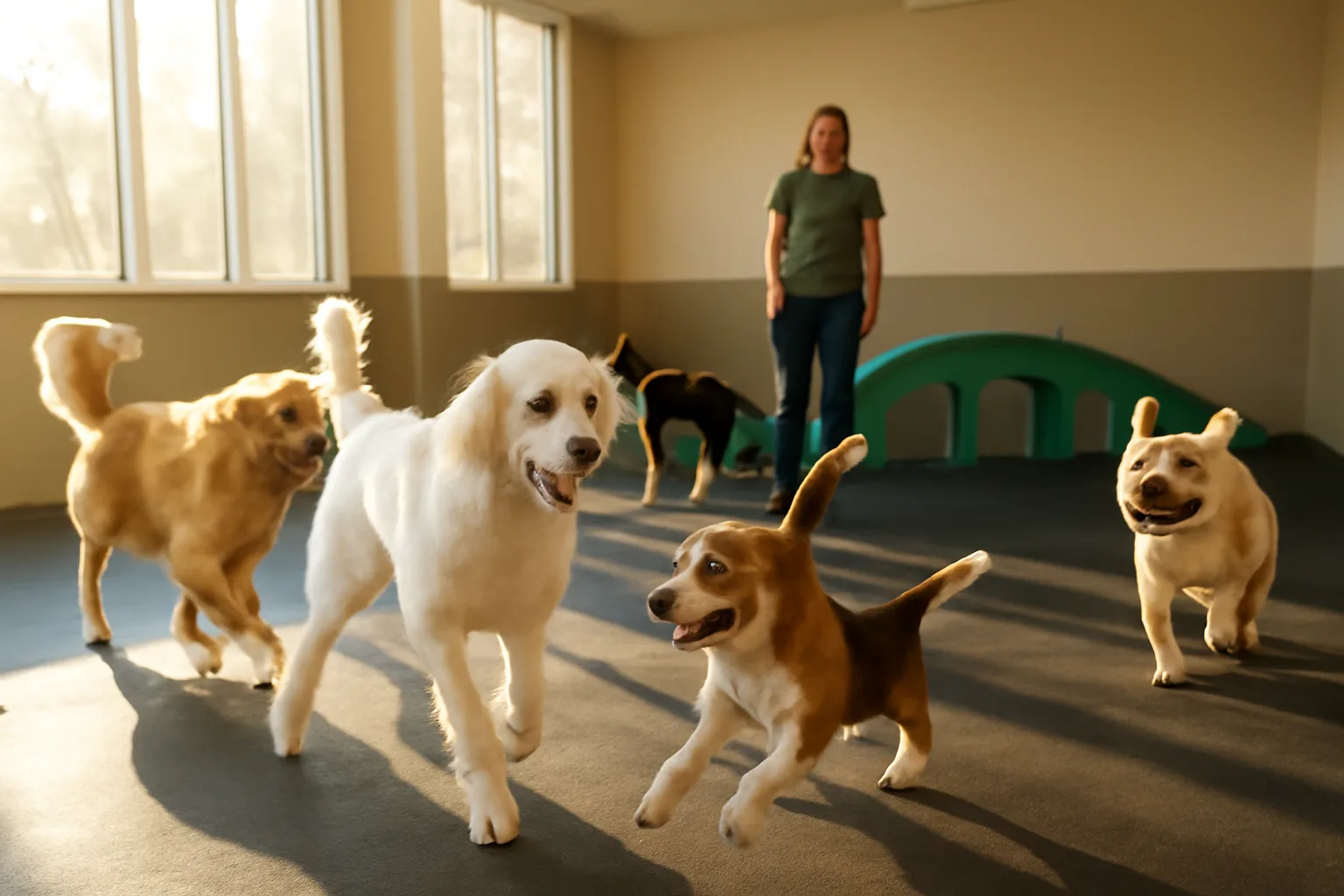
Dogtopia Chantilly is a franchise location of Dogtopia, a national dog daycare and boarding brand with hundreds of locations across the US and Canada. Like other Dogtopia franchises, the Chantilly, Virginia location typically offers daycare, boarding, spa services (baths, nail trims), and sometimes training add-ons. Franchise locations follow brand standards for play group structure, webcam access, and staff-to-dog ratios, but pricing and specific policies are set locally by the franchise owner. If you're researching this location as a pet owner, the best move is to call the facility directly or check its page on the Dogtopia corporate site for current rates, since franchise pricing varies by market and changes over time. If you're researching it as an operator thinking about opening a similar business in Fairfax County or elsewhere in Virginia, the more useful frame is understanding the licensing and zoning path, which we cover in detail below. For a broader look at how Dogtopia operates as a franchise model and how it compares to independent daycare and boarding businesses, see our Dogtopia overview.
How much does dog boarding cost?
| Basic kennel boarding | $25-$45 | No playtime included, standard at many vet clinics | |
|---|---|---|---|
| Daycare-chain boarding (Dogtopia, Camp Bow Wow) | $35-$65 | Includes daytime play group access | |
| Luxury suite boarding | $60-$120 | Private rooms, webcams, premium bedding | |
| In-home pet sitter boarding | $35-$75 | Via marketplace apps, varies by sitter experience | If you're an operator setting your own rates, the honest answer is: price to your local market, not a national average. Pull three to five competitor quotes within a 15-mile radius before you set your rate card. |
Dog boarding in the US generally runs $30 to $85 per night for standard kennel or suite boarding, with luxury or in-home boarding options running higher. Franchise daycare/boarding chains like Dogtopia, Camp Bow Wow, and Best Friends Pet Care tend to price in the $35 to $65 per night range depending on region and add-ons like extra playtime or medication administration. Costs vary a lot by region. Boarding in a major metro area (DC suburbs, where Chantilly sits, included) tends to run higher than rural or small-town rates because of higher commercial rent and labor costs. A 2023 survey-based estimate from Rover, a pet-sitting marketplace, put average dog boarding costs nationally around $40-$75 per night depending on the sitter type and location, though marketplace platforms like Rover price differently than brick-and-mortar daycare facilities [1]. Here's a rough comparison of typical boarding cost structures: | Boarding type | Typical nightly cost | Notes |
How much is dog boarding at a franchise like Dogtopia specifically?
Dogtopia doesn't publish a single national rate card because pricing is set franchise-by-franchise, but publicly available location pages and franchise disclosure materials suggest boarding typically runs in the $40-$70 per night range across most US locations, with daycare running somewhat less per day. Add-ons (spa day, extra play sessions, transportation) cost extra almost everywhere. For the Chantilly location specifically, current published rates aren't something we can verify and reprint reliably here since franchise pricing changes and isn't posted on a stable, citable government or corporate document. Call the location or check its live booking page for exact current pricing before assuming any number holds. What is stable and worth knowing: franchise agreements often require a location to meet certain facility standards (climate control, flooring, group sizes) regardless of what they charge, which is one reason franchise boarding sometimes costs more than an independent kennel down the street. You're partly paying for brand-standard infrastructure and reporting, more than the overnight stay.
How do you register a dog?
Registering a dog usually means two separate things: getting a dog license from your local government (required almost everywhere for rabies control and identification) and, separately, registering a purebred dog with a breed registry like the American Kennel Club (AKC) for pedigree purposes. These are not the same process and people mix them up constantly. For the local government version: most counties and cities require a dog license once a dog reaches a certain age (commonly 4 months) and require proof of current rabies vaccination to get one. In Virginia, for example, state code requires dogs 4 months or older to be licensed by the locality where the owner resides [2]. You typically register at your county treasurer's office, animal control office, or county government website, and you'll need your rabies certificate from your vet. For AKC registration: that's a private organization process, not a government one. You register a litter or an individual dog through the AKC's own system, which requires the sire and dam to already be AKC registered (for full pedigree registration) or you go through their alternative listing process for dogs without registered parents. More on that below.
How to get a dog license?
Getting a dog license requires proof of rabies vaccination, a small fee (often $5-$25 per year, sometimes discounted for spayed/neutered dogs), and an application through your county or city clerk, treasurer, or animal control office. Requirements and fees are set locally, so the exact process depends entirely on where you live. General steps that hold true almost everywhere in the US: 1. Get your dog vaccinated for rabies by a licensed veterinarian and keep the certificate. 2. Find your county or city's dog licensing office, usually the treasurer, clerk, or animal control department. 3. Submit the application with proof of rabies vaccination and pay the fee. 4. Renew annually or per the term your locality sets (some issue 1-year tags, some issue 3-year tags tied to rabies vaccine duration). Fairfax County, Virginia (where Chantilly is located) requires dog licenses proving rabies vaccination under Virginia state code, with licensing administered locally [2] [3]. If you live elsewhere, search "[your county] + dog license" and look for a.gov result, since third-party sites often show outdated fees. Missing a license isn't just a technicality. Many jurisdictions issue fines for unlicensed dogs, and some animal control offices use license databases to reunite lost dogs with owners faster than microchip lookups alone.
How do you get a dog papers, and how do you get papers for a dog?
"Papers" almost always means AKC registration papers (or another breed registry's equivalent), which is proof of a dog's pedigree, not a legal requirement to own a dog. You get papers by registering the litter through the breed registry, typically the AKC, using registration information from the sire and dam's own registered status. Here's the actual mechanism: when a breeder's dog (the dam) gives birth, the breeder submits an AKC litter registration application, which requires both parents to be individually registered with the AKC already. Once the litter is registered, individual puppies get registration numbers, and buyers receive registration paperwork transferring an individual puppy's registration to their name. If your dog doesn't have registered parents but appears to be purebred, the AKC has historically offered a listing program (formerly called the Indefinite Listing Privilege, more recently marketed as the Purebred Alternative Listing) that lets you register a dog for competition and companion events without full pedigree papers, provided you can show the dog appears to be purebred. This does not give the dog full pedigree/breeding registration status; it's mainly for owners who want to enter their dog in AKC sports. Program names and enrollment details have changed over the years, so confirm current terms directly with the AKC before assuming a specific program name still applies. If you bought a dog described as "purebred" with no papers and no way to get them, that's worth a hard conversation with the seller before you pay. Legitimate breeders almost always have a paper trail.
How can I get papers for my dog if I don't know the breeder?
If you don't know or can't reach the original breeder, you generally cannot get full AKC pedigree registration papers retroactively; the registry system depends on the breeder registering the litter at time of birth. Your realistic options are more limited than most people expect. Option one: DNA breed testing (Embark, Wisdom Panel) tells you what breeds are likely present but does not create legal registration papers. It's useful for your own knowledge and sometimes for insurance or breed-specific legislation questions, but it's not a registry substitute. Option two: the AKC's alternative listing program mentioned above lets you get a dog listed for participation in AKC companion events (agility, obedience, rally) even without documented parentage, as long as the dog is spayed/neutered and appears to be a purebred of an AKC-recognized breed. This is the closest thing to "getting papers after the fact," but it's explicitly not full breeding-eligible registration. Option three, and often the right one: if you just want proof of ownership and identification, get your dog microchipped and licensed with your county. That gives you a legal record even without pedigree papers. Full AKC pedigree papers for a dog with an unknown or unregistered breeder simply aren't available through any legitimate channel, and anyone offering to sell you "instant papers" for a fee outside the AKC's actual process is running a scam.
How to become a dog breeder, and what rules apply once you cross state lines?
Becoming a dog breeder legally means understanding three separate layers of rules: federal USDA/APHIS licensing, state breeder or kennel licensing, and local zoning. Which ones apply to you depends heavily on scale and whether you sell dogs sight unseen or across state lines. Federal (USDA APHIS): the Animal Welfare Act requires a USDA license for most breeders who sell dogs wholesale, sell to pet stores, or sell dogs sight unseen (i.e., the buyer never sees the animal or the breeding facility in person before purchase) if they have more than 4 breeding females, under the Act's implementing regulations at 9 CFR Part 2 [4]. Breeders who sell directly, in person, to buyers who see the animal beforehand ("retail" sales) are typically exempt from federal licensing regardless of scale, though this exemption has been narrowed by rulemaking over the years, so check current APHIS guidance before assuming you're exempt. State level: most states layer their own commercial breeder or kennel licensing on top of federal rules, often triggered at lower thresholds than USDA's. Virginia, for instance, defines a "commercial dog breeder" under Va. Code section 3.2-6507 as anyone who maintains 30 or more adult female dogs for breeding purposes and sells or offers to sell 30 or more puppies in a calendar year, requiring a permit through the Virginia Department of Agriculture and Consumer Services [5]. Other states set the bar much lower (some trigger commercial breeder rules at 3-5 breeding females), so never assume your home state mirrors Virginia's threshold. Local zoning: even a small hobby breeder can trip local zoning rules around number of dogs per household, kennel setback distances from property lines, or noise ordinances, none of which are set federally. This is the layer people forget until a neighbor complains. Practically, becoming a legitimate breeder means: pick your breed and confirm health testing protocols for that breed (many breed clubs publish OFA/CHIC testing requirements), register with your state ag department if you cross their threshold, check your county zoning for kennel or animal limits, and register litters with a breed registry like AKC if you want pedigree papers to pass to buyers. Skipping the state and zoning steps because you're small is the most common expensive mistake; a lot of state thresholds are lower than people assume.
What USDA thresholds should breeders and boarding operators know?
| More than 4 breeding females + sight-unseen sales | USDA Class A/B license | 9 CFR Part 2 [4] |
|---|---|---|
| 30+ adult breeding females + 30+ puppies sold/year (Virginia) | State commercial breeder permit | Va. Code 3.2-6507 [5] |
| Any dog 4+ months old (Virginia) | County dog license | Va. Code 3.2-6524 [2] |
| Boarding/daycare with no breeding | State/county kennel license, zoning, health permit | State ag dept + county zoning office |
The USDA's Animal Welfare Act licensing threshold for dog breeders centers on the number of breeding females and the sales channel, more than total dog count. Under 9 CFR Part 2, a person who has more than 4 breeding female dogs and sells any offspring sight unseen (online, shipped, wholesale to a pet store) generally needs a USDA Class A (breeder) or Class B (broker/dealer) license [4]. For boarding and daycare operators specifically: pure boarding and daycare operations that don't breed or wholesale dogs are typically not USDA-licensed at all; USDA/APHIS licensing under the Animal Welfare Act targets breeders, dealers, exhibitors, and certain transporters, not commercial pet care facilities. Boarding kennels are regulated almost entirely at the state and county level (state ag department kennel license, county zoning and health permits), not federally. If you're opening a boarding or daycare facility, your compliance research time is much better spent on state kennel licensing and county zoning than on USDA rules, which likely don't apply to you unless you're also breeding. Here's a quick threshold reference: | Trigger | Requirement | Source |
What does it take to open a boarding or daycare facility like Dogtopia in your area?
Opening a facility means clearing three separate approval processes that don't run on the same timeline: a state kennel or pet care facility license, county or city zoning approval (often a conditional use permit for commercial animal care in many zoning districts), and a local business license or health permit. None of these offices talk to each other automatically, so you're the one tracking all three. Zoning is usually the slowest part. Commercial dog daycare and boarding is rarely a "by-right" use in standard commercial zones; most counties classify it as a conditional use or special exception requiring a public hearing, notice to neighbors, and sometimes a traffic or noise study. Timelines for a conditional use permit hearing commonly run 60-120 days from application to decision in busy suburban counties, though this varies widely and you should confirm current timelines with your specific zoning office. State licensing requirements vary even more. Some states have no specific commercial boarding/daycare license category at all and instead fold kennels into general business licensing; others have detailed pet care facility rules covering ventilation, sanitation, and staff ratios. Always check your state department of agriculture's page for "kennel license" or "pet care facility" requirements before assuming a general business license covers you. If you'd rather not build this checklist from scratch for your specific state and county, that's exactly the gap our $149 one-time Kennel License & Zoning Packet is built to fill: it walks you through state-specific licensing requirements and county zoning prep so you're not guessing which office to call first. It's a research and prep tool, not legal representation, and it doesn't guarantee approval; local boards make that call.
How do state licensing and county zoning rules differ for boarding facilities?
State licensing governs how you run the facility (sanitation, staff ratios, veterinary care access, record-keeping); county zoning governs where you're allowed to run it at all (which parcels, what conditions, how many dogs, what setbacks). You need both, and getting one doesn't excuse you from the other. A common mistake: operators get their state kennel license approved, assume they're cleared to open, and then discover their specific commercial zone doesn't allow "animal boarding" as a permitted use without a conditional use permit they never applied for. Always confirm zoning first, or at least in parallel, because a zoning denial after you've signed a lease is a much more expensive problem than a licensing delay. The reverse mistake also happens: operators get zoning approval and then discover the state licensing inspection requires physical changes (a specific isolation area for sick animals, a certain drainage standard, a minimum ventilation rate) that their build-out doesn't meet, forcing costly retrofits. Read your state's facility standards document before you finalize your floor plan, not after. For comparison shopping between what different facility types (daycare-only vs. boarding vs. combined) require, see our guides on dog boarding, pet boarding, and doggy day care licensing basics.
What should I ask before choosing a Dogtopia location or any daycare/boarding facility?
Before you book at Dogtopia Chantilly or any similar facility, ask about their state license status, staff-to-dog ratios during play groups, vaccination requirements for entry, and what happens in a medical emergency. A facility that can't answer these clearly and quickly is a red flag regardless of brand name. Specific questions worth asking any boarding or daycare operator: What's your current state kennel license number, and can I see it? What vaccines do you require (rabies, DHPP, bordetella, and increasingly canine influenza)? What's your play group size and supervision ratio? What's your protocol if my dog gets sick or injured overnight when no staff is on-site? Do you have 24-hour on-site supervision for overnight boarders, or does staff leave after evening feeding? That last question matters more than people realize. Some boarding facilities, franchise and independent alike, don't staff overnight; dogs are checked at set intervals but not continuously supervised. That's not automatically disqualifying, but you should know it going in, and it's worth asking directly rather than assuming. For a broader comparison of national daycare and boarding chains including Dogtopia's model, our dog hotels near me and dog kennels guides break down what to expect at different facility tiers.
Frequently asked questions
How much does dog boarding cost per night on average?
Standard dog boarding runs about $30-$85 per night nationally, with daycare-chain boarding (Dogtopia, Camp Bow Wow) typically landing $35-$65 per night depending on region. Luxury suite boarding with webcams and private rooms can run $60-$120. Prices are always local; a facility in a high-rent suburb like Chantilly, VA usually charges more than a rural kennel two counties over.
How much is dog boarding at Dogtopia specifically?
Dogtopia doesn't publish one national rate; each franchise location sets its own pricing. Industry estimates put typical Dogtopia boarding around $40-$70 per night, but you should call the Chantilly location or check its live booking page for current, accurate pricing since franchise rates change and vary by market.
How do you register a dog with your local government?
Get proof of current rabies vaccination from your vet, then apply for a dog license through your county or city's treasurer, clerk, or animal control office. Most jurisdictions require licensing once a dog turns 4 months old, with fees typically $5-$25 per year. This is separate from AKC breed registration.
How do you get a dog license?
Get your dog's rabies vaccination certificate from a licensed vet, then submit an application and fee to your county or city's dog licensing office (often the treasurer or animal control department). Virginia requires dogs 4 months and older to be locally licensed under state code [2]; check your specific county's .gov page for exact fees and renewal terms.
How do you get papers for a dog?
"Papers" means AKC (or another registry's) pedigree registration, obtained when a breeder registers a litter using both parents' existing AKC registration numbers. Buyers then receive individual registration transfer paperwork. You cannot get full pedigree papers for a dog whose breeder never registered the litter at birth.
How can I get papers for my dog if I don't know who bred it?
You generally can't get full AKC pedigree papers without the original breeder's registration. Options include DNA breed testing (informational only, not registration), the AKC's alternative listing program for entering companion events, or simply getting your dog microchipped and county-licensed for legal identification purposes.
How to become a dog breeder legally?
Confirm health testing protocols for your breed, check whether you cross your state's commercial breeder license threshold (Virginia's is 30+ adult breeding females and 30+ puppies sold per year under Va. Code 3.2-6507 [6]), check county zoning for kennel/animal limits, and register litters with AKC or another registry if you want to offer pedigree papers to buyers.
Does the USDA require a license for dog boarding or daycare facilities?
No. USDA/APHIS licensing under the Animal Welfare Act targets breeders, dealers, and exhibitors, not standard boarding or daycare operations. If your facility only boards and doesn't breed or wholesale dogs, USDA licensing typically doesn't apply; your compliance work centers on state kennel licensing and county zoning instead.
What USDA threshold triggers a breeder license?
Under 9 CFR Part 2, breeders with more than 4 breeding female dogs who sell any offspring sight unseen (online, shipped, wholesale) generally need a USDA Class A or B license [5]. Breeders selling in person to buyers who see the dog and facility beforehand are typically exempt from federal licensing regardless of scale, though rules have tightened over time.
How long does it take to get zoning approval for a boarding facility?
It depends heavily on your county, but conditional use permit hearings for commercial animal care uses commonly take 60-120 days from application to a board decision in busier suburban counties. Rural counties can be faster; contested hearings with neighbor opposition can take much longer. Always confirm current timelines with your specific zoning office.
Is a dog license the same as AKC registration?
No, these are completely different systems. A dog license is a local government requirement tied to rabies control, renewed annually or per your county's term, and has nothing to do with breed or pedigree. AKC registration is a private registry system proving pedigree, unrelated to any legal ownership requirement.
What's the difference between a hobby breeder and a commercial breeder?
States set their own thresholds. Virginia defines a commercial breeder as anyone with 30+ adult breeding females who sells 30+ puppies a year under Va. Code 3.2-6507 [6], but many other states set commercial breeder triggers far lower, sometimes 3-5 breeding females. Check your specific state agriculture department's breeder licensing page rather than assuming a national standard.
Sources
- Rover, Cost of Dog Boarding survey data: National average dog boarding cost estimates by sitter type and region
- Virginia Code section 3.2-6524, dog licensing requirements: Virginia requires dogs 4 months or older to be locally licensed
- Virginia Code section 3.2-6522, rabies vaccination required for licensing: Virginia dog licenses require proof of current rabies vaccination
- Animal Welfare Act regulations, 9 CFR Part 2, Subpart A licensing requirements: USDA license threshold based on breeding females and sight-unseen sales
- Code of Virginia section 3.2-6507, commercial dog breeder definition and permit requirement: Virginia's commercial dog breeder threshold of 30 adult female dogs and 30 puppies sold annually