Last updated 2026-07-26
TL;DR
Opening a pet boarding business needs a state or county kennel license, local zoning approval (usually a conditional use permit), and facility standards for sanitation, ventilation, and staffing ratios. Most operators don't need a USDA license unless they also sell dogs wholesale or breed and sell across state lines. Budget $10,000 to over $250,000 depending on whether you're converting a home or building new.
What licenses do you need to open a pet boarding business?
You'll typically need three separate approvals, and they come from three different offices, which is why this trips people up. First is a local business license from your city or county. Second is a kennel or animal facility license, which in most states comes from the county (sometimes the county clerk, sometimes animal control) rather than the state. Third is zoning approval confirming your property can legally operate a kennel, boarding facility, or animal daycare, which almost always means a conditional use permit or special exception, not a by-right use. A handful of states run their own commercial boarding/kennel licensing program at the state level. California requires kennels to comply with state health and safety code provisions on animal facilities [1], while many other states leave kennel licensing entirely to county ordinance. There's no single federal kennel license for a boarding-only business. The federal layer (USDA APHIS) only applies if you're also breeding and selling dogs wholesale or sight-unseen, which is a different track covered below. The honest order of operations: check zoning first, before you sign a lease or make an offer on a property. A landlord will happily rent you a building in a district that doesn't allow kennels, and you'll find out only after you've spent months on buildout. Call the county planning department and ask directly: "Is a commercial dog boarding kennel a permitted or conditional use on this parcel?" Get the answer in writing if you can. See our guides on dog boarding and pet boarding licensing requirements for state-by-state specifics, since terminology (kennel license vs. commercial animal establishment permit vs. animal facility permit) varies a lot.
How much does dog boarding cost to start and to run?
| Home-based (in-home boarding) | $5,000 to $20,000 | $25 to $45 | |
|---|---|---|---|
| Small commercial kennel (10-20 runs) | $40,000 to $120,000 | $30 to $55 | |
| Full-service facility with daycare/grooming | $150,000 to $300,000+ | $40 to $85 | These ranges are drawn from typical small-business buildout costs reported by kennel design and construction consultants and are not government-set figures; treat them as planning ranges, not quotes. |
Startup costs for a boarding facility range from about $10,000 for a small home-based operation to $250,000 or more for a purpose-built kennel with 30+ runs, HVAC, and a dedicated outdoor play yard. The biggest cost drivers are the building itself (renovation vs. new construction), fencing and containment, ventilation/HVAC sized for animal odor and disease control, and drainage (sealed, sloped flooring that meets sanitation codes). Recurring costs include liability insurance (often $500 to $2,000+ a year depending on capacity and whether you offer off-leash daycare, which carries higher risk), workers' comp if you have employees, waste disposal, and annual license renewal fees, which vary by jurisdiction and are usually in the low hundreds of dollars rather than thousands. What customers pay is a separate question from what it costs you to operate, but it matters for your business plan. Boarding rates run roughly $25 to $85 a night depending on region, whether it's a shared kennel or private suite, and add-ons like daycare, grooming, or medication administration. Daycare-only rates typically run $20 to $40 a day. These are market rates, not fees set by any agency, so check three to five competitors within a 20-mile radius before pricing your own. | Facility type | Typical startup cost | Typical nightly rate |
How does zoning work for a boarding kennel, and how do you prepare for the hearing?
Zoning is where most boarding businesses stall, not licensing. Almost every county zones commercial kennels as a conditional use (also called special exception or special use permit) rather than a use allowed outright, even in commercial and agricultural districts. That means a public hearing in front of a zoning board or planning commission, more than a form you file. What boards actually care about: noise (barking, measured in decibels at the property line in some ordinances), setback from residential property lines, hours of outdoor animal access, parking and traffic for drop-off/pick-up, and odor/waste management. Bring a site plan showing fencing, sound barriers if you're adding them, and your outdoor play schedule. Neighbors show up to these hearings, and barking complaints are the single most common objection raised against kennel conditional-use applications. Practical prep steps: request the county's specific conditional use application packet in advance (don't wing it from a generic form), get your site plan drawn to scale, and consider a sound mitigation letter or plan if any residential parcel is within a few hundred feet. Some counties require a public notice mailed to neighbors within a set radius, commonly 200 to 500 feet, before the hearing date, so timelines can run 60 to 120 days from application to decision. We are not a law firm and don't represent anyone before a zoning board, but if you want a structured starting packet to organize your zoning and licensing documents before you file, our $149 Kennel License & Zoning Packet walks through what most counties ask for so you're not guessing at the first meeting.
What facility standards do inspectors check for boarding and daycare?
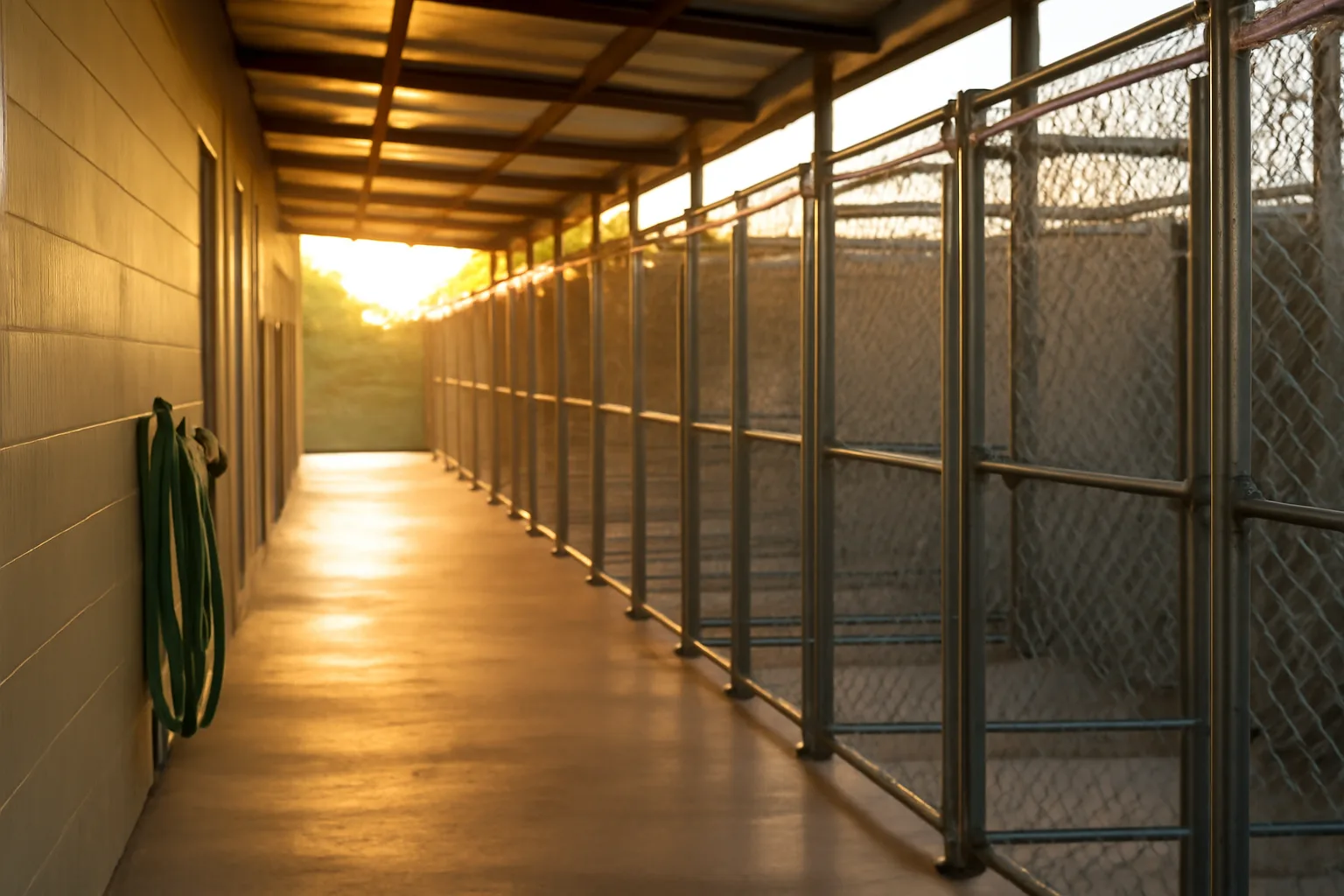
Inspectors (county animal control, state agriculture department, or a health department depending on your state) generally check the same handful of things: sanitation and drainage, ventilation, containment/fencing height and integrity, staff-to-dog ratios during supervised play, record-keeping (vaccination records, intake forms), and emergency protocols including fire evacuation. If your facility falls under USDA licensing (see below), the federal standard requires primary enclosures sized so each dog can "turn about freely, to stand, sit, and lie in a comfortable normal position, and to walk in a normal manner" per 9 CFR 3.6 [2], plus specific requirements for surfaces, drainage, and temperature control (facilities housing dogs must generally be kept between 45°F and 85°F for more than four consecutive hours, with some allowances) under 9 CFR 3.2 and 3.3 [3]. Even if you're not USDA-licensed, these federal standards are a reasonable baseline to design toward, because many state and county codes borrow language directly from them. Staffing ratios aren't federally mandated for boarding-only kennels, but many state model codes and industry best-practice guidance recommend roughly one staff member per 10 to 15 dogs during active group play, tighter for puppies or mixed-size groups. Ask your state veterinarian's office or department of agriculture whether your state publishes a specific ratio requirement, because a few do and most don't. Our facility standards and dog kennels resources go deeper on flooring materials, drainage slope requirements, and ventilation rates by climate zone.
Do you need a USDA license to open a boarding or daycare business?
Almost never, for boarding and daycare specifically. USDA APHIS licensing under the Animal Welfare Act applies to dealers, breeders selling wholesale, exhibitors, and certain transporters, not to businesses that board or provide daycare for dogs already owned by the public [4]. If all you do is board, walk, and play with other people's dogs, APHIS is not your regulator. Where it gets relevant is if your boarding business also breeds and sells puppies. USDA requires a license from anyone who sells dogs at wholesale, or who sells dogs sight unseen (including online sales) to buyers, subject to specific thresholds. Under the 2013 rule change (effective November 2013), the definition of "retail pet store" in the Animal Welfare Act regulations was amended so that most breeders selling puppies sight unseen, including online and by phone, need a USDA license unless they sell 25 or fewer breeding females' worth of puppies a year directly to the public and meet other conditions of the retail exemption [5]. Breeders who sell only in person, face-to-face, at their own premises are generally exempt regardless of volume, per the "retail pet store" exemption definition in 9 CFR 1.1 [4]. So: a pure boarding/daycare operator, no. A boarding operator who also runs a breeding program and ships puppies out of state or sells sight unseen, yes, likely. Check APHIS's own licensing determination guidance directly, because the thresholds and exemptions have specific wording that matters ("sight unseen" is a defined term, not a casual phrase) [5].
How to become a dog breeder (if you're expanding a boarding business into breeding)
Some boarding operators eventually add a breeding program, so it's worth covering separately since it triggers different rules entirely. Becoming a licensed dog breeder generally means three layers: state breeder licensing (many states, like Ohio and Pennsylvania, require a commercial breeder license once you exceed a certain number of breeding females or dogs kept, with thresholds that vary by state) [6], possible USDA licensing if you sell wholesale or sight-unseen as described above, and local zoning clearance for a breeding kennel, which is often a separate conditional use from boarding. Pennsylvania's Dog Law, 3 P.S. Section 459-102 and related kennel licensing provisions, requires a kennel license for anyone keeping dogs for purposes including breeding and sale above set thresholds, with kennel class tiers and inspection requirements tied to dog count [7]. Ohio's Commercial Dog Breeders Act, codified at Ohio Revised Code Chapter 956, sets its own threshold and licensing structure through the Ohio Department of Agriculture [6]. These numbers are not federal and not universal, so you have to check your specific state's department of agriculture page, not assume another state's threshold applies to you. Practically: if you're a boarding operator thinking about adding breeding, don't assume your existing kennel license covers it. Breeding almost always requires its own permit application, its own inspection standard (often stricter, covering whelping areas, veterinary care records, and record-keeping on litters), and its own fee.
How do you register a dog, and how is that different from licensing your kennel?
These are two completely different systems, and boarding operators get asked about this by customers constantly, so it's worth being able to answer it. Registering a dog with a breed registry (AKC, UKC, or similar) is about pedigree and breed documentation. Licensing a dog with your city or county is a legal requirement tied to rabies vaccination and animal control, unrelated to breed papers. To license a dog: most counties require proof of current rabies vaccination, then issuance of a dog license tag, usually renewed annually, through the county treasurer, clerk, or animal control office. Fees typically run $10 to $25 a year for a spayed/neutered dog and often double for an intact dog, though exact numbers are set locally and vary widely, so check your specific county's animal control or treasurer page rather than assume a number. If you're boarding dogs commercially, most states or counties will ask you to confirm each boarding dog has current rabies vaccination and sometimes a valid license tag as a condition of your own kennel permit, so it's smart to require proof of vaccination at intake regardless of whether local law technically mandates it. This protects you from liability more than it satisfies a regulator.
How do you get papers for a dog, or get a dog registered with a breed registry?
"Papers" almost always means AKC (American Kennel Club) or a similar breed registry's registration certificate, and getting them requires the dog's parents to already be registered with that same organization. If you bought a puppy from a breeder, the breeder should provide an AKC registration application (paper or the newer digital process) at the time of sale; you then complete and submit it to the AKC to register the puppy in your name. If you didn't get papers at purchase and the parents aren't registered, there's no way to add papers after the fact through AKC's standard process; AKC registration requires documented lineage from already-registered parents, more than proof the dog is purebred by appearance. Some breed-specific or "mixed" registries (like the AKC's Purebred Alternative Listing/PAL for spay/neuter-only registration, or Continental Kennel Club, which has much looser standards) offer alternate paths, but these carry far less weight for breeding or showing purposes than full parentage-verified AKC registration. For boarding business owners, this matters mostly as a customer-service question. It's fine to explain to a boarding client that you can't get their dog "papers" retroactively; that's an AKC/registry process issue, not something a kennel, vet, or groomer can resolve. Direct them to AKC's own registration information rather than guessing.
What insurance and staffing does a boarding facility need?
Insurance for a boarding/daycare business typically includes general liability (covering a bite injury or property damage), commercial property insurance, and often a specific "care, custody, and control" endorsement or bailee's coverage, since standard general liability sometimes excludes damage to animals in your care unless you add this rider. Many operators also carry business owner's policies (BOPs) that bundle several of these. Costs vary widely by state, claims history, and dog capacity, commonly landing between $500 and $2,500 a year for a small to mid-size operation, though you should get quotes from at least two insurers who specifically write pet-care policies rather than a generalist agent unfamiliar with kennel risk. Staffing needs scale with capacity and services. A small home-based operation might run with the owner alone. A 20-to-40-dog commercial kennel with daycare typically needs at least 2 to 4 staff on-site during business hours, more during peak boarding seasons (holidays run notoriously tight on staffing industry-wide). Background checks for staff are smart even where not legally required, since staff have unsupervised access to clients' homes-adjacent property (leashes, keys if you offer pickup) and to animals. Workers' comp is legally required in nearly every state once you have employees, regardless of headcount in most states, so don't skip it to save money in year one; it's one of the more commonly audited requirements if a county or state inspector cross-checks your business license application.
How long does it take to get all approvals and open?
Realistically, budget 4 to 9 months from lease signing to opening day, and that's if zoning goes smoothly. The zoning hearing alone can take 60 to 120 days depending on your county's public notice requirements and hearing calendar. Add build-out time (renovation permits, inspections, fencing installation) and your kennel license inspection, which usually can't happen until the physical space is substantially complete. A rough timeline: month 1, confirm zoning eligibility and submit conditional use application; months 2 to 4, zoning hearing and decision, plus building permit applications running in parallel; months 3 to 6, construction/renovation and staff hiring; month 6 to 7, final kennel license inspection; month 7 to 9, opening. Rushing the zoning step is the most common mistake, because signing a lease before zoning approval means you're paying rent on a space you might not be allowed to use as a kennel.
What ongoing compliance should you expect after you open?
Most kennel licenses require annual renewal, often tied to a re-inspection, so budget for at least one unannounced or scheduled inspection a year even after your initial approval. Renewal fees are typically far lower than initial licensing fees (a fraction of the setup cost), but missing a renewal deadline can lapse your license and force you to reapply from scratch in some counties, so calendar it. Expect periodic checks on vaccination record-keeping, sanitation logs, staff-to-dog ratios during inspection walk-throughs, and any changes to your facility (adding an outdoor run, expanding capacity, adding grooming or training services) may trigger a new zoning review or an amendment to your conditional use permit, more than a phone call to the county. If you plan to grow past your original approved capacity, tell your zoning office before you do it, not after a complaint prompts an inspection. Our doggy day care, dog hotels near me, and Dogtopia pages cover how larger franchise and multi-service models handle these renewal and expansion triggers if you're modeling growth from year one.
Frequently asked questions
How much does dog boarding cost?
For pet owners, boarding typically costs $25 to $85 per night depending on region, kennel type (shared run vs. private suite), and add-ons like daycare or medication administration. For business owners, startup costs range from about $10,000 for a home-based operation to $250,000+ for a purpose-built commercial kennel. Both figures are market-driven, not government-set.
How do you register a dog?
Dog registration usually means one of two things: local licensing (proof of rabies vaccination submitted to your county treasurer or animal control office for an annual tag, typically $10 to $25) or breed registry registration (AKC or similar, which requires the puppy's parents already be registered with that organization). Check which one you actually need.
How do you get a dog license?
Bring proof of current rabies vaccination to your county's animal control office, treasurer, or clerk (varies by county) and pay the annual licensing fee, commonly $10 to $25 for spayed/neutered dogs and higher for intact dogs. Some counties allow online or mail-in renewal after the first year. Check your specific county's animal control page for the exact process.
How do you get papers for a dog?
"Papers" typically means AKC or similar breed registry registration, which requires the dog's parents to already be registered with that organization. A responsible breeder provides a registration application at time of sale. There's no process to add papers retroactively if the parents weren't registered; alternate registries exist but carry far less weight for breeding or showing.
How can I get papers for my dog if the breeder didn't give me any?
If the parents weren't AKC-registered, there's no standard path to add full papers after the fact. Contact the breeder first; sometimes registration is simply delayed, not absent. If parentage truly isn't documented, AKC's Purebred Alternative Listing (PAL) allows registration for spay/neuter, agility, and companion events, but not for breeding or conformation showing.
How do you become a dog breeder legally?
You generally need state breeder licensing once you exceed your state's threshold for breeding females or dogs kept (thresholds vary significantly by state), possible USDA APHIS licensing if you sell wholesale or sight-unseen, and local zoning clearance for a breeding kennel. Check your state department of agriculture's specific breeder licensing page for exact numbers.
Do I need a USDA license to board dogs?
No. USDA APHIS licensing under the Animal Welfare Act covers dealers, breeders selling wholesale or sight-unseen, and exhibitors, not businesses boarding dogs already owned by the public. If you only board and provide daycare, USDA is not your regulator; your requirements come from state and county kennel licensing instead.
What's the difference between a kennel license and a business license?
A business license lets you legally operate any business in your city or county. A kennel license (issued separately, often by the county or its animal control department) specifically authorizes housing animals commercially and typically requires a facility inspection. Most boarding operators need both, plus zoning approval as a third, separate requirement.
How many dogs can I legally keep before I need a kennel license?
This threshold is set locally and varies widely; some counties require a kennel license at 4 or more dogs, others set it at 6, 10, or higher. Pennsylvania's Dog Law sets specific kennel class tiers tied to dog counts kept for breeding or sale. Check your specific county ordinance rather than assume a number.
What's a conditional use permit and why does my boarding business need one?
A conditional use permit (sometimes called a special exception) is zoning approval required when a use, like a commercial kennel, isn't allowed outright in a district but can be approved case-by-case after a public hearing. Boards evaluate factors like noise, setbacks, and traffic. Most commercial boarding facilities need one even in commercial or agricultural zones.
How long does it take to open a dog boarding business from start to finish?
Realistically 4 to 9 months from lease signing to opening day, assuming no zoning appeal. The zoning hearing process alone often takes 60 to 120 days depending on your county's public notice and hearing schedule, with construction and licensing inspections running partly in parallel.
Do I need insurance to open a boarding kennel?
Yes, practically speaking, even where not legally mandated. Most operators carry general liability plus a care, custody, and control endorsement (since standard liability often excludes injury to animals in your care), commonly running $500 to $2,500 a year for a small to mid-size facility. Workers' comp is legally required in nearly every state once you have employees.
Sources
- California Health and Safety Code, Division 105, Part 6: California kennel facilities must comply with state health and safety code provisions on animal facilities
- USDA APHIS, 9 CFR 3.6 (Animal Welfare Act regulations): primary enclosures must allow each dog to turn about freely, stand, sit, lie comfortably, and walk normally
- USDA APHIS, 9 CFR 3.2-3.3 (Animal Welfare Act regulations): USDA-licensed facilities housing dogs must generally maintain ambient temperature between 45°F and 85°F for more than four consecutive hours with limited exceptions
- USDA APHIS, Animal Welfare Act (7 U.S.C. 2131 et seq.) and licensing definitions at 9 CFR 1.1: APHIS licensing applies to dealers, breeders selling wholesale, and exhibitors under the Animal Welfare Act, not boarding-only operators
- USDA APHIS, Federal Register: Retail Pet Stores and Licensing Requirements Under the Animal Welfare Act (78 FR 57227, Sept. 18, 2013): the 2013 rule change amended the retail pet store definition so most breeders selling puppies sight unseen need a USDA license unless a retail exemption applies
- Ohio Revised Code Chapter 956, Commercial Dog Breeders: states set specific breeding female or dog-count thresholds for commercial breeder licensing that vary by state
- Pennsylvania Dog Law, 3 Pa. Cons. Stat. Section 459-201 (Kennel licenses): Pennsylvania's Dog Law requires kennel licenses with class tiers tied to the number of dogs kept for breeding or sale