Last updated 2026-07-25
TL;DR
"The dog cabin" usually means a small-scale, cabin-style dog boarding or daycare setup. Boarding runs about $25 to $85 a night depending on region and services. Licensing needs a state or county kennel license, local zoning approval, and (for breeders selling wholesale or online) a USDA Class A/B license once you cross certain sale thresholds.
What is a "dog cabin" and how is it different from a regular kennel?
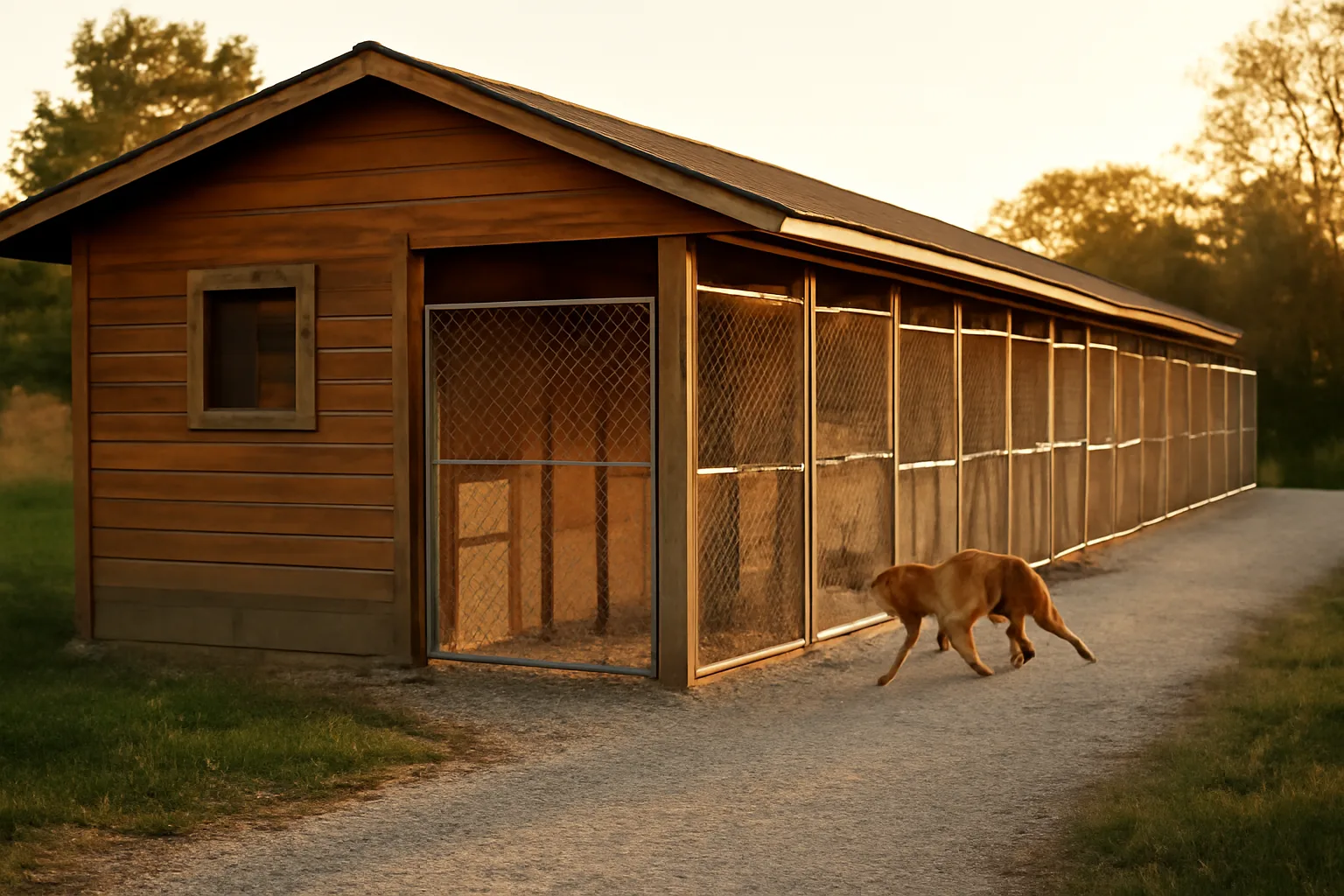
A dog cabin is really just a name, usually a boarding or daycare business built around small individual lodging units (cabins, suites, or bungalows) instead of a wall of wire kennel runs. Some operators use "cabin" in the business name because it sounds warmer than "kennel." Regulators don't care about the name. They care about square footage per dog, drainage, ventilation, fencing, and staff-to-dog ratios, same as they would for any other boarding kennel. If you're planning a facility styled around individual cabins or suites, your state's animal boarding rules and your county's zoning code apply exactly the same way they would to a traditional kennel. There is no separate "cabin" category in state law that we've found in any state agriculture or health code. The name is marketing. The permit process underneath it is standard commercial animal facility licensing. Worth knowing up front: some small-scale or cage-free boarding operations market themselves as more humane or less clinical than a wire-run kennel, and that can be true in practice. But zoning boards and health inspectors evaluate you on noise, waste handling, parking, and animal density, not on decor. A cute name doesn't buy you a variance.
How much does dog boarding cost?
Nightly boarding rates in the US typically run $25 to $45 for basic kennel-style stays, and $40 to $85 or more for higher-end suite, cabin, or "luxury" boarding with extra playtime, webcams, or private yards. Rural and small-town operators often price at the low end; large metro facilities and boutique cage-free chains price at the high end. These are market prices set by individual businesses, not government fees, so there's no official source, just what operators post and what customers report paying. A few things move the price a lot: whether the facility does group play (adds staffing cost, raises price), whether it's cage-free (higher liability insurance, higher price), and geography (a facility in a high-rent metro area prices closer to $60 to $90 a night; a rural kennel might sit at $20 to $35). Add-ons like medication administration, grooming, or extra walks are usually billed separately and can add $5 to $25 per stay. If you're the one setting rates for a new facility, don't just copy a competitor's number. Work backward from your actual costs: labor (usually the biggest line item), insurance, utilities for climate control, and waste disposal. A common rule of thumb in the industry is that labor alone should not exceed roughly 40 to 50% of boarding revenue if you want a sustainable margin, though nobody publishes hard industry-wide data on this and estimates vary by region and facility size.
What licenses does a dog boarding or dog cabin facility actually need?
Three separate approvals, usually, and they come from three different offices. First, a state or county kennel/boarding license. Many states regulate commercial boarding facilities under an animal facility or kennel licensing statute, often through the state department of agriculture. Requirements commonly cover sanitation, ventilation, food storage, isolation areas for sick animals, and recordkeeping on vaccination status. Fees and specific rules vary by state; there is no single national fee schedule. Second, local zoning approval. Boarding kennels are frequently classified as a conditional or special use in commercial or agricultural zones, meaning you need a hearing before a zoning board, more than an over-the-counter permit. This is the step people underestimate. A property can be zoned commercial and still not permit "kennel" or "animal boarding" as a use without a conditional use permit or variance. Third, if you're a breeder rather than (or in addition to) a boarding operator, you may need a USDA license once you cross federal thresholds, covered in the next section. For the zoning piece specifically, county zoning prep is its own project: site plans, parking counts, setback distances from residential property lines, and noise mitigation plans (sound-attenuating fencing, indoor-only overnight hours, etc.) are common conditions boards attach to approval.
How do you get a dog license (for a pet owner)?
Getting a dog license for a pet is a local government process, separate from anything a boarding or breeding business needs. Most cities and counties require dog owners to register their dog annually or biennially with the local animal control office or county clerk, usually after proof of rabies vaccination. You typically bring a rabies certificate from your vet to the county treasurer, animal control office, or town clerk, pay a small fee (commonly in the $10 to $30 range for an altered dog, sometimes double for an unaltered dog), and get a tag. This is different from breed registration (AKC-style "papers") and different from a commercial kennel license. A dog license is a local government requirement tied to rabies control and animal control recordkeeping. Some counties tier the fee: lower for spayed/neutered dogs, higher for intact dogs, as an incentive tool. Check your specific county treasurer or animal control page, because fees and renewal cycles are set locally and change often.
How do you get papers for a dog, or register a dog with a breed registry?
"Papers" means registration with a breed registry like the American Kennel Club (AKC), not a government license. This confuses a lot of new breeders and pet owners because the word "registered" gets used for both government dog licensing and private breed registries, and they are completely unrelated processes. To register a purebred puppy with AKC, the litter's breeder registers the litter first (submitting the sire and dam's registration numbers and a litter application), and then each puppy buyer completes individual registration using the paperwork the breeder provides at the time of sale. If you bought a dog described as purebred but got no paperwork, you generally cannot create AKC papers after the fact without the breeder's participation, because registry eligibility is tied to verified parentage, not appearance or breed type. If your dog has no papers and you want a registry document anyway, some breed clubs and registries offer DNA-based parentage verification or alternative registries with looser standards, but these carry far less weight for showing, breeding eligibility, or resale value than an AKC pedigree with verified lineage. For anyone building a breeding program, the honest answer is: your papers situation is decided by which registry you enroll your breeding stock with, before you breed, not after a litter is already born.
How do you become a dog breeder, legally?
Legally, becoming a dog breeder means clearing three layers: local zoning (can you keep and breed dogs commercially at your address), state licensing (many states license commercial breeders above a certain number of adult female dogs or litters per year), and federal USDA licensing if you sell wholesale, sell sight-unseen, or exceed federal thresholds. Start with your state department of agriculture's animal breeder or "pet dealer" rules. States that regulate breeders typically set a threshold, for example a minimum number of intact female dogs or litters sold per year, above which you need a state commercial breeder license, inspections, and recordkeeping on health and vaccination history. Thresholds and fees differ by state, so check your specific state agriculture department page rather than assuming a number. Then check federal rules. The USDA Animal Welfare Act regulates certain breeders through APHIS. Under 9 CFR 2.1, breeders who sell dogs at wholesale (to pet stores, brokers, or other resellers) or who sell dogs sight unseen (the buyer never personally observes the animal or its housing before purchase, for example many online sales) generally need a USDA license unless they qualify for an exemption. The regulation defines the retail pet store exemption at 9 CFR 2.1(a)(3)(iii) as applying to a person who sells animals "at retail for hobby, breeding, or other purposes" only to purchasers who physically inspect the animal at the seller's location before purchase [1]. There is a common small-breeder exemption. Breeders who sell no more than a limited number of dogs per year directly to the public, and who maintain a set number or fewer of breeding females, may be exempt from federal licensing under 9 CFR 2.1(a)(3)(iii). That same section describes the retail exemption as applying to people who sell animals only at retail, in person, to buyers who see the animals and their housing before purchase [1]. If you sell exclusively at your own location, in person, you may not need a USDA license at all, even if you sell a fair number of dogs. It's the wholesale and sight-unseen sales that trigger it, not volume alone.
What are the USDA thresholds that trigger a federal breeder license?
| In-person retail sales only, buyer sees dog and premises | Usually exempt from federal USDA license [1] | |
|---|---|---|
| Any sight-unseen sale (internet, shipped, phone order) | USDA license generally required [1] | |
| Sales to pet stores, brokers, or resellers (wholesale) | USDA license generally required [1][2] | |
| Breeding female count and sales pattern outside the retail exemption | USDA Class A/B license triggers [1][2] | USDA license fees are tiered by anticipated gross revenue from animal sales, with application and annual fees set out in 9 CFR 2.6 [3]. Fee tiers change periodically, so check the current eCFR text rather than relying on an old number. |
The trigger isn't a flat number of puppies. It's how you sell them. USDA/APHIS licenses two relevant classes for dog breeding operations: Class A (breeders who sell directly to the public and to licensees/registered research facilities) and Class B (dealers, brokers, and certain resellers), as defined at 9 CFR 2.1 and the definitions section at 9 CFR 1.1 [1][2]. The practical dividing line most breeders hit is this: if every sale happens in person, at your home or facility, with the buyer seeing the dog and its living conditions before money changes hands, you likely fall under the retail exemption and don't need a federal license, regardless of how many litters you produce in a year. The moment you sell a dog to someone who never visits (a shipped puppy, an online sale, a sale through a broker or pet store), that transaction pulls you toward the wholesale/sight-unseen definition and USDA licensing requirement under 9 CFR 2.1 [1]. APHIS licensing also applies to anyone who maintains breeding female dogs above the retail-exemption thresholds and sells any offspring wholesale or sight unseen, per the definitions and exemption structure in 9 CFR 1.1 and 2.1 [1][2]. Below is a simplified comparison of how the two paths generally work, but always confirm against the current eCFR text and your state's breeder statute, since both agencies update fee schedules and thresholds periodically. | Sales channel | Typical requirement |
How do state and county rules stack on top of USDA rules?
Federal, state, and county requirements are three separate filters, and you can need all three, two, or (in rare rural areas) none beyond basic animal control rules. USDA licensing only kicks in for wholesale or sight-unseen sales above the thresholds discussed above. It says nothing about whether your county allows a breeding kennel on your land in the first place. Your state department of agriculture may separately require a commercial breeder or pet dealer license once you exceed a state-set number of litters or intact females, independent of how you sell the dogs. Some states regulate breeders more aggressively than the federal floor; a few effectively mirror it. You have to check your specific state, because there's meaningful variation and outdated blog posts get this wrong constantly. Then county or municipal zoning decides whether breeding-scale dog keeping is even a permitted land use at your address, and if so, under what conditions (setbacks, number of dogs, noise limits, odor/waste management plans). A property can be perfectly fine for USDA and state purposes and still get denied at a local zoning hearing because the neighbors show up and the board decides the noise or traffic impact isn't acceptable. This is where a lot of new breeders and boarding operators get tripped up: they research the federal rule, assume it's the whole answer, and skip the local zoning hearing prep entirely. Preparing for that hearing (site plans, sound studies, letters of support, a realistic capacity number) matters as much as the state paperwork, sometimes more, since local boards can deny a use permit even when you're fully compliant federally and at the state level.
What does a zoning hearing for a boarding or breeding facility actually involve?
Most jurisdictions that treat kennels, boarding facilities, or breeding operations as a conditional use require a public hearing before the planning or zoning board, more than a form submission. Expect to bring a site plan showing building footprint, outdoor run locations, fencing, parking, and distances to property lines. Expect neighbors to be notified and given a chance to comment, sometimes to object. Boards commonly ask about noise mitigation (sound-dampening fencing, limits on outdoor hours), waste management (how you handle and dispose of animal waste, sometimes requiring a written plan), maximum animal capacity, and traffic/parking impact for a boarding business with daily drop-off and pickup. Some counties require a public health department sign-off in addition to zoning, especially if the facility is near a well or septic system. Getting turned down at this stage is common enough that it's worth treating the hearing prep seriously rather than as a formality. If you're pulling together a packet for the first time (site plan, projected capacity, noise and waste plans, and the state/county license applications in one place), a resource built specifically around this process, like KennelPermit's $149 one-time Kennel License & Zoning Packet, can save you from missing a required attachment that gets your hearing continued to the next month. That said, no packet or consultant guarantees approval; local boards vote based on their own judgment and public input, not a checklist alone.
How much does it cost to actually license and open a facility?
Costs stack from several independent sources, and none of them is standardized nationally, so treat every number here as a range to verify locally. State kennel or commercial breeder license fees commonly run from roughly $25 to a few hundred dollars annually, depending on the state and the size category of the operation; check your state department of agriculture's current fee page rather than an old figure. County zoning application fees for a conditional use permit or variance often run several hundred to a few thousand dollars, covering staff review time, public notice mailings, and sometimes a required site plan review by a county engineer. USDA license fees are tiered by projected gross revenue from animal sales under the Animal Welfare Act fee schedule at 9 CFR 2.6, with separate application and annual license fee amounts [3]. On top of government fees, expect facility build-out costs (fencing, drainage, HVAC for climate control, fire suppression in some jurisdictions) that dwarf the licensing fees themselves for anyone building new. Insurance (general liability plus care, custody, and control coverage for the animals) is another recurring cost many first-time operators underestimate when they budget.
What facility standards do inspectors actually check?
Inspectors, whether state agriculture department staff or county health/zoning enforcement, generally check the same core categories no matter what the facility calls itself. Sanitation (daily waste removal, disinfection protocols, clean water access), housing (adequate space per dog, protection from extreme temperatures, secure fencing with no escape gaps), and recordkeeping (vaccination records, incident logs, intake/discharge records) top the list under most state kennel regulations and under USDA's own facility standards for licensed breeders [3]. For breeders specifically under USDA oversight, the Animal Welfare Act regulations at 9 CFR Part 3 set specific minimum standards. The regulation at 9 CFR 3.6 requires that housing facilities for dogs be constructed to allow each dog "sufficient space to turn about freely, to stand, sit, and lie in a comfortable, normal position, and to walk in a normal manner," with enclosure size formulas tied to the dog's body length, plus temperature ranges the facility must maintain and required veterinary care programs [3]. If you're planning a facility, whether you call it a dog cabin, a lodge, or a straightforward kennel, walk your state's specific facility standard checklist line by line before you finalize architectural plans. Retrofitting a building after a failed inspection costs far more than designing to the standard the first time. Resources like facility standards guidance and your state's own kennel inspection checklist (usually posted as a PDF on the agriculture department site) are worth reading before you sign a lease.
Boarding vs. daycare vs. breeding: which license category do you fall under?
This trips people up because a single facility often does two or three of these things, and each one can carry different licensing weight. Boarding (overnight stays) typically falls under a state's kennel or animal facility licensing law and local zoning as a boarding kennel use. Daycare (daytime only, no overnight stays) is regulated less consistently. Some states fold it into the same kennel license category; others have no specific daycare statute at all, leaving it to county business licensing and zoning only. If you're planning a doggy day care alongside boarding, check whether your state treats them as one combined facility type or two separate registrations, because the answer varies and affects your fee total. Breeding is the one most likely to pull in federal USDA rules on top of state and local rules, per the thresholds discussed above. A facility that boards dogs commercially and also breeds and sells litters wholesale needs to clear all three regulatory layers separately: state kennel license for the boarding side, possible state breeder license for the breeding side, and USDA licensing if sales cross the wholesale/sight-unseen line. If you're weighing which model to build, comparing dog boarding against pet boarding setups side by side, or looking at branded models like Dogtopia, can help you see how licensing scope changes with square footage and service mix before you commit to a lease.
Frequently asked questions
How much does dog boarding cost per night?
Typical US boarding rates run about $25 to $45 a night for basic kennel-style stays and $40 to $85 or more for suite-style or cage-free boarding with extra playtime and amenities. Rates are set by individual businesses, not government agencies, so prices vary a lot by region, facility type, and add-on services like grooming or medication administration.
How do I register a dog with my local government?
Bring proof of current rabies vaccination to your county treasurer, town clerk, or animal control office, fill out a short registration form, and pay the local licensing fee, often $10 to $30 for a spayed or neutered dog and more for an intact dog. Renewal is usually annual or every two years, depending on your county's ordinance.
How do you get papers for a dog?
"Papers" means registration with a breed registry like AKC, which requires the breeder to register the litter first and pass individual puppy registration to each buyer at time of sale. You generally cannot create papers after purchase if the breeder didn't provide them, since registries require verified parentage, more than breed appearance.
How can I get papers for my dog if I don't know the breeder?
Without breeder cooperation, standard registries like AKC usually won't issue papers, since eligibility depends on documented lineage, more than DNA or appearance. Some alternative registries or DNA breed-identification services exist, but they carry far less recognition for showing or breeding purposes. If papers matter to you, get them in writing at the time of purchase, not after.
How do you become a dog breeder legally?
Check local zoning to confirm breeding is a permitted use at your property, check your state department of agriculture for any commercial breeder licensing threshold, and check USDA/APHIS rules under 9 CFR 2.1 if you plan to sell wholesale or sight unseen. Selling only in person at retail often keeps you under the federal licensing threshold, but state and local rules still apply independently.
How do I get a dog license?
A dog license (as opposed to breed registry "papers") is issued by your city or county, usually through animal control or the county clerk, after you show proof of rabies vaccination and pay a small fee. This is a government requirement tied to rabies and animal control tracking, separate from any breed registration.
What USDA threshold requires a breeder to get licensed?
There's no flat puppy-count threshold; it's about sales channel. Under 9 CFR 2.1, breeders who sell wholesale or sight unseen (shipped, online, or through a broker/pet store) generally need a USDA license unless a retail exemption applies. Selling only in person at your own premises typically qualifies for the retail exemption regardless of volume.
Do I need a USDA license if I only sell puppies locally in person?
Likely not, if every buyer visits your property and sees the dog and its housing before purchase. The regulation at 9 CFR 2.1(a)(3)(iii) describes this in-person, at-retail sales pattern as generally meeting the retail pet store exemption, regardless of how many litters you produce annually. State breeder licensing rules can still apply separately.
What's the difference between a kennel license and a breeder license?
A kennel license (state or county) usually covers commercial facilities that board, house, or sell dogs generally, focused on sanitation and housing standards. A breeder license, at the state level, specifically targets operations producing litters above a set threshold, and at the federal level (USDA) targets wholesale or sight-unseen sellers. You may need one, both, or neither depending on your business model.
How much does it cost to get a kennel license?
State kennel or breeder license fees commonly range from roughly $25 to a few hundred dollars a year depending on the state and facility size category. County zoning application fees for a conditional use permit often run several hundred to a few thousand dollars separately. Always confirm current fees on your specific state agriculture department and county zoning office pages.
Can I open a dog boarding facility in a residential zone?
Usually not without a conditional use permit or variance, since most residential zoning codes exclude commercial animal boarding outright or require special approval. Even in commercial or agricultural zones, boarding is often classified as a conditional use requiring a public hearing rather than an over-the-counter permit. Check your specific county zoning ordinance before signing a lease.
What happens at a zoning hearing for a boarding kennel?
You typically present a site plan, address noise and waste management, answer board questions about capacity and hours, and neighbors get a chance to comment or object. Boards can approve, deny, or approve with conditions (like sound fencing or limited outdoor hours). No packet or consultant guarantees approval; the outcome depends on the board's judgment and public input.
Is dog daycare regulated differently than overnight boarding?
It depends on the state. Some states fold daycare into the same kennel license category as overnight boarding; others have no daycare-specific statute, leaving regulation to county business licensing and zoning only. Always check whether your state agriculture department's kennel rule explicitly includes daytime-only facilities or defines them separately.
Sources
- 9 CFR 2.1, Requirement to obtain a license (Animal Welfare Act regulations): Sight-unseen and wholesale dog sales generally require a USDA license, with a retail exemption at 9 CFR 2.1(a)(3)(iii) for in-person sales where buyers inspect the animal before purchase.
- 9 CFR 1.1, Definitions (Animal Welfare Act regulations): USDA defines dealer, breeder, and related license classes (Class A/B) used to categorize commercial dog breeders and dealers.
- 9 CFR Part 3, Standards (Animal Welfare Act regulations, Subpart A: Dogs): Federal minimum standards for housing, enclosure size, and care for licensed dog breeding facilities.
- 9 CFR 3.6, Primary enclosures (Animal Welfare Act regulations): Housing facilities for dogs must provide each dog sufficient space to turn about freely, stand, sit, lie comfortably, and walk normally.
- 9 CFR 2.6, Annual license fees (Animal Welfare Act regulations): USDA license application and annual fees are tiered by anticipated gross revenue from animal sales.
- USDA APHIS, Animal Welfare Act (statute overview, 7 U.S.C. 2131 et seq.): The federal statutory basis for USDA/APHIS regulation of commercial animal breeders and dealers under the Animal Welfare Act.