Last updated 2026-07-25
TL;DR
Dog boarding in Chicago typically costs $35-$75 per night depending on neighborhood and amenities, with daycare running $25-$45 per day. Anyone keeping dogs for boarding needs a City of Chicago business license and must meet Chicago Animal Care and Control rules; every dog in the city also needs an individual dog license under the municipal code.
How much does dog boarding cost in Chicago?
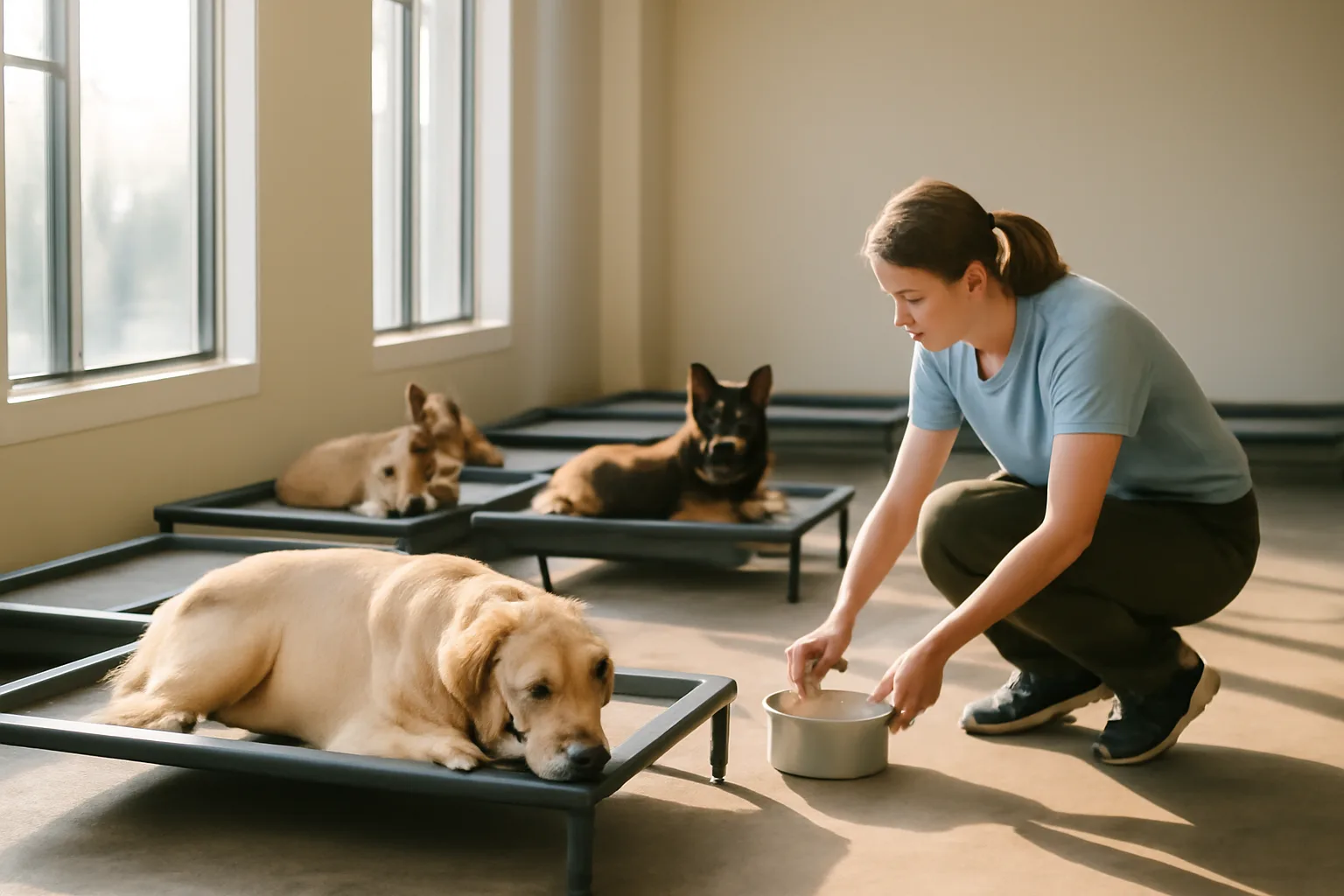
Expect to pay somewhere between $35 and $75 per night for standard dog boarding in Chicago, with luxury "dog hotel" suites in neighborhoods like Lincoln Park or the West Loop running higher, sometimes $80-$120 a night once you add playtime packages, grooming, or private suites. Basic daycare (not overnight) tends to run $25-$45 per day, and most facilities offer discounted multi-day punch cards that knock 10-20% off the per-day rate. Price depends heavily on what's included. A bare-bones kennel stay with a couple of potty breaks costs less than a cage-free boarding setup with webcams, group play, and one-on-one attention. Holiday weekends (Thanksgiving, Christmas week, July 4th) often carry a surcharge of $10-$20 per night at busier facilities because demand spikes and staff need holiday pay. There's no government price-setting here. Chicago doesn't regulate what a kennel can charge; this is pure market pricing, so the real answer to "how much is dog boarding" is whatever a given facility posts, and it's worth calling three or four places in your neighborhood before booking, especially around holidays when good spots fill up weeks in advance. If you're an operator setting rates, look at what dog hotels near me style competitors charge in your specific neighborhood rather than citywide averages. A boarding facility in Hyde Park competes on different pricing than one in River North.
How do you register a dog in Chicago?
Every dog living in Chicago for more than 30 days needs a city dog license, issued through Chicago Animal Care and Control or via the city's online portal. Registration requires proof of a current rabies vaccination from a licensed veterinarian; the license tag then has to be worn on the dog's collar. [1] The city sells the dog license (sometimes bundled as a "pet license") in one-year and multi-year terms, with a reduced fee for spayed or neutered dogs compared to intact animals. Fees are set by city ordinance and adjusted periodically, so check the current fee schedule on the Chicago Animal Care and Control site or through the city's official pet registration page rather than relying on an old number. [1] Owners who skip registration risk a citation if animal control catches it, and shelters use license tags to reunite lost dogs with owners fast, so it's genuinely useful beyond just compliance. If you just adopted a dog from Chicago Animal Care and Control or a partner rescue, ask whether the adoption fee already included registration; sometimes it does.
How do you get a dog license (and how is that different from dog papers)?
A dog license is a city or county registration tag proving your dog is vaccinated and accounted for; it has nothing to do with breed registration papers. In Chicago, you get a dog license through Chicago Animal Care and Control, in person or through the city's online licensing system, by submitting proof of rabies vaccination and paying the fee. [1] Outside city limits but still in Cook County, unincorporated-area residents register through Cook County Animal and Rabies Control, which runs a similar rabies-tag-based licensing system under county ordinance. [2] If you live in a suburb with its own animal control department (Evanston, Oak Park, Naperville, etc.), check that municipality's ordinance instead, since suburb rules often differ from the city's. None of this produces "papers" in the breed-registry sense. A license tag proves rabies compliance to animal control; it's a public health and welfare tool, not a pedigree document. People conflate the two constantly, and it trips up new dog owners who call city hall asking for AKC-style papers and get sent to voicemail.
How do you get papers for a dog?
"Papers" usually means AKC (American Kennel Club) registration or papers from another breed registry like UKC (United Kennel Club), and no government office issues these. If a puppy came from a registered litter, papers come from the breeder, who registers the litter with the AKC and transfers registration to the buyer. If you already own a dog with no papers and want to register it, most breed registries won't retroactively grant full pedigree papers without documented parentage. The AKC does have a Purebred Alternative Listing (PAL) program (formerly Indefinite Listing Privilege) that lets an unregistered but apparently purebred dog compete in certain events like agility or obedience without full pedigree registration; it's not the same as a full pedigree and doesn't make the dog eligible for conformation showing or breeding registration. [3] If you're asking "how can I get papers for my dog" because you want to breed it, understand that reputable registries expect verifiable lineage, health testing, and often require both parents to be registered already. A mixed-breed or unknown-parentage dog generally can't get full pedigree papers no matter who you ask; PAL-type programs are the honest path if you want registry involvement without fabricated lineage.
How do you become a dog breeder in Illinois?
Illinois regulates commercial dog breeding under the Animal Welfare Act administered by the Illinois Department of Agriculture, which requires a state license for anyone breeding and selling dogs above certain thresholds, plus facility inspections covering housing, sanitation, and veterinary care. [4] The specific licensing tier and fee depend on how many breeding females you keep and whether you sell directly to the public or through brokers/pet stores; check the Department of Agriculture's Bureau of Animal Health and Welfare page for the current fee schedule and application forms before you assume a number. [4] Separately, if you sell more than a handful of puppies a year across state lines, or sell wholesale to pet stores rather than directly to the end buyer, you may cross into USDA APHIS licensing territory. Under the Animal Welfare Act regulations, breeders who sell dogs sight-unseen (over the internet, by phone, by mail) to buyers who never physically inspect the animal or its home facility before purchase generally need a USDA Class A or Class B license, per the retail pet store exemption rules at 9 CFR 2.1. [5] APHIS's own guidance states that anyone who sells animals "sight unseen" and doesn't qualify for the retail pet store exemption must be licensed. [5] If you're operating in Chicago itself, city ordinance also restricts pet store sourcing: puppies, kittens, and rabbits sold by Chicago pet stores generally must come from shelters or rescue organizations rather than commercial breeders, per the city's Municipal Code on companion animal sales. [6] That doesn't stop a private breeder from selling directly to buyers, but it does close off the pet-store wholesale channel inside city limits. Before you take a single deposit, get the state license application in hand and read the actual inspection checklist, since retrofitting a facility after inspectors flag housing or ventilation problems costs far more than building to standard the first time.
What licenses does a Chicago boarding or daycare facility actually need?
A dog boarding or daycare business physically located in Chicago needs, at minimum, a City of Chicago business license under the applicable category (commonly filed as an "Animal Care" or kennel-type license through the Department of Business Affairs and Consumer Protection), plus compliance with Chicago Animal Care and Control's animal care establishment rules covering caging, sanitation, ventilation, and staff-to-animal supervision ratios. [7] Zoning matters just as much as the license itself. Chicago's zoning code determines which districts allow kennels, veterinary clinics, or "animal services" uses outright versus which require a special use permit and a hearing before the Zoning Board of Appeals. A commercial corridor zoned B3 might allow it outright; a residential-adjacent RS-3 lot almost certainly won't without a variance. Call the Chicago Department of Planning and Development or check the zoning map before signing a lease, not after. If you're just outside city limits, Cook County zoning rules apply instead for unincorporated areas, and individual suburbs (Evanston, Skokie, Oak Park, etc.) each run their own zoning and business licensing on top of county rules. There's no single "Chicagoland" rulebook; every municipality line matters. This is where a lot of new operators get burned: they find a great commercial space, sign a year lease, then discover the zoning classification doesn't permit an animal boarding use and they need a special use hearing that takes months. Confirm zoning before you commit to anything.
How does USDA licensing interact with a Chicago-area boarding or breeding business?
USDA APHIS licensing generally targets breeders selling wholesale or sight-unseen, and dealers, exhibitors, and certain large-scale operations; it does not typically cover a standard boarding kennel or daycare that only houses other people's pets temporarily. [5] Boarding-only facilities usually fall under state and local pet care/kennel rules, not APHIS. Where it gets relevant for boarding operators is if the same facility also breeds and sells dogs. A boarding kennel that also runs a breeding program selling puppies sight-unseen to out-of-state buyers needs to look hard at whether it crosses the retail pet store exemption threshold under 9 CFR Part 2. [5] APHIS's Animal Welfare Act licensing page spells out who needs a Class A (breeder who sells animals it has bred and raised) versus Class B (broker, dealer, or breeder buying/reselling) license. [5] If that's you, budget real time for this. USDA inspections cover housing structure, sanitation, veterinary care records, and enclosure sizing under 9 CFR Part 3, and first-time applicants often fail an initial inspection on something fixable like enclosure square footage or a missing veterinary care plan. [8] Better to catch that on paper before an inspector shows up.
What does a Chicago zoning hearing for a kennel actually look like?
If your location needs a special use permit rather than allowing kennels outright, you'll file an application with the Chicago Zoning Board of Appeals, pay a filing fee, and get a hearing date, typically scheduled out several weeks to a couple of months depending on the board's docket. [9] Notice usually has to go out to neighboring property owners within a set radius, and neighbors can show up and object, most commonly about noise, odor, or traffic. Bring a real plan to the hearing, more than good intentions. Boards want specifics: how many dogs at capacity, what hours you're open, how you handle outdoor exercise and noise, what your ventilation and waste disposal setup looks like, and whether you've got a sound-dampening plan for any outdoor play yard. Operators who show up with a site plan, sound mitigation details, and a written operations plan tend to do a lot better than ones who wing it. This is the part most first-time applicants underestimate. A zoning hearing isn't a rubber stamp, and objections from a single vocal neighbor can delay or sink an application. If you want a structured way to organize the paperwork (business license application, zoning packet, state and county forms) before you walk into a hearing room, that's exactly the kind of prep work our $149 one-time Kennel License & Zoning Packet at kennelpermit.com/license-packet-builder is built to organize, though it's not a substitute for a local land-use attorney if your case is contested.
How much does it cost to open a dog boarding facility in Chicago (licensing side)?
On the pure licensing and permitting side (not construction, buildout, or rent), plan for a City of Chicago business license fee, a possible zoning application/special use fee if your location isn't zoned for kennels outright, and any required health or fire inspections tied to occupancy. Exact fees change and are set by city ordinance, so pull the current fee schedule from the Department of Business Affairs and Consumer Protection rather than trusting an old blog post. [7] If you're also boarding out of a home-based setup in unincorporated Cook County or a suburb, county or municipal kennel license fees apply instead of, or in addition to, city fees, and Cook County Animal and Rabies Control has its own registration requirements for facilities keeping multiple dogs. [2] Don't forget insurance. Most commercial landlords and many municipalities effectively require general liability coverage (often $1 million per occurrence is the market standard quote) before you can operate, even though it's not always spelled out as a licensing line item. Budget for it anyway.
Boarding kennel vs. daycare vs. home boarding: how does licensing differ?
| Setup type | Typical Chicago/Cook County requirement | Zoning concern | |
|---|---|---|---|
| Commercial boarding kennel (overnight, dedicated facility) | City business license + Animal Care and Control compliance | Usually needs commercial zoning district or special use permit | |
| Daycare only (no overnight stays) | City business license, may fall under lighter animal-care category | Still typically needs commercial/industrial zoning, not residential | |
| Home-based boarding (a few dogs in a private residence) | May need a county or city kennel license depending on dog count; check local threshold | Residential zoning often caps number of dogs kept per household regardless of business license | |
| Breeder operating from home | Illinois Dept. of Agriculture license if above threshold; possible USDA license if sight-unseen sales | Zoning may separately restrict breeding as a home occupation | The residential dog-count cap is the trap people miss. Even if you get a business license, your municipality's zoning code or municipal animal ordinance might cap how many dogs a single residential property can keep (commonly somewhere in the 3-5 range for many Illinois municipalities, though Chicago's own limit should be confirmed directly with Animal Care and Control since it's set by local ordinance, not a statewide number). A business license doesn't override that cap. Home boarders through platforms like Rover or Wag technically still fall under these same local rules in most cities, even though enforcement is spotty. If you're scaling up a home boarding side gig into a real business, that's the point to get a business license and confirm zoning rather than hope nobody notices. |
What facility standards does Chicago Animal Care and Control expect?
Facilities need adequate space per animal, proper ventilation, temperature control, sanitary flooring and drainage, separate isolation space for sick animals, and a documented cleaning protocol; Chicago Animal Care and Control enforces these standards for any facility caring for animals commercially. [7] These mirror, in spirit, the kind of enclosure and sanitation rules APHIS applies at the federal level for licensed breeders and dealers under 9 CFR Part 3, even though city-licensed boarding kennels aren't USDA-regulated themselves. [8] Staff-to-dog supervision ratios aren't always spelled out as a hard number in city code the way some states now require (a few states have moved toward explicit ratios in recent years), so Chicago operators should default to industry best practice: enough staff on the floor that no group play area is ever unsupervised, and a written incident response plan for bites, escapes, or medical emergencies. Insurance carriers increasingly ask for this in writing anyway. If you're comparing your setup against pet boarding standards elsewhere, or looking at how a franchise like Dogtopia builds out its play areas and ventilation, use that as a design benchmark, not a compliance substitute; your actual obligation is whatever Chicago Animal Care and Control's current rules say.
What should Chicago dog owners check before booking a boarding facility?
Ask for the facility's current city business license number and proof of Chicago Animal Care and Control compliance; a legitimate operator will have both on hand without hesitation. Also ask about staff-to-dog ratios during group play, vaccination requirements for other boarded dogs (bordetella, rabies, DHPP at minimum), and what happens in a medical emergency, including which vet they use and whether they'll call you first or act immediately. Tour the place if at all possible, even for a well-reviewed spot. Look at flooring (non-slip, easy to hose down), ventilation (does it smell reasonable, or is there a wall of ammonia the second you walk in), and whether dogs are actually supervised in real time or left on camera with nobody watching. A facility that won't let you tour before booking is a red flag regardless of how good the online reviews look. For overnight stays specifically, ask what "overnight" actually means: is staff physically on-site all night, or does everyone go home at 8pm and hope for the best? Both models exist and both can be fine, but you should know which one you're paying for.
Frequently asked questions
How much does dog boarding cost in Chicago?
Standard overnight boarding in Chicago runs about $35-$75 per night, with luxury suites at higher-end facilities reaching $80-$120. Daycare-only (no overnight) typically costs $25-$45 per day. Prices vary by neighborhood, amenities, and holiday surcharges; there's no government-set rate, so it's pure market pricing and worth comparison shopping.
How do I register a dog in Chicago?
Get your dog's rabies vaccination from a licensed vet, then apply for a Chicago dog license through Chicago Animal Care and Control or the city's online portal, submitting proof of vaccination and paying the applicable fee. The license tag must stay on the dog's collar, and registration is required for any dog kept in the city over 30 days.
How do you get a dog license in Chicago or Cook County?
Inside city limits, apply through Chicago Animal Care and Control with proof of current rabies vaccination. In unincorporated Cook County, register through Cook County Animal and Rabies Control instead. Suburbs with their own animal control departments (Evanston, Oak Park, etc.) may run separate systems, so check your specific municipality's ordinance.
How do I get papers for my dog?
Breed registry papers (AKC, UKC) come from the breeder at the time of sale, based on registered parentage; no government office issues them. If your dog already lacks papers, full retroactive pedigree registration usually isn't possible without documented lineage, though AKC's Purebred Alternative Listing program allows limited event participation for apparently purebred dogs without full papers.
How can I get papers for a mixed-breed or unknown-parentage dog?
You generally can't get full pedigree papers for a dog without documented purebred lineage. Registries like AKC require verifiable parentage for standard registration. Programs like AKC's Purebred Alternative Listing let apparently purebred dogs of unknown registration compete in some events, but this isn't full pedigree paperwork and won't make the dog eligible for breeding registration.
How do you become a dog breeder in Illinois?
Commercial breeders above the state's threshold need a license from the Illinois Department of Agriculture under the state Animal Welfare Act, plus facility inspections covering housing and veterinary care. If you sell sight-unseen across state lines or wholesale to pet stores, you may also need a USDA APHIS license under 9 CFR Part 2's retail pet store exemption rules.
Does a Chicago boarding facility need a USDA license?
Usually no. USDA APHIS licensing targets breeders, dealers, and exhibitors, particularly those selling animals sight-unseen or wholesale. A facility that only boards other people's pets temporarily is regulated at the city and state level (Chicago Animal Care and Control, business licensing) rather than through APHIS, unless it also runs a qualifying breeding operation.
What zoning is needed to open a dog boarding business in Chicago?
It depends on the district. Commercial corridors zoned for general business often allow kennel or animal-care uses outright; residential-adjacent districts usually require a special use permit and a hearing before the Zoning Board of Appeals. Always confirm zoning with the Chicago Department of Planning and Development before signing a lease.
Can I board dogs out of my Chicago home legally?
Possibly, but check two things separately: whether you need a city or county kennel license based on how many dogs you're keeping, and whether your residential zoning caps the number of dogs allowed per household. A business license doesn't override a zoning-based dog-count cap, and enforcement varies by neighborhood.
What facility standards does a Chicago dog boarding kennel have to meet?
Chicago Animal Care and Control requires adequate space per animal, proper ventilation and temperature control, sanitary and drainable flooring, isolation space for sick animals, and documented cleaning protocols. There's no universal published staff-to-dog ratio in city code, so operators should default to constant supervision during group play as best practice.
How long does a Chicago kennel zoning hearing take?
Timelines vary with the Zoning Board of Appeals' docket, but expect several weeks to a couple of months from filing to hearing date, plus required neighbor notification periods. Contested applications with neighbor objections can take longer. Bring a detailed operations plan (capacity, hours, noise and waste mitigation) to improve your odds.
Do I need both a city business license and a state license to board dogs in Chicago?
Yes, generally. You need a City of Chicago business license plus compliance with Chicago Animal Care and Control facility rules. If you also breed dogs above Illinois's regulatory threshold, you need a separate Illinois Department of Agriculture breeder license on top of the city requirements.
Sources
- City of Chicago, Animal Care and Control - Pet Registration: Chicago dogs need a city license/registration with proof of rabies vaccination
- Cook County Animal and Rabies Control: Unincorporated Cook County residents register dogs through county animal and rabies control
- American Kennel Club - Purebred Alternative Listing (PAL): AKC's PAL program allows event participation for unregistered purebred-appearing dogs without full pedigree papers
- Illinois Department of Agriculture - Animal Welfare: Illinois requires state licensing and inspection for commercial dog breeders under the state Animal Welfare Act
- USDA APHIS - Animal Welfare Act Licensing (9 CFR 2.1): Breeders who sell animals sight unseen and don't qualify for the retail pet store exemption generally need a USDA license
- Municipal Code of Chicago, companion animal sales provisions: Chicago restricts pet stores from sourcing dogs, cats, and rabbits from commercial breeders, favoring shelter/rescue sourcing
- City of Chicago, Department of Animal Care and Control: Chicago Animal Care and Control sets facility standards and licensing compliance for commercial animal care operations
- USDA APHIS - Animal Welfare Act Regulations, 9 CFR Part 3: USDA sets housing, sanitation, and enclosure standards for licensed animal facilities under 9 CFR Part 3
- City of Chicago, Zoning Board of Appeals: Special use permits for uses like kennels require a hearing before the Chicago Zoning Board of Appeals