Last updated 2026-07-25
TL;DR
Dogtopia Bakersfield is a franchised daycare and boarding location operating under Kern County kennel and business rules like any other facility. Daycare typically runs $30-45 a day and boarding $45-65 a night at comparable California franchises, though Dogtopia doesn't publish a fixed national rate card. Anyone opening a similar business in Kern County needs a kennel license, zoning clearance, and possibly a state kennel or breeder registration depending on scope.
What is Dogtopia Bakersfield and what does it offer?
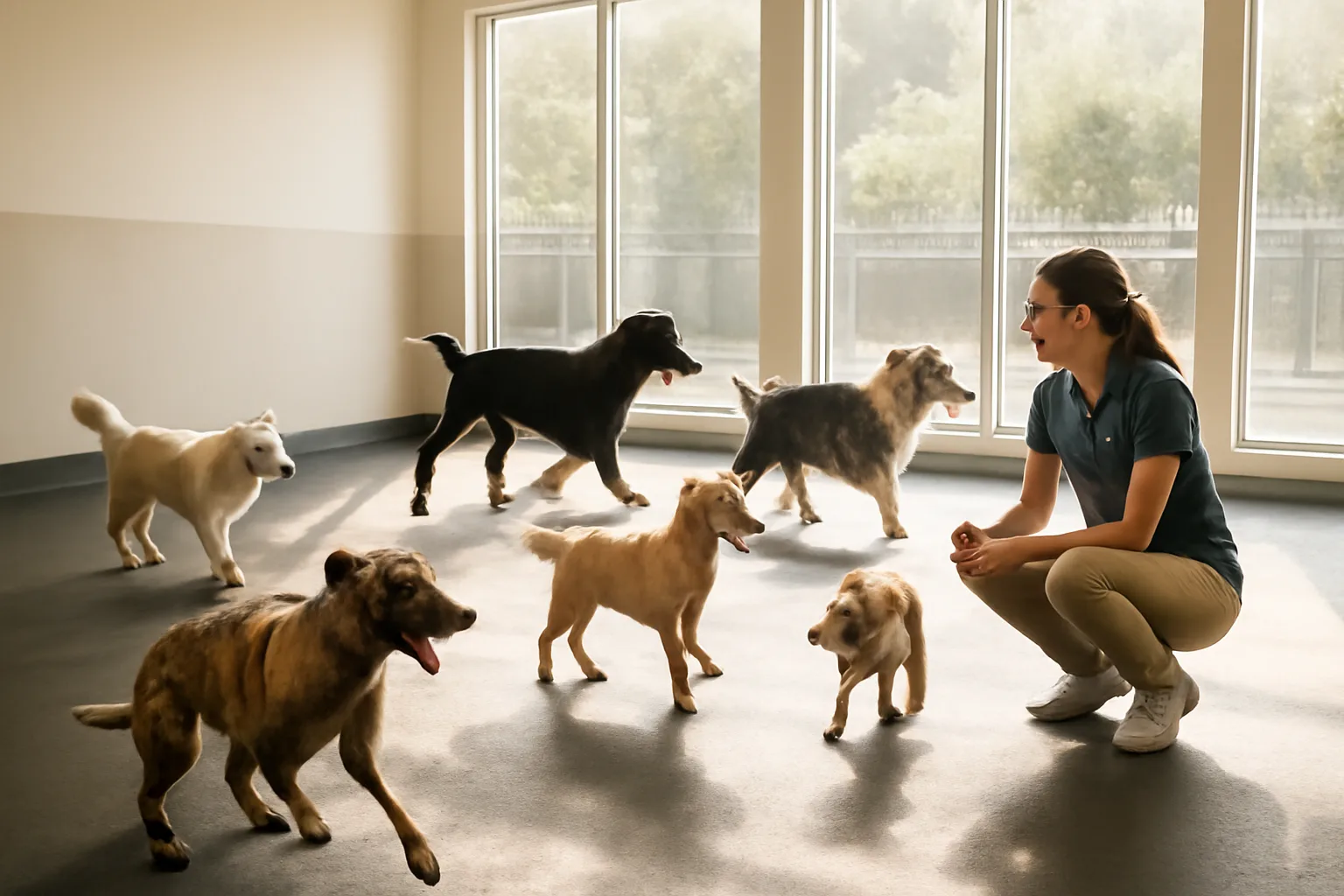
Dogtopia is a national franchise chain built around open-play dog daycare, with boarding and spa services added at most locations. The Bakersfield location operates like the rest of the chain: dogs get grouped by size and temperament, play in open rooms supervised by staff, and owners can watch on webcam feeds through the company's app. It is not a state or county licensing entity itself. It is a private business that still has to clear the same local hoops as any independent boarding or daycare operator in Kern County. That distinction matters if you're researching the brand because you're thinking about opening something similar. A franchise fee and a brand name don't replace a kennel license, a zoning clearance, or a fire and building inspection. Every one of those requirements comes from the city or county where the physical building sits, not from the franchisor. If you want a broader look at how Dogtopia operates as a franchise model across different states, that's a useful next read before you get into the local paperwork.
How much does dog boarding cost in Bakersfield and similar markets?
Pricing at Dogtopia locations is set by the individual franchise owner, not a fixed national schedule, so a Bakersfield rate can differ from one in Fresno or Los Angeles. Nationally, daycare at Dogtopia franchises tends to run in the $30-45 per day range, and overnight boarding (often bundled with daycare access) tends to land around $45-70 a night, based on published rate sheets various franchise locations post on their own sites. Independent kennels and smaller boarding operators in California's Central Valley often charge less, sometimes $25-40 a night, because they carry lower overhead than a franchise with national marketing fees baked in. The honest answer to "how much does dog boarding cost" is that it depends heavily on three things: whether the facility is a franchise or independent, whether the dog needs a private suite versus a shared kennel run, and what region of the country you're in. Boarding in coastal California cities routinely runs higher than in the Central Valley. The U.S. Bureau of Labor Statistics tracks "pet services" spending as part of its Consumer Expenditure Survey, though it doesn't isolate boarding from grooming and other categories in the public tables, so a precise national per-night average is hard to pin down from federal data alone [1]. If you're comparing options for your own dog, it's worth checking dog boarding and pet boarding options side by side, since boarding and daycare pricing structures often get bundled in ways that make apples-to-apples comparison hard.
How is Dogtopia Bakersfield licensed and zoned?
Any commercial dog boarding or daycare facility in Kern County needs to satisfy local zoning before it can legally open its doors, regardless of brand name. Kern County's zoning ordinance controls where kennels, animal boarding, and similar uses are permitted, typically restricting them to specific commercial or agricultural-zoned parcels rather than allowing them by right in retail strip centers. A prospective operator has to confirm the parcel's zoning designation with the Kern County Planning and Natural Resources Department before signing a lease, because a location that looks perfect for a storefront daycare might sit in a zone that doesn't allow animal boarding at all. Kern County's zoning ordinance text itself, Title 19 of the Kern County Code, is the controlling document for these designations, and it specifically defines "kennel" and related animal-use categories within its zoning district tables [2]. On top of zoning, California counties and cities license kennels and animal facilities under local ordinances that vary widely. Some counties treat any facility housing four or more dogs as a "kennel" requiring a separate permit; others tie the threshold to number of dogs boarded overnight versus daycare-only dogs that go home each evening. This is the part that trips up a lot of new operators: they assume a well-known franchise brand comes pre-approved. It doesn't. Every location, franchise or independent, files its own zoning application, its own conditional use permit if required, and its own local kennel license.
What does a zoning hearing look like for a boarding or daycare facility?
If the parcel isn't zoned for animal boarding outright, the operator usually needs a conditional use permit (CUP), which means a public hearing in front of a planning commission or zoning board. Neighbors get notified, and noise, odor, and traffic are the three objections that come up almost every time. Kern County's planning process for a CUP typically requires a site plan, a description of hours of operation, and sometimes a noise mitigation plan showing how barking will be contained (indoor-only play areas, sound-dampening panels, limited outdoor yard hours). California's Government Code section 65905 sets the baseline public hearing and notice requirements that counties like Kern must follow before approving a conditional use permit of this kind [3]. A hearing board wants to see specifics, not promises. "We'll keep it quiet" doesn't hold up. A stated maximum dog capacity, a defined outdoor play schedule, and a plan for waste disposal carry far more weight. Boards in California counties have denied or delayed kennel CUPs specifically over unresolved noise complaints from adjacent residential zones, so if your parcel borders houses, expect that to be the central fight at the hearing. Building out a paper trail before the hearing, not during it, saves time. That means confirming zoning compatibility, drafting a site plan, and having a noise and odor mitigation plan ready to hand to the board the day you file, not the day of the hearing.
Does a dog need to be registered, and how do you register a dog?
Registering a dog usually means two separate things get conflated: local licensing (a legal requirement in most cities and counties) and breed registration with a kennel club (optional, for pedigree documentation). To register a dog locally, owners typically bring proof of rabies vaccination to their county's animal control or animal services department, pay a licensing fee, and get a tag. California Food and Agricultural Code section 30801 authorizes counties to require dog licensing and to condition that license on current rabies vaccination, which is the state-level backbone for Kern County's local licensing program [4]. That local license is what most people mean when they ask "how to register a dog" for legal purposes. It's separate from registering a dog's pedigree with a group like the American Kennel Club, which has nothing to do with legal ownership and everything to do with documenting bloodline for breeding or show purposes. For boarding and daycare operators, this matters because many facilities require proof of current rabies and other vaccinations before a dog can be admitted, and some jurisdictions require the facility itself to verify that dogs boarded on-site carry current county licenses.
How do you get a dog license, and how much does it cost?
Getting a dog license means visiting or mailing an application to the county or city animal control office, providing proof of rabies vaccination (a certificate from the vet, more than verbal confirmation), and paying the fee. Most California counties set differential pricing: a lower fee for spayed or neutered dogs, a higher fee for intact dogs, sometimes as a matter of policy meant to reduce backyard breeding. That differential licensing authority traces back to California Food and Agricultural Code section 30804, which lets counties set license fees and impose higher fees on unaltered dogs [5]. License periods typically run one to three years depending on the option chosen. Late fees apply if a dog goes unlicensed past the grace period after the rabies vaccination is due for renewal, and animal control officers can and do cite owners of unlicensed dogs during routine calls or after a bite complaint. It's a small, boring piece of paperwork that most owners ignore until animal control shows up at their door. For a boarding or daycare operator, verifying current licensing during intake isn't usually a legal requirement, but it's smart practice: an unlicensed, unvaccinated dog is a liability risk in a group play setting.
How do you get papers for a dog, and what does 'getting papers' actually mean?
"Getting papers" almost always means registering a dog's pedigree with a breed registry like the American Kennel Club (AKC), not obtaining a legal document required to own the dog. If both parents are AKC-registered and the litter is reported by the breeder, puppies are generally eligible for AKC registration, and the new owner completes that registration using a form or online application the breeder provides at the time of sale. There's no other kind of legal "papers" that a pet dog needs beyond a rabies certificate and, where required, a county license. If a dog doesn't have documented parentage, it can't retroactively get AKC papers no matter how purebred it looks. Some owners pursue DNA-based breed identification services instead, but that's a different thing entirely: it tells you likely breed composition, not registered pedigree status, and it won't get a dog into conformation shows or AKC litter registration. For breeders, papers are also tied to sales. A buyer asking how to get papers for their dog after already purchasing a puppy without registration documents is usually out of luck unless the breeder is cooperative and the litter itself was eligible for registration in the first place.
How do you become a dog breeder, legally?
Becoming a legal dog breeder starts with figuring out which regulatory tier applies to your operation, and that depends almost entirely on scale and how you sell. If you sell puppies sight-unseen (meaning the buyer never meets the dog or visits the facility before purchase, such as through online sales shipped directly), and you have more than four breeding females, you likely need a USDA Animal Welfare Act license as a "dealer," administered by APHIS. Federal regulation defines this licensing requirement at 9 CFR 2.1, which sets out who must be licensed under the Animal Welfare Act. As the regulation states, a license is required for "any dealer or exhibitor" whose activity meets the definitions in the rule, and APHIS's own program materials describe the sight-unseen threshold in plain terms for breeders trying to self-assess [6]. Breeders who sell only through in-person transactions, where the buyer physically visits before purchase, are generally exempt from federal licensing under the AWA's retail pet store exemption, though that exemption has specific conditions and doesn't automatically apply just because you call your operation a hobby breeder. States layer their own rules on top: California requires a state kennel license for facilities meeting certain size thresholds and imposes its own record-keeping and inspection requirements through county animal control in many jurisdictions. Becoming a breeder legally also means checking county zoning (breeding kennels are frequently zoned separately from boarding/daycare uses), securing a local business license, and, if selling across state lines, registering with USDA APHIS as a Class A (breeder) or Class B (dealer) licensee depending on structure [6]. Skipping any one of these steps is how well-meaning hobby breeders end up facing fines or shutdown orders after a neighbor complaint triggers a county inspection. For a side-by-side on where boarding, daycare, and breeding licensing diverge, see dog kennels, which breaks down how kennel classifications differ by state.
What's the difference between boarding, daycare, and breeding licenses?
| Daycare (day use only) | County/city zoning + business license | Number of dogs on-site at once | Kennel or animal facility permit | |
|---|---|---|---|---|
| Overnight boarding | County/city zoning + animal control | Overnight occupancy limits | Kennel license, fire inspection | |
| Small-scale breeding | State department of agriculture / county | Number of breeding females | State kennel license | |
| Commercial breeding (sight-unseen sales) | USDA APHIS | More than 4 breeding females + sight-unseen sales | Federal Class A/B license [6] | A facility that does all three (boarding, daycare, and breeding on the same property) has to satisfy every applicable tier simultaneously. That's rare but not unheard of, and it's exactly the kind of operation that draws the most zoning board scrutiny, since mixed-use animal facilities tend to generate more noise and traffic complaints than single-purpose ones. |
These three business models get regulated completely differently, and conflating them is one of the most common mistakes new operators make. Boarding (overnight stays) and daycare (day-use only, dogs go home nightly) are usually licensed locally, through county or city kennel ordinances, animal control permits, and zoning clearance. Breeding, especially at commercial scale, adds a state kennel license layer and potentially a federal USDA APHIS license if the sight-unseen sales threshold is crossed [6]. | Business type | Primary regulator | Key trigger for stricter tier | Typical local requirement |
What should someone check before opening a facility like Dogtopia in another county?
Before signing a lease or franchise agreement, confirm four things with the actual county or city office, not with a franchise sales rep or a general internet search: zoning designation for the specific parcel, whether a conditional use permit is required, the local kennel license fee and renewal cycle, and whether state-level kennel licensing applies based on the number of dogs housed. Every one of these varies by jurisdiction, and a franchise development team's estimate of "it usually takes X weeks" is not the same as a confirmed timeline from your specific county planning department. A lot of new operators lose months because they assumed the zoning would work out and started build-out before getting written confirmation. That's backwards. Get the zoning letter first, then sign the lease. This is genuinely one of the more tedious parts of opening a facility, gathering the right forms from the right offices in the right order. That's the gap a $149 one-time Kennel License & Zoning Packet is built to close: it organizes the state licensing forms, the zoning hearing prep checklist, and the county-specific document list into one packet so you're not reverse-engineering it county by county. It doesn't replace legal advice and it doesn't represent you before a zoning board, but it does save the research time most first-time operators burn just figuring out where to start. You can look at the license-packet-builder to see what's covered before you commit to a location.
How does Dogtopia Bakersfield compare to independent boarding options nearby?
Franchise daycare chains like Dogtopia generally offer more standardized facilities (webcam access, branded play rooms, consistent staff training programs across locations) in exchange for pricing that tends to run higher than independent competitors in the same market. Independent kennels and smaller boarding operations in Kern County often compete on price and sometimes on more flexible boarding arrangements (in-home boarding, smaller group sizes), but consistency varies a lot more operator to operator since there's no corporate training standard behind them. For a pet owner choosing where to board a dog, the decision usually comes down to whether webcam monitoring and open-play group daycare matter more than price, or whether a smaller, quieter, one-on-one boarding setup is a better fit for an anxious or reactive dog. Neither model is objectively better; they serve different dogs and different owner preferences. If you're researching this as a potential operator rather than a pet owner, it's worth looking at doggy day care and dog hotels near me to see how positioning and pricing differ between the daycare-only model and the boarding-heavy "hotel" model, since your zoning and licensing needs can differ based on which one you're building toward.
Frequently asked questions
How much does dog boarding cost at a franchise like Dogtopia?
Franchise daycare typically runs $30-45 a day and overnight boarding $45-70 a night, based on rate sheets published by individual Dogtopia franchise locations, though exact pricing is set locally by each franchise owner, not a fixed national rate. Independent kennels in the same region often charge less.
How do I register a dog with my county?
Bring proof of current rabies vaccination to your county or city animal control office, complete the license application, and pay the fee, which is often lower for spayed/neutered dogs. Kern County residents register through Kern County Animal Services, operating under authority granted by California Food and Agricultural Code section 30801.
How do you get a dog license?
Visit or mail an application to your county or city animal control office with proof of rabies vaccination and pay the licensing fee. Most jurisdictions offer one, two, or three-year license terms, and late renewal typically triggers a penalty fee on top of the base cost.
How do you get papers for a dog?
"Papers" usually means AKC or similar breed registry documentation, which requires that both parents were registered and the breeder reported the litter. If a dog's parentage wasn't documented at birth, there's no way to retroactively get registry papers, regardless of apparent breed.
How can I get papers for my dog if the breeder didn't provide any?
If the breeder didn't register the litter or provide registration paperwork at sale, you generally can't obtain retroactive AKC papers. Contact the breeder directly first; if the litter was eligible but simply unregistered, some breeders can still complete late registration. If not, DNA breed testing is an alternative that shows likely breed composition but isn't registry documentation.
How do you become a dog breeder legally?
Determine your regulatory tier first: more than four breeding females plus sight-unseen sales generally triggers a USDA APHIS Class A or B license under the Animal Welfare Act. Below that threshold, state kennel licensing and county zoning and business license rules still apply, and all of it needs confirming before you sell a single litter.
What's the USDA threshold for needing an APHIS breeder license?
Federal rule at 9 CFR 2.1 and USDA APHIS program guidance describe licensing as generally required for anyone with more than four female dogs used for breeding who sells puppies sight unseen, meaning the buyer never meets the dog before purchase. In-person retail sales are typically exempt regardless of the number of females kept.
Does Dogtopia Bakersfield require special zoning to operate?
Yes, in the sense that any commercial dog boarding or daycare facility in Kern County has to sit on a parcel zoned to allow animal boarding uses under Title 19 of the Kern County Code, confirmed through the Kern County Planning and Natural Resources Department. Franchise brand recognition doesn't exempt a location from local zoning review.
Is a franchise like Dogtopia pre-approved for licensing everywhere?
No. Each individual location, franchise or independent, has to file its own zoning application, business license, and local kennel permit with the specific city or county where it operates. There's no blanket national approval that transfers between locations.
What's the difference between a dog license and AKC registration papers?
A dog license is a legal requirement in most counties, tied to rabies vaccination and renewed annually or every few years through animal control. AKC registration papers document pedigree for breeding or show purposes and have no legal bearing on pet ownership; a dog can be perfectly legal without ever having registry papers.
How much does a Kern County dog license cost?
Kern County Animal Services sets differential fees, generally lower for spayed/neutered dogs and higher for intact dogs, with license terms that can run one to three years, under authority granted by California Food and Agricultural Code section 30804. Exact current fees are published by the department and should be confirmed directly since rates change periodically.
What triggers a conditional use permit hearing for a boarding facility?
If the parcel's base zoning doesn't allow animal boarding by right, the operator needs a conditional use permit, which requires a public hearing before the planning commission or zoning board under notice procedures set out in California Government Code section 65905. Noise, odor, and traffic from neighbors are the most common objections raised at these hearings.
Sources
- U.S. Bureau of Labor Statistics, Consumer Expenditure Surveys: Federal consumer expenditure data tracks pet services spending but does not isolate a specific per-night boarding rate
- Kern County Code, Title 19 (Zoning): Kern County zoning ordinance controls where kennel and animal boarding uses are permitted and defines kennel use categories
- California Government Code Section 65905: California law sets public hearing and notice requirements counties must follow before approving a conditional use permit
- California Food and Agricultural Code Section 30801: State law authorizes counties to require dog licensing conditioned on current rabies vaccination
- California Food and Agricultural Code Section 30804: State law lets counties set differential dog license fees, including higher fees for unaltered dogs
- 9 CFR 2.1, Animal Welfare Act Licensing Requirements: USDA licensing under the AWA applies to breeders with more than four breeding females who sell puppies sight unseen