Last updated 2026-07-25
TL;DR
Dogtopia Milwaukee runs daycare and boarding for dogs, with daycare typically priced per day and boarding priced per night plus daycare; exact rates vary by location and aren't published nationally. Wisconsin requires every dog over 5 months old to have a rabies vaccination and county dog license (Wis. Stat. § 174.05), separate from any kennel or breeder license the facility itself needs.
What is Dogtopia Milwaukee and what does it offer?
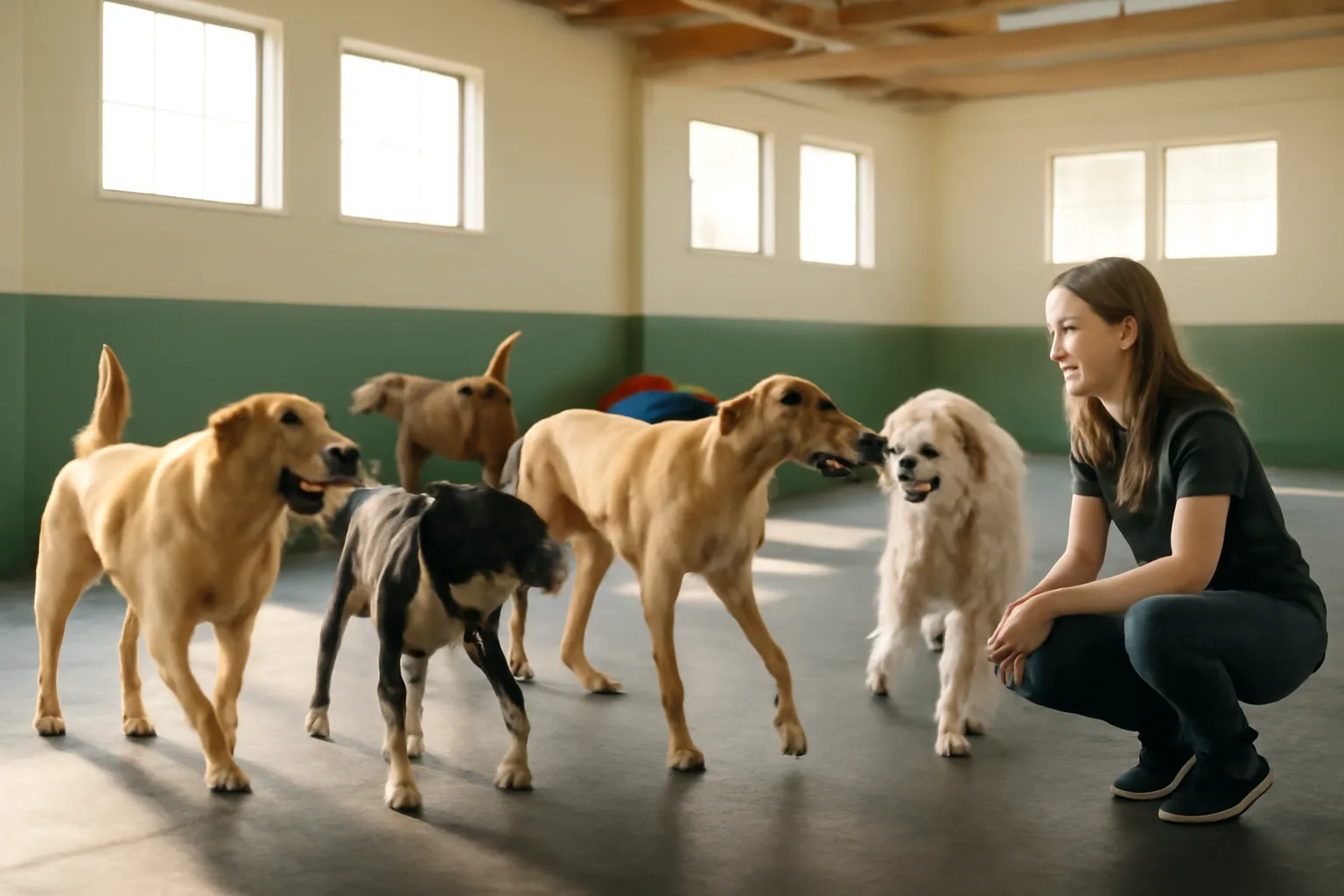
Dogtopia is a national franchise chain built around open-play dog daycare, with boarding and spa services layered on top at most locations. The Milwaukee-area outposts (there are franchise locations serving the metro, often listed under nearby suburbs like Wauwatosa or Brookfield depending on the year) follow the same model as Dogtopia locations everywhere: dogs go into supervised group play instead of individual kennel runs for most of the day. The core offering is daycare, boarding, and add-ons like spa baths, nail trims, and sometimes training. Boarding dogs typically join daytime play groups and then get an individual suite or kennel space overnight. That's the operational difference worth understanding if you're comparing Dogtopia to a traditional pet boarding kennel: traditional kennels usually keep dogs in individual runs with scheduled outdoor time, while Dogtopia-style facilities keep dogs in group play rooms most of the day. Because it's a franchise, pricing, hours, and even exact services can differ by location. Corporate doesn't publish a national rate card, and franchise owners set local pricing based on real estate costs, staffing, and local competition. If you're a pet owner, the only reliable way to get Milwaukee-specific pricing is to call the location directly or use their online booking tool. If you're an operator studying the model, that same variability is the point: franchise fees and territory costs are set by Dogtopia's franchise disclosure document, not by any government agency.
How much does dog boarding cost in Milwaukee?
Dog boarding in the Milwaukee area, across independent kennels, franchise daycares like Dogtopia, and boutique boarding operations, generally runs somewhere between $35 and $75 per night for a standard dog, with premium suites, large breeds, or added daycare play running higher. National industry surveys peg average per-night boarding costs in a similar band, though there's no single authoritative government dataset tracking private boarding rates, so treat any number (including this one) as a market estimate, not an official figure. Factors that move the price up in a given facility: private suites versus shared runs, webcam access, extra daycare play sessions bundled into the overnight stay, medication administration, and specialty diets. Multi-dog discounts are common for families boarding two dogs from the same household. For daycare specifically (as opposed to overnight boarding), a single day typically costs less than a boarding night, often in the $25 to $45 range at chain facilities in Midwest metro markets, with package pricing (10-day or 20-day punch cards) bringing the per-visit cost down further. Again: these are market ranges pulled from typical Midwest daycare pricing patterns, not a cited government source, because no state or federal agency tracks private boarding and daycare pricing. If you're opening a facility yourself, the more useful benchmark isn't what Dogtopia charges. It's your local market's price ceiling versus your fixed costs (rent, staffing ratios, insurance) so you can set a rate that actually covers overhead. Compare notes with other dog boarding operators in your metro before setting your first price sheet.
Does Wisconsin require a dog license, and how do you get one?
Yes. Wisconsin state law requires owners to license every dog over 5 months old, every year, through their county (or in some cases municipal) clerk's office. This is separate from any commercial kennel license a boarding or daycare business needs. Under Wisconsin Statute 174.05, "the owner of a dog that has attained the age of 5 months on January 1 of any year, or attains the age of 5 months during any year, shall annually cause it to be listed for a license before the license is due" [1]. The dog must have a current rabies vaccination on file for the county to issue the license; without proof of vaccination, most counties will only issue a temporary or unvaccinated license, which usually costs more. Milwaukee County residents typically license through their municipality (the City of Milwaukee, or their specific suburb like Wauwatosa, West Allis, or Brookfield), not directly through the county in every case. Fees are set locally and change periodically, so check your specific municipal clerk's page rather than assuming a statewide number. As a general pattern across Wisconsin counties, spayed/neutered dogs cost less to license than intact dogs under the fee structure set out in Wis. Stat. § 174.055, which is a small financial nudge state law builds in to encourage sterilization [2]. Late fees apply if you don't renew on time. Wisconsin Statute 174.05(2)(b) allows counties to charge a late fee, commonly around $5, on top of the license fee if you register after the statutory deadline (typically March 31 of each year in most counties) [1]. If you're a boarding facility owner, ask every new client for proof of current license and rabies vaccination at intake; some counties actually require kennels to verify this before boarding a dog.
How do you register a dog if you just adopted or moved to Wisconsin?
Registering a dog for the first time follows basically the same process as annual licensing. Bring proof of rabies vaccination (or get one from a vet first), then go to your municipal or county clerk's office, in person or online in many jurisdictions, and pay the license fee. If you moved from another state, your dog's out-of-state rabies certificate is usually accepted, but the license itself doesn't transfer. Wisconsin doesn't recognize another state's dog license; you need a new one from your new county or municipality within a set window after establishing residency, commonly 30 days in many Wisconsin municipalities (check your specific city's ordinance, since this isn't uniform statewide). If your dog isn't spayed or neutered and you don't have proof, expect a higher fee tier. Some Wisconsin municipalities also require a rabies tag to be visibly attached to the dog's collar, separate from the license tag itself. A note on "registering" versus "licensing": these terms get used interchangeably by pet owners, but they mean different things depending on context. A dog license is a local government requirement tied to rabies control and animal control funding. Registering a dog with a breed registry (like the AKC) is a totally separate, private, optional process that has nothing to do with your county clerk. If someone asks you how to register a dog and means the legal requirement, they mean the county/municipal license. If they mean getting breed papers, that's a different question entirely, covered below.
How do you get papers for a dog (AKC registration explained)?
"Papers" almost always means AKC (American Kennel Club) registration, a private pedigree record, not a government requirement. To get AKC papers, a puppy's litter needs to come from two AKC-registered parents, and the breeder needs to register the litter with the AKC after whelping. Here's the actual mechanism: when a breeder registers parents that are already AKC-registered and mates them, they can then register the resulting litter. Each puppy in that litter becomes individually eligible for registration, and the breeder typically provides the buyer with either a completed registration application or, more commonly now, an AKC Registration Certificate or access to register online through AKC's website using a code from the litter registration. If you bought a puppy without papers and want to get them after the fact, your options are limited. If both parents are AKC-registered but the breeder never registered the litter, the breeder (not the buyer) has to do the litter registration; a buyer generally cannot register a dog whose parentage can't be documented and whose breeder won't cooperate. AKC does have a program called "Purebred Alternative Listing" (PAL) for dogs that look purebred and are spayed/neutered but lack registration paperwork, allowing them to compete in some AKC events without full pedigree registration, though this is not the same as full papers and doesn't establish breeding rights. If a dog is mixed breed, there is no path to AKC papers, full stop. Mixed breed dogs can be registered with AKC Canine Partners for enrollment in some events, but that's an identification and event-eligibility program, not a pedigree record. For breeders reading this: getting your own breeding stock properly AKC-registered, and registering every litter promptly, is what lets your buyers get papers. Skipping that step (some backyard breeders do, to avoid the AKC's per-dog fee) means your puppies can never get full registration later, no matter what the buyer does.
How do you become a dog breeder legally?
Becoming a legal dog breeder means clearing three separate layers: local zoning, state licensing, and (if you cross certain thresholds) federal USDA licensing. Most first-time breeders only think about the third layer and get surprised by the first two. Start with zoning. Many counties and municipalities restrict how many intact dogs you can keep on a residential lot, or require a kennel license/conditional use permit once you exceed a certain number of adult dogs. This varies enormously by jurisdiction; some cities allow four dogs with no permit, others cap it at two or three. Check your specific municipal zoning code before you acquire breeding stock, not after. Next, state licensing. Wisconsin, for example, regulates dog breeders and sellers who sell 25 or more dogs per year or maintain more than a set number of female dogs capable of breeding, through its Wisconsin Department of Agriculture, Trade and Consumer Protection (DATCP) under the state's Dog Seller and Breeder statute, Wis. Stat. § 173.41 [3]. Under that section, someone who sells 25 or more dogs a year that they bred and raised on the premises has to hold a license, with limited exceptions for hobby breeders below that threshold and for certain nonprofit rescues. Finally, federal USDA licensing. If you sell dogs sight-unseen to a broker, pet store, or another business, and you maintain more than 4 breeding females, you likely need a USDA Class A (breeder) or Class B (broker/dealer) license under the Animal Welfare Act, administered by USDA APHIS. The federal threshold is specifically about wholesale-type sales; a breeder who sells directly to the public, in person, at their own home, is generally exempt from USDA licensing under the "retail pet store" exemption defined at 9 CFR § 1.1, even with more than 4 breeding females, as long as buyers physically visit before purchase [4]. Realistically, most small hobby breeders selling a litter or two a year directly to families never trigger USDA jurisdiction. It's the larger commercial operations, and anyone selling through a broker, pet store chain, or online sight-unseen, that need to check the federal threshold carefully.
What is the USDA threshold that triggers a federal breeder license?
| Hobby breeder | 1 to 4 | Direct, in-person only | Usually none federally; check state/county | |
|---|---|---|---|---|
| Small commercial | 5+ | Direct, in-person only (buyer visits) | Often exempt (retail exemption); state license may still apply | |
| Wholesale/online | Any number, if selling wholesale | Sight-unseen, broker, or pet store sales | USDA Class A or B license required [4] | |
| Large-scale breeder | 5+ and wholesale | Any wholesale/sight-unseen channel | USDA license required, plus state license in most states | State requirements stack on top of this regardless of federal status. Wisconsin's 25-dogs-per-year threshold under Wis. Stat. § 173.41 is a completely separate trigger from the federal 4-female threshold, and a breeder can owe a state license, a federal license, both, or neither depending on their specific numbers and sales channel [3][4]. |
The USDA APHIS threshold hinges on two things: how many intact adult female dogs you keep for breeding, and whether you sell to buyers who never see the dog or the premises in person before purchase. Under the Animal Welfare Act regulations at 9 CFR § 2.1, a person who maintains more than 4 female dogs used for breeding and sells any puppies wholesale (to pet stores, brokers, research facilities, or online/sight-unseen to the public) generally needs to be licensed as a USDA dealer [4]. The regulation defines a "retail pet store" exemption at 9 CFR § 1.1 for those who sell animals only at retail to the public for personal use, in face-to-face transactions [4]. The most important exemption is the retail pet store exemption: breeders who sell animals directly to buyers who come to their premises, or the buyer's residence, to see the animal in person before purchase, are typically exempt regardless of how many breeding females they have, as long as they don't also sell wholesale. This exemption specifically does not extend to internet or phone sales where the buyer never physically visits before the transaction; USDA amended the regulatory definition of "retail pet store" through a 2013 final rule to close that loophole after a wave of online-only puppy sales tried to claim the retail exemption without in-person visits [5]. Here's a comparison of how the thresholds stack for a small breeder versus a mid-size or commercial operation: | Scale | Breeding females | Sales channel | Licensing needed |
What does it cost and take to open a Dogtopia-style daycare or boarding facility?
Opening a daycare/boarding facility, whether it's an independent operation or a Dogtopia franchise, means clearing local zoning approval, a commercial kennel or animal facility license (state and/or county level), health and building code inspections, and often a conditional use permit if the property isn't already zoned for kennel or commercial animal use. Zoning is usually the first bottleneck, not the license itself. Many municipalities classify dog daycare and boarding under "kennel" zoning categories that are restricted to specific commercial or industrial zones, or require a conditional use permit (CUP) and a public hearing even in zones that technically allow it. Noise ordinances, required setback distances from residential property lines, and outdoor play area restrictions are common sticking points that trip up first-time applicants at the hearing stage. Franchise operators like Dogtopia handle a lot of this through corporate real estate and legal teams who've done it dozens of times across different states. Independent operators building from scratch have to research all of this themselves, county by county, which is genuinely one of the most time-consuming parts of opening (often more time than raising the capital). This is the exact gap our $149 one-time Kennel License & Zoning Packet is built for: a structured way to pull together your state licensing requirements, county zoning checklist, and facility standards documentation into one packet before you walk into a zoning hearing or apply for your kennel license. It's not legal representation and it won't guarantee approval (nobody can guarantee that; zoning boards vote how they vote), but it saves you from missing a required document or misunderstanding a threshold that a clerk will bounce back to you anyway.
How do state and county rules differ for boarding vs breeding facilities?
Boarding and daycare facilities are regulated primarily as commercial animal facilities: building codes, sanitation, ventilation, staff-to-dog ratios in some states, and fire/safety inspections. Breeding facilities are regulated primarily around animal welfare in a different sense: breeding female limits, whelping conditions, and sale thresholds. A facility that does both, say, a boarding kennel that also breeds and sells puppies on the side, needs to clear both regulatory tracks separately. It's common for operators to hold a county kennel license for the boarding side and, if they cross the state or federal breeder thresholds, a separate breeder license or USDA registration for the breeding side. These aren't interchangeable and one doesn't substitute for the other. State departments of agriculture typically oversee breeder licensing (like Wisconsin DATCP under Wis. Stat. § 173.41), while county or municipal zoning and health departments typically oversee boarding/daycare facility approval. That means a single facility might deal with three different government offices: the state ag department, the county zoning office, and possibly a county or city health/building inspector, each with its own application, fee, and inspection schedule. If you're comparing your options across facility types, it helps to look at how dog kennels, doggy day care centers, and dedicated dog hotels near me-style boarding operations differ in their regulatory footprint before picking a business model.
Dogtopia franchise vs independent boarding: what's the real difference for pet owners?
For pet owners deciding between a Dogtopia location and an independent boarding kennel, the practical differences come down to play style, price, and consistency across locations, not licensing (both types of business need the same underlying state/county approvals to legally operate). Dogtopia and similar chain daycares emphasize open-play group socialization for most of the day, webcam access in many locations, and standardized branding/protocols across franchises, which some owners like for consistency if they travel and use different Dogtopia locations in different cities. Independent kennels vary far more: some run similarly open, social setups, others keep dogs in individual runs with scheduled outdoor time and much less group interaction, which some owners actually prefer for anxious or reactive dogs that don't do well in group play. Neither model is inherently "more licensed" or "more legitimate." Both need the same county kennel license or equivalent commercial permit, and both are subject to the same state animal welfare inspections where applicable. The real question for a pet owner is whether your dog does better in an all-day group play environment or a calmer, individually-managed setting, and that's a judgment call about your specific dog's temperament, not a licensing distinction. If you're researching general dogtopia locations elsewhere for comparison, the franchise model is consistent nationally even though pricing and specific building layouts differ location to location.
Frequently asked questions
How much does dog boarding cost per night?
Typical Midwest boarding rates run roughly $35 to $75 per night depending on suite type, add-ons, and location, with chain daycare/boarding operators often landing in the middle of that range. There's no official government price index for private boarding; these are market estimates from typical regional pricing patterns, not a cited statistic.
How much is dog daycare per day?
A single daycare day typically runs $25 to $45 in most Midwest metro markets, with multi-day punch cards or monthly packages lowering the effective per-visit price. Rates vary by facility size, staff ratios, and whether the price includes extras like nail trims or bath add-ons.
How do you register a dog in Wisconsin?
Bring proof of current rabies vaccination to your county or municipal clerk's office and pay the annual license fee. Wisconsin Statute 174.05 requires every dog over 5 months old to be licensed annually, and most municipalities also let you renew online once you're in the system.
How do you get a dog license?
Contact your county or city clerk's office (in Wisconsin, often the municipal clerk rather than the county directly), bring proof of rabies vaccination, and pay the license fee, which is typically lower for spayed/neutered dogs. Renewal is required annually, usually by March 31 in most Wisconsin municipalities.
How do you get papers for a dog?
"Papers" means AKC registration, which requires both parents to be AKC-registered and the breeder to register the litter after whelping. Buyers of purebred puppies from a registered litter get a registration certificate or online registration code from the breeder; there's no path to full AKC papers for a dog with unknown or unregistered parentage.
How can I get papers for my dog if the breeder never registered the litter?
Only the breeder can register a litter with the AKC after the fact, using the AKC-registered parents' information; buyers generally can't do this themselves. If the breeder won't cooperate or the parents weren't registered, full AKC papers usually aren't obtainable, though AKC's Purebred Alternative Listing (PAL) program allows some spayed/neutered purebred-looking dogs limited event eligibility without full pedigree papers.
How do you become a dog breeder legally?
Check local zoning for intact-dog limits or kennel permit requirements first, then check your state's breeder licensing threshold (Wisconsin's is 25+ dogs sold per year under Wis. Stat. § 173.41), then check whether you exceed the USDA's 4-breeding-female wholesale threshold under the Animal Welfare Act. Most hobby breeders selling direct, in-person, never trigger federal licensing.
What is the USDA threshold for needing a dog breeder license?
USDA regulations at 9 CFR § 2.1 generally require a Class A or B license if you maintain more than 4 female dogs for breeding and sell wholesale, meaning sight-unseen, through brokers, or to pet stores. Breeders who sell only in-person to buyers who visit before purchasing usually qualify for the retail pet store exemption defined at 9 CFR § 1.1, regardless of how many breeding females they have.
Does Dogtopia require dogs to be licensed or vaccinated?
Most Dogtopia locations require proof of current vaccinations (rabies, DHPP, bordetella) as a condition of daycare or boarding enrollment, similar to most commercial boarding facilities, though this is a facility policy rather than a government requirement. Whether your dog also needs a county license is a separate legal requirement that exists regardless of where you board.
Is a dog license the same as AKC registration?
No. A dog license is a local government requirement tied to rabies control and animal control funding, issued by your county or city clerk. AKC registration is a private pedigree record from the American Kennel Club that has nothing to do with government licensing; you need both separately if you want a legally licensed, fully-papered purebred dog.
How much does it cost to license a dog breeding kennel?
Kennel and breeder license fees vary by state and county and aren't standardized nationally; some states charge a flat annual fee while others scale by number of dogs. Check your specific state department of agriculture's fee schedule and your county zoning office rather than assuming a number, since fees change and vary widely by jurisdiction.
Can you board a dog without a current rabies vaccination?
Almost no licensed boarding or daycare facility will accept a dog without proof of current rabies vaccination, both as a matter of facility policy and, in many states, a legal requirement tied to the county dog licensing system. Get the rabies vaccination and any required boosters well before your planned boarding date.
Sources
- Wisconsin State Legislature, Wis. Stat. § 174.05: Wisconsin requires annual dog licensing for dogs over 5 months old and allows counties to charge late fees
- Wisconsin State Legislature, Wis. Stat. § 174.055: Wisconsin dog license fee structure differs for spayed/neutered versus intact dogs
- Wisconsin State Legislature, Wis. Stat. § 173.41: Wisconsin requires a dog seller/breeder license for those selling 25 or more dogs bred and raised on the premises per year
- Animal Welfare Act regulations, 9 CFR § 1.1 and § 2.1: USDA requires a license for breeders with more than 4 breeding females who sell wholesale or sight-unseen, with a retail exemption for in-person sales
- USDA APHIS, Federal Register final rule amending the definition of retail pet store (78 FR 57227): USDA closed the retail pet store exemption loophole for sight-unseen and online puppy sales in a 2013 rulemaking
- Cornell Legal Information Institute, 7 U.S.C. § 2131 (Animal Welfare Act, congressional statement of policy): The Animal Welfare Act is the federal statute under which USDA APHIS licenses commercial dog breeders and dealers