Last updated 2026-07-25
TL;DR
Dog day care typically costs $25-$50 a day and boarding runs $35-$85 a night, depending on region. Dog licenses come from your city or county for $10-$25 a year. "Papers" means AKC or breed registry documents, not a government license. Becoming a breeder legally means state and sometimes USDA registration once you sell to the public or cross wholesale thresholds.
How much does dog day care cost?
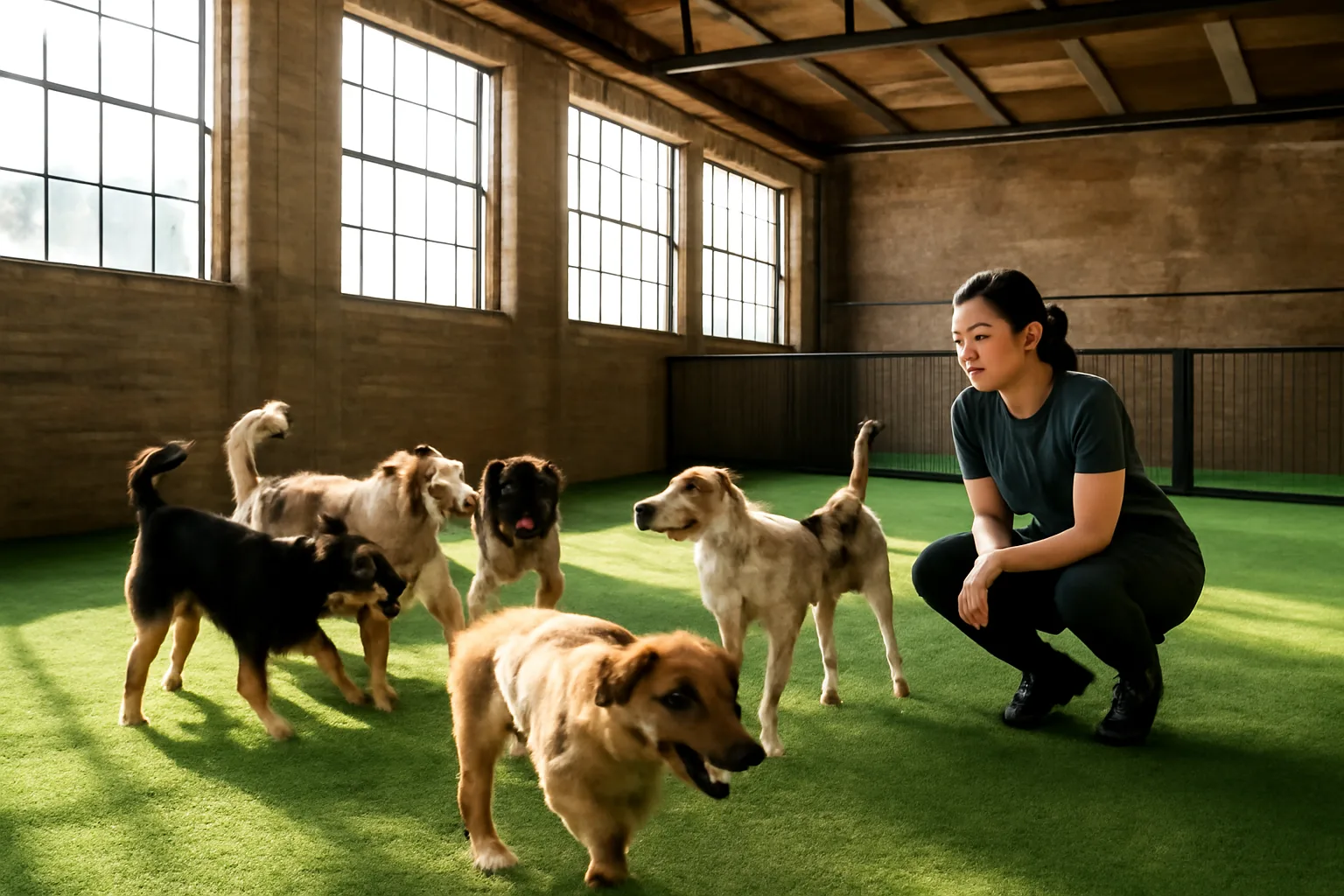
Dog day care usually runs $25 to $50 per day in most US markets, with prices climbing to $60 or more in expensive metro areas like San Francisco, New York, or Boston. Rural and small-town facilities often charge $18 to $30. Most operators offer multi-day punch cards (10 days for the price of 9, or similar) and monthly unlimited packages that run $400 to $700. The cost spread comes down to a few things: local rent, staff-to-dog ratios, and whether the facility offers extras like webcams, grooming add-ons, or specialized play groups by size and temperament. A facility with a 10:1 dog-to-staff ratio and a converted warehouse space charges very differently than one with a 6:1 ratio and finished turf yards. If you're pricing your own facility, the honest move is to call 8 to 10 competitors within a 15-mile radius, get their day rates and package pricing, and price yourself within that band unless you have a real differentiator (better hours, specialized small-dog rooms, on-site vet tech). Undercutting the market by a lot usually signals lower quality to pet owners, not a deal. For a full cost breakdown by region and service tier, see dog boarding and pet boarding.
How much is dog boarding, and how is it priced differently from day care?
Dog boarding (overnight stays) costs more than day care because you're covering overnight staffing, larger runs or suites, and liability exposure that comes with a dog sleeping on-site unsupervised for hours. Typical rates run $35 to $85 per night depending on suite type: standard kennel runs are cheapest, private suites with webcams or 'luxury' bedding cost the most. Multi-dog discounts (10-20% off for a second dog from the same household) are standard practice, and holiday surcharges (Thanksgiving week, Christmas week, July 4th) of $10 to $20 a night are common too, since demand spikes hard around those dates. Some facilities bundle day care access into overnight boarding stays so dogs get play time instead of sitting in a run all day. That's a real value-add worth pricing in if your facility has the play yard capacity to support it without overcrowding. One thing new operators underprice: staffing costs for overnight care. If your state or insurer requires a live-in or overnight staff member (some do, some just require someone on-call), that labor cost has to get baked into your nightly rate or you'll be losing money on every stay.
How do you register a dog, and how do you get a dog license?
Registering a dog and licensing a dog are usually the same action at the local level: most US cities and counties require an annual or multi-year dog license, obtained through the county clerk, county treasurer, or a local animal control office. Fees typically run $10 to $25 per year for spayed/neutered dogs and $20 to $50 for intact dogs, with the higher fee acting as a soft incentive toward spay/neuter. The general process: bring proof of current rabies vaccination (required in nearly every jurisdiction) to your county's licensing office or health department, pay the fee, and you'll get a tag and a certificate. Some counties now allow this entirely online. New York State, for example, requires every dog four months or older to be licensed with the town, city, or village clerk where the owner lives, and requires proof of a current rabies vaccination to do it, under New York Agriculture and Markets Law Article 7 [1]. There is no federal dog registration or license. If you're searching for a "national dog registry," what you actually want is a local license (proof you're a compliant dog owner) or a breed registry like AKC (proof of pedigree, not government-issued). Requirements and fees vary by county, sometimes by city within the same county, so always confirm with your specific county clerk or animal control office rather than assuming a neighboring county's rule applies to you.
How do you get papers for a dog (or "how do I get papers for my dog")?
"Papers" means registration with a breed registry, most commonly the American Kennel Club (AKC), and it has nothing to do with government licensing. To register a purebred puppy with AKC, the litter itself has to be registered first by the breeder, using AKC's litter registration application, and each puppy in that litter then gets an individual registration application (often called a 'blue slip') that the breeder passes to the buyer. If you already own an adult dog with no papers, you generally cannot get full AKC papers after the fact unless you can prove pedigree through the breeder's registered litter records. AKC does offer a Purebred Alternative Listing (PAL) program for dogs that look and act like a specific breed but lack documented parentage, which lets them compete in some AKC events (like agility or obedience) without full pedigree registration. Mixed-breed dogs cannot get AKC papers, full stop, regardless of how purebred one or both parents look. If someone offers to sell you 'papers' for a mixed-breed dog, that's not a legitimate registry service. For buyers: always ask the breeder for the puppy's individual AKC registration application (the blue slip) at pickup, plus a copy of the sire and dam's registration, more than a verbal promise that 'papers are coming.' Reputable breeders have this paperwork ready before puppies go home.
How do you become a dog breeder legally?
Becoming a dog breeder legally starts with your state's animal welfare or agriculture department, not the federal government, unless you cross specific USDA thresholds. Most states require a breeder or kennel license once you exceed a certain number of adult breeding females or annual litters; the exact number varies a lot by state, so check your state department of agriculture's breeder licensing page directly rather than guessing. At the federal level, USDA's Animal and Plant Health Inspection Service (APHIS) regulates commercial dog breeders under the Animal Welfare Act, but the licensing trigger depends on how you sell. Under the 2013 rule change to the Animal Welfare Act regulations, APHIS requires a license from breeders who sell puppies sight unseen (online, through a broker, or to a pet store) and who have more than four female dogs used for breeding, codified at 9 CFR 2.1 [2]. If you sell every puppy face-to-face, in person, at your own home or premises, you're generally exempt from USDA licensing under what's often called the 'retail pet store' exemption, even at higher volume, though your state license requirement still applies. Beyond licensing, real legal breeding also means: a written health-testing protocol for breed-specific conditions (hip dysplasia, eye disease, cardiac issues depending on breed), a vet of record who does wellness exams on the breeding stock, and clean whelping/housing space that would pass a facility inspection if your state or USDA showed up unannounced, which they can and do. For operators building or expanding kennel space to support breeding or boarding, county zoning approval usually has to happen before you can legally operate, not after. See dog kennels for a facility-standards rundown.
What's the difference between a dog license, dog papers, and a breeder/kennel license?
| Dog license | Proof your pet dog is registered locally, usually tied to rabies vaccination | City/county clerk or animal control | $10-$25/year | |
|---|---|---|---|---|
| Dog papers (AKC registration) | Proof of pedigree for a purebred dog | AKC or other breed registry | $25-$40 per dog (litter fee separate) | |
| Breeder/kennel license | Legal authorization to breed and sell dogs commercially | State department of agriculture; USDA APHIS if thresholds are crossed | Varies widely by state; USDA license fees are tiered by revenue [2] | |
| Boarding/day care facility license or permit | Legal authorization to operate a commercial pet care business | State (some states), county health/zoning, or city | Varies; often bundled with zoning/conditional use permit | A dog can have a city license and zero AKC papers (most family pets). A dog can have AKC papers and no city license if the owner just never registered locally, which is technically non-compliant in most places. A breeder can be fully licensed by their state and still be USDA-exempt if they only sell in person. None of these four things substitute for another. |
These three things get confused constantly, and mixing them up costs people time and money. Here's the actual breakdown: | Term | What it actually is | Who issues it | Typical cost |
What licenses does a dog boarding or day care facility need?
Facility licensing for boarding and day care operators layers three separate approvals, and missing any one of them is the most common reason new operators get shut down or delayed: state kennel/animal facility license (required in some states, not others), county or city zoning approval (a conditional use permit or special exception is standard for kennels in residential-adjacent zones), and a local business license or health permit. Some states, like Pennsylvania, require a kennel license for anyone keeping 26 or more dogs over four months old, issued through the state's Bureau of Dog Law Enforcement, with facility standards covering space, sanitation, and record-keeping spelled out in Pennsylvania's Dog Law, 3 P.S. Section 459-102 and related sections [3]. Other states have no state-level kennel license at all and push everything down to county health departments and zoning boards. There's no substitute for checking your specific state. Zoning is usually the slowest part, not the licensing paperwork. Boarding and day care facilities generate noise, traffic, and odor concerns that neighbors show up to oppose at public hearings, so budget real time (often 60 to 120 days) for a conditional use hearing, more than the few weeks it takes to fill out a license application. This is the exact intersection where our $149 one-time Kennel License & Zoning Packet is built to help: it organizes the state, county, and zoning-hearing documents you'll need into one packet before you walk into a hearing, so you're not scrambling for the right form the week before your meeting. Start at /license-packet-builder. It's not a guarantee of approval and it's not legal representation; local boards make the final call.
When does the USDA get involved in dog boarding, day care, or breeding?
USDA APHIS involvement is triggered by specific activity, not by the mere existence of a facility. For breeders: APHIS licensing under the Animal Welfare Act applies to anyone who sells or offers to sell dogs sight unseen (internet, phone, mail order, or through a broker/pet store) and maintains more than four breeding females, per the 2013 rule change codified at 9 CFR 2.1 [2]. For boarding and day care operators specifically, straight commercial pet boarding of owned pets (a dog owner drops their own dog off for the weekend) is generally not USDA-regulated activity, because the Animal Welfare Act's definitions at 7 U.S.C. 2132 define regulated "dealers" and related terms around breeding, brokering, and exhibiting animals, not temporary boarding of pets for their own owners [4]. Your regulatory exposure as a boarding/day care operator comes from state and county rules, not federal APHIS licensing, in the vast majority of cases. Where it gets mixed: if your facility also breeds and sells dogs, or if you board dogs as part of a breeding/brokering operation crossing the sight-unseen sales threshold, that side of the business can trigger USDA licensing even though your boarding operation itself doesn't. Keep the two business lines cleanly separated in your recordkeeping if you run both.
What does dog day care and boarding facility inspection actually look for?
Inspections (state, county, or USDA depending on your situation) generally check the same core categories: sanitation and disease control, physical space and containment, staff-to-animal ratios, record-keeping, and emergency planning. USDA's animal welfare regulations at 9 CFR Part 3, Subpart A, lay out standards for space (enough for the dog to stand, turn around, and lie down normally), temperature control, and sanitation frequency for anyone under its jurisdiction [5]. For state-licensed kennels, expect inspectors to check: vaccination records for every dog on-site, cleaning logs, functioning ventilation, secure double-door entry systems (to stop dogs bolting), fire and emergency evacuation plans, and separation protocols for sick or aggressive dogs. Pennsylvania's kennel regulations, for example, specify minimum enclosure sizes tied to dog weight and require exercise access beyond the primary enclosure [3]. A facility that passes on paper but flunks in practice usually fails on one of two things: staff-to-dog ratios that look fine in the plan but break down during actual busy hours, or cleaning logs that exist but don't match observed reality. Inspectors notice both fast. See doggy day care and dogtopia for how larger chain operators structure their standard operating procedures, which is a reasonable benchmark even if you're independent.
What zoning approvals does a dog boarding or day care facility need before opening?
Zoning approval usually has to happen before your county or state will even accept your kennel/facility license application, which is the opposite order most first-time operators expect. Most residential and even a lot of commercial zones classify a dog boarding/day care use as a conditional use, special exception, or requires a variance, meaning you go before a zoning board or planning commission, more than a permit clerk. What boards typically want to see: a site plan showing outdoor play area location relative to property lines, a noise mitigation plan (sound barriers, limited outdoor hours), parking capacity for peak drop-off/pickup times, and often a traffic study for larger facilities. Check your specific county zoning office's website for the exact application, since these vary enormously county to county, even within the same state. The single biggest mistake new operators make is signing a lease before confirming zoning will actually allow a kennel use at that address. Get written zoning confirmation (or at minimum a pre-application meeting with the zoning administrator) before you're locked into a commercial lease. For a side-by-side on what different facility types (in-home boarding vs. standalone day care vs. hotel-style) tend to need from zoning boards, see dog hotels near me.
How long does it take to open a licensed dog boarding or day care facility?
Realistic timelines run 3 to 9 months from lease signing to opening day, and zoning is almost always the bottleneck, not the license application itself. A straightforward state kennel license, once your facility passes inspection, can be issued in a matter of weeks. A contested zoning hearing with neighbor opposition can add 60 to 120 days on its own, and if you have to appeal a denial, add months more. A realistic sequence looks like this: pre-application zoning conversation (2-4 weeks), site plan preparation (2-6 weeks), zoning hearing scheduling and notice period (30-60 days minimum in many counties), build-out or renovation (4-12 weeks depending on scope), state/county facility inspection and license issuance (2-6 weeks), and business license/insurance finalization (2-4 weeks, often running in parallel). Operators who've done this before build in the slack; first-timers usually don't, and then they're paying rent on an empty building for months waiting on a hearing date. If your county has a queue for zoning board hearings (many do, meeting monthly), get on the calendar the day you sign your lease, not after.
How much does it cost to license and zone a dog boarding or day care facility?
Total licensing and zoning costs for a new facility typically run somewhere between $500 and $5,000+ before you even factor in build-out, and the spread depends entirely on your state and county. Line items to budget for: state kennel/facility license fee (commonly $50-$500 depending on state and dog capacity), county zoning application/conditional use permit fee (commonly $200-$2,000, higher in dense counties with public hearing costs), business license fee ($50-$300 typically), and any required site plan or engineering documents if your county demands them for the hearing. These numbers are directional; your state department of agriculture and county zoning office post the actual current fee schedules, and they change. Never assume last year's fee or a neighboring county's fee applies to you. What catches people off guard isn't the fee itself, it's the soft costs: attorney or consultant fees if you hire help for the hearing (often $1,500-$5,000+ if contested), signage/mailing costs for required public notice, and lost rent during the zoning delay window covered above.
Frequently asked questions
How much does dog boarding cost per night?
Dog boarding typically runs $35 to $85 per night depending on your region and suite type, with private suites and add-ons (webcams, extra playtime) at the top of that range. Rural markets run cheaper, often $25-$40. Multi-dog discounts of 10-20% are standard. Always compare at least 5-8 local facilities before setting your own rates.
How much does dog day care cost per day?
Dog day care usually costs $25 to $50 per day in most US markets, with expensive metro areas running $50-$60+. Most facilities offer punch cards or monthly unlimited packages ($400-$700/month) that lower the effective per-day rate for regular attendees.
How do you register a dog with the city or county?
Bring proof of current rabies vaccination to your city or county clerk, animal control office, or health department, pay the annual licensing fee (typically $10-$25), and you'll receive a tag and certificate. Some counties let you do this online now. Requirements and fees are set locally, so confirm with your specific county.
How do you get a dog license?
Dog licenses come from your local city or county government, not a state or federal agency. You'll need proof of rabies vaccination and to pay a fee, usually $10-$25 annually. New York State law, for example, requires every dog four months or older to be licensed with the local town, city, or village clerk.
How do I get papers for my dog?
If your dog is purebred from a litter the breeder registered with AKC, request the individual registration application ("blue slip") from the breeder. If you own an adult dog with no documented pedigree, full AKC registration usually isn't possible after the fact; AKC's Purebred Alternative Listing (PAL) program is an option for eligible dogs to compete in some events.
Can you get papers for a mixed-breed dog?
No. AKC registration requires documented purebred parentage from a registered litter. Mixed-breed dogs cannot receive full AKC papers regardless of appearance. If someone offers to sell 'papers' for a known mixed-breed dog, that offer isn't a legitimate registry service and should raise a red flag.
How do you become a dog breeder legally?
Check your state department of agriculture's breeder licensing rules first, since most states license breeders above a certain number of females or litters. If you sell puppies sight unseen (online, by mail, through a broker) and have more than four breeding females, you also need a USDA APHIS license under the Animal Welfare Act.
Do all dog breeders need a USDA license?
No. USDA APHIS licensing applies specifically to breeders who sell dogs sight unseen and keep more than four female dogs for breeding, per the 2013 Animal Welfare Act rule update codified at 9 CFR 2.1. Breeders who sell every puppy face-to-face at their own premises are generally exempt federally, though state licensing rules still apply.
Does a dog boarding facility need a USDA license?
Usually no. Straight boarding of owned pets (dogs dropped off by their owners) generally falls outside the Animal Welfare Act's licensing structure, which targets dealers, breeders, and exhibitors as defined at 7 U.S.C. 2132. Your regulatory requirements as a boarding operator come mainly from your state and county, not federal APHIS licensing.
What's the difference between a dog license and AKC registration?
A dog license is a local government requirement proving your dog is registered and vaccinated against rabies; it costs $10-$25 a year in most places. AKC registration ("papers") is a private breed-registry record proving pedigree. You can have one without the other, and neither substitutes for the other.
How long does zoning approval take for a dog boarding facility?
Contested zoning hearings for kennel or boarding uses commonly add 60 to 120 days beyond the base application timeline, sometimes longer if you need to appeal a denial or resubmit a revised site plan. Get a pre-application meeting with your county zoning administrator as early as possible.
What does a dog boarding facility inspection check for?
Inspectors typically check vaccination records, sanitation and cleaning logs, enclosure size and ventilation, staff-to-dog ratios, fire/emergency evacuation plans, and secure double-door entry to prevent escapes. USDA's animal welfare regulations at 9 CFR Part 3 cover minimum space and sanitation frequency for regulated facilities.
Sources
- New York Consolidated Laws, Agriculture and Markets Law, Article 7 (Licensing, Identification and Control of Dogs): New York requires dogs four months or older to be licensed with the town, city, or village clerk, with proof of rabies vaccination.
- Electronic Code of Federal Regulations, 9 CFR 2.1 (Animal Welfare Act licensing requirements): USDA licensing requirement for breeders selling sight unseen with more than four breeding females, per the 2013 rule change.
- Pennsylvania Dog Law, 3 Pa. Stat. Section 459-102 and related sections (Bureau of Dog Law Enforcement): Pennsylvania kennel license required for facilities with 26 or more dogs, with enclosure and standards requirements.
- Animal Welfare Act, 7 U.S.C. Section 2132 (Definitions): The Animal Welfare Act's definitions section frames federal licensing around dealers, breeders, and exhibitors, not standard pet boarding of owned animals.
- Electronic Code of Federal Regulations, 9 CFR Part 3, Subpart A (Specifications for the Humane Handling, Care, Treatment, and Transportation of Dogs): USDA facility standards cover space, sanitation frequency, and temperature control for licensed facilities housing dogs.