Last updated 2026-07-24
TL;DR
Dogtopia Davis is a franchise daycare and boarding location in Davis, California. Daycare typically runs $35 to $50 a day and boarding $50 to $75 a night at Dogtopia locations nationally, though exact Davis pricing comes from the location directly. Any facility in Davis needs a City of Davis business license and Yolo County compliance, separate from any dog license for individual pets.
What is Dogtopia Davis and how does the franchise model work
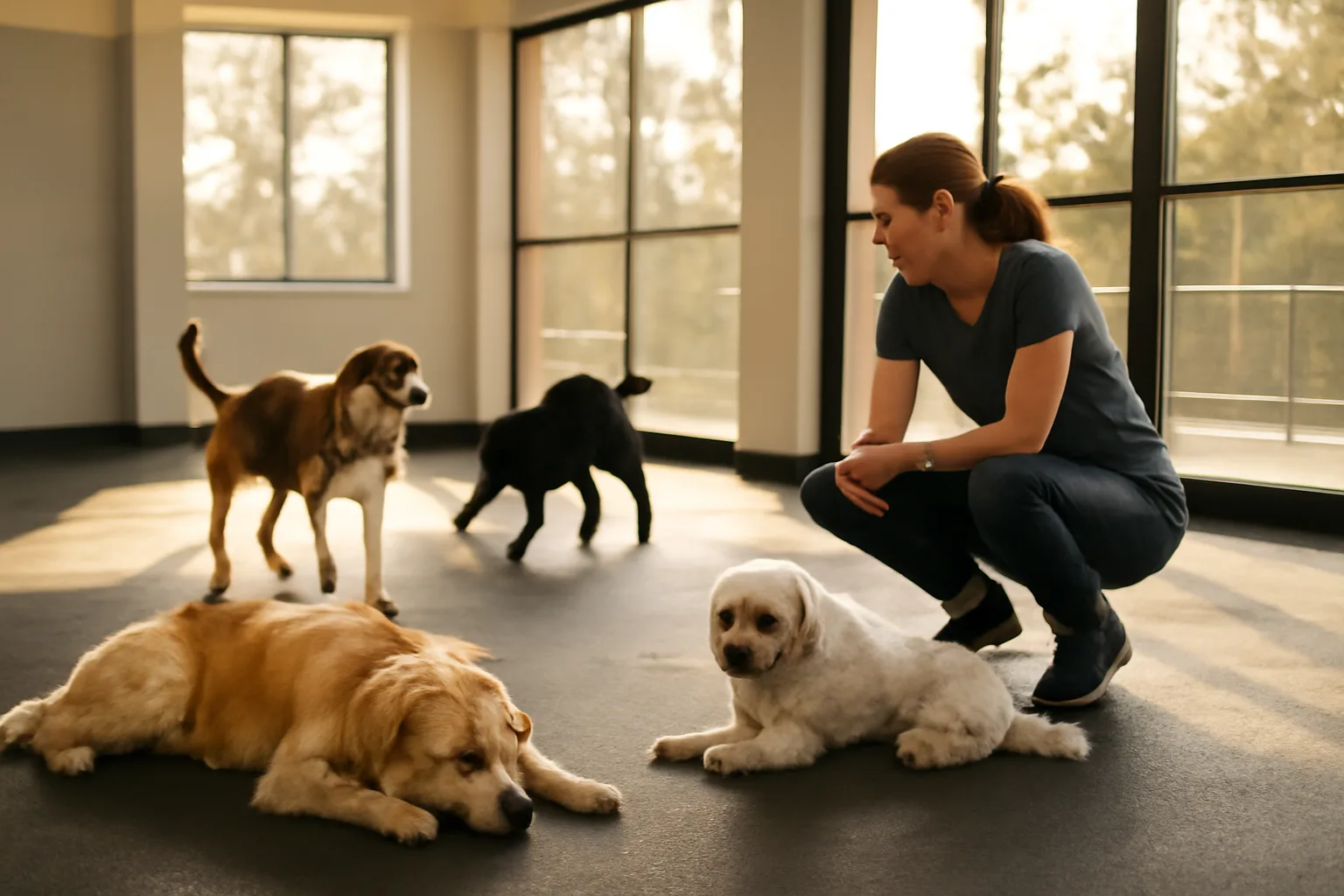
Dogtopia is a national franchise chain that runs dog daycare, boarding, and spa services out of company-branded facilities. Dogtopia Davis is one location in that network, operating in Davis, California, inside Yolo County. Like most Dogtopia locations, it's independently owned by a local franchisee but built to the parent company's facility layout and operating standards, open-play daycare rooms grouped by dog size and temperament, webcams for owners to check in, and add-on services like bathing and nail trims. The franchise model matters for anyone comparing Dogtopia Davis to a mom-and-pop kennel down the street. A franchisee pays Dogtopia Inc. an initial franchise fee and ongoing royalties, and in exchange gets a built-out playbook: staff training curricula, safety protocols, marketing support, and a recognizable brand. That's a different animal than a single-owner boarding operation building its own systems from scratch. If you're a reader comparing dogtopia as a franchise brand against independent dog boarding or pet boarding businesses, the licensing and zoning burden is the same either way. Franchise or not, the facility still has to satisfy the City of Davis and Yolo County that it meets local animal facility and business rules. For exact current hours, services, and Davis-specific pricing at this location, the franchise's own location page is the only reliable source, since Dogtopia sets local pricing at the franchisee level and it changes over time.
How much does dog boarding cost
Dog boarding costs generally range from $25 to $85 a night depending on region, facility type, and whether the dog needs a private suite versus a shared kennel run. Luxury pet hotels and suite-style boarding (the kind Dogtopia-style facilities lean toward) commonly land in the $45 to $75 a night range, while basic kennel boarding at a vet clinic or budget kennel can run $25 to $40 a night. Several cost drivers show up again and again in the industry: dog size (many facilities charge more per pound tier), add-ons (grooming, extra playtime, medication administration), and season (holiday weeks routinely book at premium rates or with minimum-stay requirements). Daycare, which is priced separately from overnight boarding, typically runs $25 to $50 a day at national chains, with multi-day packages bringing the per-day rate down. There's no federal price-setting body for pet boarding costs. These ranges come from aggregated industry reporting rather than a single government source. Treat them as planning ballpark, not quotes. The only way to get a real number for Dogtopia Davis specifically is to call the location or check their current online booking rates, since franchise locations set their own local pricing based on market rates in Davis and greater Sacramento.
How much is dog boarding at a franchise like Dogtopia versus an independent kennel
| Budget/basic kennel | $25-$40 | Kennel run, scheduled potty breaks, basic feeding | |
|---|---|---|---|
| Mid-range boarding | $40-$60 | Shared or semi-private space, some playtime | |
| Franchise/luxury suite (Dogtopia-style) | $45-$75 | Open-play daycare access, suite lodging, webcams | |
| Add-on daycare (any tier) | $25-$50/day | Supervised group or private play | These are national ranges assembled from common industry pricing reports, not a single dataset, so treat the table as a planning tool. If you're shopping dog hotels near me or comparing dog kennels against a chain like Dogtopia, call three or four local operators and ask for their current nightly and daycare rates before you assume any number here applies to Davis specifically. |
Franchise boarding (Dogtopia and comparable brands) tends to price at the higher end of the market, often 10 to 30 percent above an independent kennel in the same metro area. That's because franchise overhead includes royalty fees, national marketing contributions, and brand-standard buildouts (climate control, rubberized flooring, webcam systems). Independent kennels without those costs can sometimes charge less, but service level and facility quality vary a lot more locality to locality. Here's a rough comparison based on typical industry pricing patterns, not Davis-specific data: | Boarding type | Typical nightly rate | What's usually included |
How does a facility like Dogtopia Davis get licensed and zoned in the first place
Any pet boarding or daycare business physically located in Davis, California needs two separate layers of approval before it opens: a City of Davis business license and, in most cases, a zoning clearance or conditional use permit confirming the property is zoned for a kennel or animal care use. The City of Davis issues business licenses through its Finance Department, and commercial animal facilities are also subject to the city's zoning code, which controls where kennels, dog daycares, and boarding operations can locate (commercial and light industrial zones typically allow it; residential zones usually don't without a conditional use permit). Beyond the city, Yolo County's environmental health and planning departments may weigh in too, especially if the facility handles animal waste disposal, water usage, or is located in unincorporated county land rather than inside Davis city limits. California doesn't have a single statewide kennel license the way some states do; instead, oversight is split between local business licensing, local zoning, and state-level rules that apply mainly to breeders and larger-scale animal facilities. This is the part that trips up a lot of first-time operators, franchise or independent. Getting the interior fit-out right (drainage, ventilation, noise control) is only half the job. You also have to prove to a zoning board or planning staff that the specific parcel is legally allowed to host a kennel-type use, and that can mean a public hearing, notice to neighbors, and conditions attached to the permit (hours of operation, outdoor exercise area limits, noise mitigation). A $149 Kennel License & Zoning Packet can help you organize the paperwork and checklist before you walk into that hearing, but it doesn't replace hiring a local land-use attorney if your parcel is contested or your zoning district is ambiguous.
How do you register a dog and how is that different from licensing a facility
Registering a dog means enrolling your individual pet with a local government (usually a city or county) so animal control has a record of ownership, vaccination status, and contact information. This is completely separate from licensing a boarding or daycare business. A facility license lets a business operate. A dog registration (often just called a "dog license") tracks an individual pet. In California, most cities and counties require dog owners to register their dog annually or every three years, and proof of current rabies vaccination is almost always required before the license is issued [1]. Yolo County and the City of Davis both run their own dog licensing programs, typically administered through animal services or the county's public health/animal control division, and fees are usually lower for spayed/neutered dogs than for intact dogs. If you're running a boarding or daycare facility, you'll want every boarded dog to already have current registration and rabies proof from its owner, both because it's often legally required by your local jurisdiction and because it protects your business if a dog bites another animal or a person while on your property.
How to get a dog license (the individual pet license, not a business license)
Getting a dog license is a local government process, not a state or federal one in most of the country. You typically go to your city or county's animal services office (or its online portal), provide proof of current rabies vaccination, pay a fee, and get a tag or certificate that's valid for one to three years depending on the jurisdiction. Most California counties model their dog licensing ordinances on the state's public health code, which authorizes counties to require rabies vaccination as a condition of licensing dogs [1]. Fees vary widely: some counties charge under $20 a year for a spayed/neutered dog, others charge $50 or more for an intact dog, with senior or low-income discounts common. Because Davis is in Yolo County, dog owners there register through the relevant county or city animal services program rather than through any statewide licensing office, since California doesn't run a single centralized dog license system. If your rabies vaccination has lapsed, most animal control offices won't issue or renew the license until it's current. Building in time for a vet visit before your renewal deadline saves a scramble later.
How do you get papers for a dog, and what does "papers" actually mean
"Papers" almost always means AKC registration papers or a comparable purebred registry document, not a government-issued license. Getting papers for a dog means registering it with a breed registry like the American Kennel Club, which requires that the dog's parents were themselves registered and that the litter was reported through the registry's litter registration process. If you bought a purebred puppy from a breeder, the breeder should provide either the completed AKC registration application at time of sale, or in some cases the dog is already registered and you're just transferring ownership on the AKC's system. If you already own a dog with no known registered lineage, you generally cannot retroactively get full AKC papers, since registration depends on documented parentage, not a DNA test or physical inspection alone. The AKC does offer a Purebred Alternative Listing / Indefinite Listing Privilege (PAL/ILP) program for dogs that appear purebred but lack documented lineage, letting them compete in some AKC events without full registration. So if someone asks "how do I get papers for my dog" after already owning an adult dog of unclear pedigree, the honest answer is usually: you can't get full breed registration papers retroactively, but you may be able to get a PAL number if the dog is single-breed in appearance, and you can always get government-issued proof of ownership and vaccination through your local dog license instead. Those are two very different documents solving two very different problems.
How to become a dog breeder (and where the USDA threshold kicks in)
Becoming a dog breeder starts at the state and local level (business licensing, zoning for a kennel use, and often a state kennel or breeder license depending on how many litters or dogs you keep) and only becomes a federal USDA matter once you cross specific sales thresholds. The U.S. Department of Agriculture, through its Animal and Plant Health Inspection Service (APHIS), requires a federal license under the Animal Welfare Act for anyone who sells dogs at wholesale (meaning sales to a pet store, broker, or research facility, or sales sight-unseen to the buyer), as codified in the Act's licensing provisions at 7 U.S.C. 2133 and the implementing regulations at 9 CFR Part 2 [2]. Under the Animal Welfare Act regulations, the retail pet store exemption is tied to breeding females. As defined at 9 CFR 1.1, a "retail pet store" exclusion generally does not apply to a person who maintains more than four breeding females and sells any puppies sight-unseen (online, through a broker, or otherwise not in person); APHIS evaluates licensing status case by case, and the regulatory text is more nuanced than a single bright-line number [3]. Selling puppies entirely face-to-face, where the buyer physically meets the puppy and the breeding female before purchase, generally keeps a breeder under the retail exemption regardless of volume. Before any federal question comes up, though, most new breeders need to deal with local zoning (is a kennel use allowed on your property, and how many adult dogs can you keep before you need a kennel license) and state-level breeder or kennel licensing, which California and many states run through their Department of Food and Agriculture or a dedicated animal welfare division. If you're planning to expand into higher-volume breeding, cross-check both your county zoning allowance and the APHIS licensing determination worksheet before you take a single deposit on a litter.
How do you register a dog you're breeding or a litter you've produced
Registering a litter is a breed-registry process, separate again from government dog licensing. If you're breeding AKC-registered parents, you (the breeder) file a litter registration application with the AKC, listing both parents' registration numbers, the whelping date, and the number of puppies born; the AKC then issues individual registration applications for each puppy, which the breeder passes to buyers at the time of sale. If you're a commercial-volume breeder who meets USDA's licensing threshold (see above), you also have separate federal recordkeeping obligations under the Animal Welfare Act regulations at 9 CFR Part 2, Subpart D, including maintaining records on each dog's identification, acquisition, and disposition, independent of whatever breed registry paperwork you're also handling [2]. These are parallel systems: AKC litter registration proves pedigree to a buyer, while APHIS licensing and inspection exists to enforce animal welfare standards for the dogs' housing, veterinary care, and handling. Don't confuse either of these with the buyer's obligation to register the individual adult dog with local animal control once they take the puppy home. That's a third, unrelated registration step that happens at the city or county level, tied to rabies vaccination and local ordinance, not breed pedigree or federal commercial licensing.
What should a Davis-area operator check before opening (a practical pre-hearing checklist)
Before you sign a lease or submit a permit application for a boarding or daycare facility anywhere in Davis or unincorporated Yolo County, work through this in order: 1. Confirm the zoning district for the specific parcel and whether kennel/animal daycare uses are permitted outright or require a conditional use permit, by contacting Davis Community Development or Yolo County Planning directly. 2. Check whether the City of Davis or Yolo County caps the number of dogs allowed on-site without a kennel license, since many jurisdictions define "kennel" starting at a specific dog count (commonly four or more adult dogs, though the exact number is set locally). 3. Get the City of Davis business license application requirements and fee schedule from the Finance Department, and ask whether a home occupation permit is even eligible if you were considering running anything out of a residential property (usually not, for boarding). 4. Ask Yolo County Environmental Health whether your waste disposal, water, and drainage plan needs separate sign-off, especially if you're building or renovating a structure. 5. If you'll ever sell puppies wholesale or sight-unseen, run the APHIS licensing determination worksheet now, before you're locked into a facility layout that doesn't support the required space-per-dog and sanitation standards under the Animal Welfare Act regulations [2]. This is exactly the kind of multi-agency checklist that trips up new operators. No single office tells you everything you need. You have to ask the city, the county, and potentially the state and USDA all separately. A Kennel License & Zoning Packet is built to walk through that checklist in order so you're not discovering a missing county sign-off two weeks before your planned opening date, though it's a document-organizing tool, not a substitute for a local land-use attorney if your hearing gets contested.
Dogtopia Davis compared to other daycare and boarding options in the area
When you're comparing Dogtopia Davis against independent daycares or boarding kennels in Davis and greater Sacramento, the honest differences usually come down to consistency versus price. Franchise locations like Dogtopia run a standardized daily schedule (specific playgroup rotations, camera monitoring, standardized staff training), which some owners pay a premium for because it's predictable across any Dogtopia location nationwide if they travel. Independent operators, including many doggy day care businesses and smaller dog kennels, can offer more flexible scheduling, sometimes lower prices, and often more direct owner access to whoever is actually handling the dogs day to day, since there's no multi-layer franchise structure between you and the person running daily operations. Neither model is inherently safer or better regulated. Both are subject to the exact same Davis zoning and business license requirements, and neither California nor Yolo County runs a facility-quality rating system that would let you compare them on paper. The practical move if you're a pet owner choosing between them: ask both facility types for their current staff-to-dog ratio, their vaccination requirements for admission, and whether they'll let you tour the play areas unannounced. A well-run independent kennel and a well-run Dogtopia location should both say yes to a tour request without hesitation.
Frequently asked questions
How much does dog boarding cost at a typical facility?
Nationally, boarding runs about $25 to $85 a night depending on facility type, with budget kennels near $25-$40 and luxury suite-style boarding (the style Dogtopia-type franchises offer) closer to $45-$75. Daycare is billed separately and usually costs $25 to $50 a day. These are industry-wide ranges, not government-set prices, so always confirm current rates directly with the specific facility.
How much is dog boarding at Dogtopia specifically?
Dogtopia sets pricing at the individual franchise location level, so Dogtopia Davis may price differently than a Dogtopia in another state. Franchise boarding nationally tends to run in the $45-$75 a night range, but the only accurate number for Davis is what the local franchisee currently lists on their booking page or quotes by phone.
How do I register a dog in Davis, California?
Contact Yolo County or City of Davis animal services, provide proof of current rabies vaccination, and pay the applicable fee to get your dog's local license. This is separate from breed registry papers and separate from any business licensing a boarding facility needs. Fees and renewal periods (often 1-3 years) vary by jurisdiction, so confirm current numbers with the local office.
How do you get papers for a dog you already own?
If your dog has no documented registered parentage, you generally cannot get full AKC registration papers retroactively, since registration is based on verified lineage, not a physical exam. The AKC's PAL/ILP program can give purebred-appearing dogs a listing number for some events without full registration. A government dog license is a different document entirely and doesn't require any breed proof.
How do you get papers for a puppy from a breeder?
The breeder should give you either a completed AKC (or comparable registry) application at the time of sale, or handle an ownership transfer if the puppy is already registered. This requires the litter to have been registered by the breeder first, listing both AKC-registered parents. Always confirm registration status before paying a deposit, since it can't be added after the fact if parentage wasn't documented.
How do I become a dog breeder legally?
Start with your state and local requirements: zoning approval for keeping breeding dogs, any state kennel or breeder license (many states run this through the Department of Agriculture), and business licensing. Federal USDA/APHIS licensing under the Animal Welfare Act only applies once you sell wholesale or sight-unseen above the retail exemption thresholds; check APHIS's own licensing guidance before you assume you do or don't need one.
How to get a dog license and what does it cost?
Visit your city or county animal services office or its website, show proof of current rabies vaccination, and pay the license fee, which commonly runs under $20 a year for spayed/neutered dogs in many California counties and more for intact dogs. Renewal periods run one to three years depending on local ordinance. This has nothing to do with breed registry papers.
Does a Dogtopia franchise need a different license than an independent kennel?
No. Zoning approval and business licensing requirements apply to the physical facility and its use, not to whether it's a franchise or independently owned. Dogtopia Davis has to satisfy the same City of Davis zoning and business license rules, plus any Yolo County requirements, that an independent boarding or daycare business would face at the same address.
What's the USDA threshold that requires a breeder to get a federal license?
Under the Animal Welfare Act's retail pet store exemption, breeders who sell puppies wholesale or sight-unseen (not meeting the buyer and puppy in person) generally need a USDA/APHIS license, with more than four breeding females commonly cited as a trigger point, though APHIS makes case-by-case determinations rather than applying one single bright line. Face-to-face retail sales usually stay exempt regardless of volume.
Is a dog license the same thing as AKC registration papers?
No, they're unrelated systems. A dog license is a local government record proving rabies vaccination and ownership, renewed annually or every few years through city or county animal services. AKC registration papers document verified purebred lineage through a private breed registry and have nothing to do with local government licensing or rabies compliance.
How much does it cost to open a dog boarding or daycare business in Davis?
There's no single published startup number, since it depends on lease costs, buildout requirements, business license fees, and any zoning/conditional use permit costs, all of which vary by specific property and are set by the City of Davis, Yolo County, or the property landlord. Contact Davis Community Development and Yolo County Planning directly for current fee schedules before budgeting.
Can I run a dog daycare out of my house in Davis?
Most residential zones don't permit kennel or commercial animal daycare use even under home occupation rules, because of noise, animal-count limits, and public health concerns tied to multiple non-resident dogs on a residential lot. Confirm with City of Davis Community Development or Yolo County Planning before assuming a home-based model will get approved; a conditional use permit is sometimes possible but not guaranteed.
Sources
- California Health and Safety Code Section 121690 (rabies control): California law authorizes local jurisdictions to require rabies vaccination as part of dog licensing
- 9 CFR Part 2, Subpart D (Animal Welfare Act regulations, recordkeeping requirements): Getting AKC papers for a puppy requires the breeder to register the litter based on documented registered parentage; commercial breeders have separate federal recordkeeping duties
- 9 CFR 1.1, Definitions (Animal Welfare Act regulations, "retail pet store"): Dogs without documented lineage fall outside AKC full registration; separately, the retail pet store definition in federal regulation governs which breeders need a USDA license
- 7 U.S.C. 2133, Licensing of dealers and exhibitors (Animal Welfare Act): USDA APHIS requires a federal license under the Animal Welfare Act for breeders who sell dogs wholesale or otherwise fall outside the retail pet store exemption, and imposes recordkeeping requirements on licensees
- City of Davis, Business License Information (Finance Department): The City of Davis issues business licenses through its Finance Department for commercial operations including animal care facilities
- Yolo County Planning and Public Works Department: Yolo County planning and environmental health departments have jurisdiction over land use and facility compliance for unincorporated county parcels