Last updated 2026-07-24
TL;DR
Dogtopia Evanston is a franchise daycare/boarding location; daily rates for daycare and boarding generally fall in the $35-$45 range depending on package, consistent with national Dogtopia pricing patterns. This article uses it as a case study to explain how any Illinois operator gets licensed, zoned, and inspected, plus how dog owners register a dog, get a license, or get papers for a dog.
What does Dogtopia Evanston actually offer, and what does it cost?
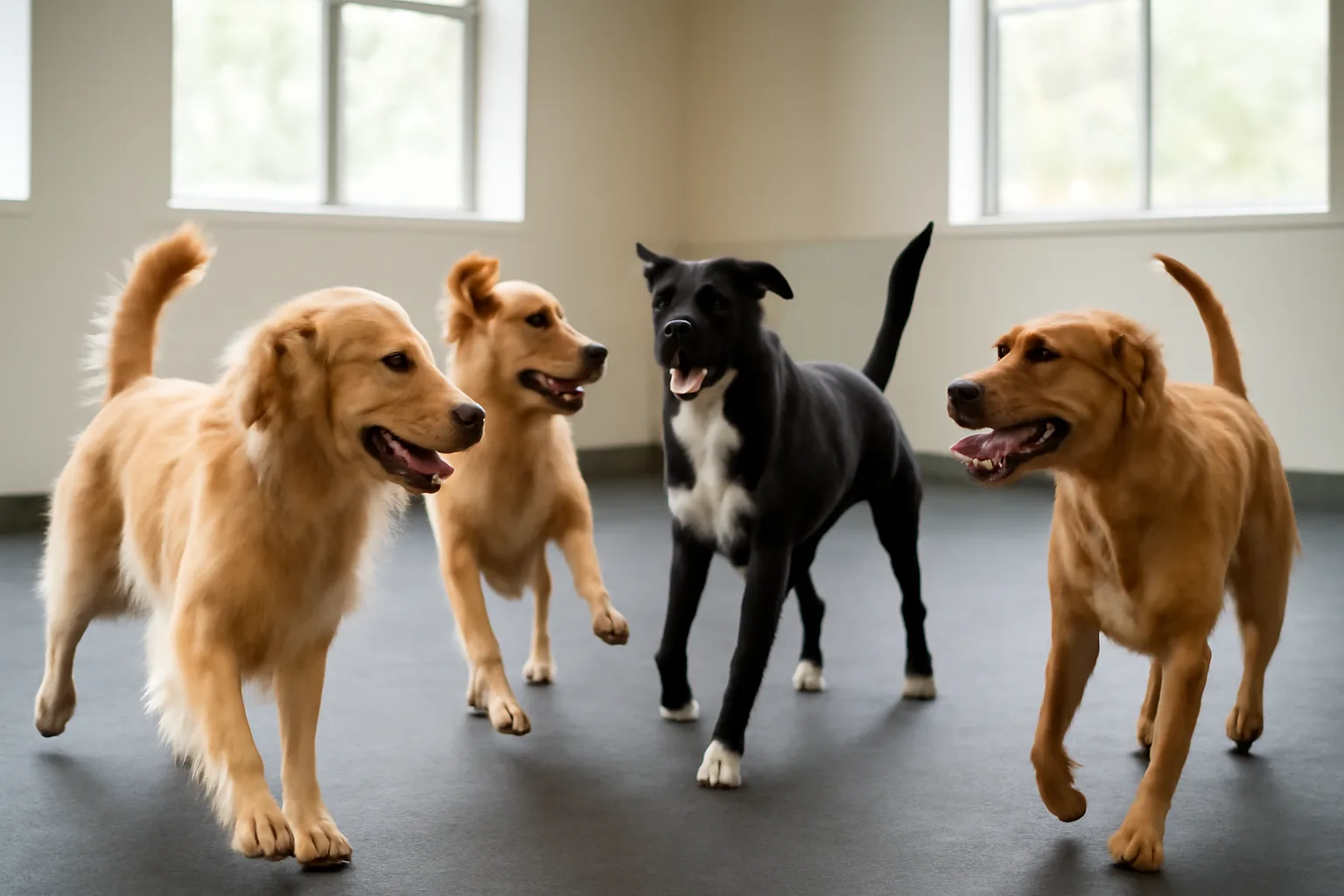
Dogtopia is a national franchise chain built around open-play daycare, boarding, and spa services for dogs. The Evanston location, like other Dogtopia franchises, runs group daycare in a supervised playroom setting rather than individual runs, with overnight boarding built around the same daycare-based model (dogs board in the same play areas they daycare in, supervised overnight by staff). Pricing varies by location because franchises set their own local rates, but Dogtopia's published national patterns put single-day daycare in the neighborhood of $35 to $45, with volume packages (10-day, 20-day, monthly unlimited) bringing the per-day cost down meaningfully. Boarding tends to run close to daycare pricing plus a modest overnight add-on, since the model bundles playtime into the stay. If you want the exact current Evanston rate sheet, call the location directly or check the franchise's location page. We're not going to guess a number down to the dollar here because franchise pricing changes and location-specific promotions move it around. For context on what boarding costs across the industry more broadly (more than Dogtopia), see the dog boarding and pet boarding breakdowns, which cover regional price ranges and what drives the spread between a basic kennel and a daycare-style facility.
How much does dog boarding cost, generally?
Dog boarding costs in the US typically range from about $25 a night at a basic kennel to $75-$100+ a night at daycare-style or luxury facilities in major metro areas. Chains like Dogtopia sit toward the middle-to-upper end of that range because the model includes supervised group play, more than a crate and a walk. A few things move the price a lot: geography (Chicago-area suburbs like Evanston cost more than rural downstate Illinois), whether the facility is franchise-branded versus independent, and whether boarding includes daycare play or is overnight-only. Add-ons like grooming, extra walks, medication administration, and specialty diets usually add $5-$20 per service per day. There's no single national government price survey for pet boarding (this is a private-market service, not something USDA or state agriculture departments track), so the honest answer is: get 3-4 local quotes, because the range genuinely is that wide even within one metro area.
How do dog boarding and daycare facilities like Dogtopia get licensed in Illinois?
Illinois regulates kennels, pet shops, groomers, and boarding facilities under the Animal Welfare Act (510 ILCS 5), administered by the Illinois Department of Agriculture. Under the Act, anyone operating a boarding kennel, dog daycare, or similar facility generally needs a state license before opening, and the license must be renewed annually [1]. The Illinois Department of Agriculture's Bureau of Animal Health and Welfare issues these licenses and can inspect facilities for compliance with state animal welfare rules covering housing, sanitation, and care standards [1]. Beyond the state license, a facility in Evanston also needs to satisfy City of Evanston business licensing and zoning rules, since municipalities layer their own requirements on top of state law. If you're opening a facility anywhere in Illinois, expect three separate approval tracks running in parallel: state animal welfare license, county or municipal zoning approval, and local business licensing/health permits. Missing any one of them can delay your opening even if the other two are done.
How does zoning work for a facility like this in Evanston or Cook County?
Zoning is usually the slowest part of opening a boarding or daycare facility, slower than the state license in most cases. Evanston's zoning ordinance assigns animal-related uses (kennels, pet daycare, veterinary clinics) to specific zoning districts, and many commercial districts require a special use permit or conditional use approval rather than allowing the use "by right." That means before you sign a lease, you need to confirm the property's zoning district and whether pet daycare/boarding is a permitted use, a special use, or not allowed at all in that district. Evanston's zoning code, Title 6 of the Evanston City Code, and the zoning administrator's office (part of the city's Community Development Department) is the authoritative source for that district-by-district breakdown; check the specific zoning map and text for the parcel before committing to a location [2]. If the property sits in unincorporated Cook County rather than inside Evanston's city limits, Cook County's own zoning ordinance and the Cook County Department of Planning and Development would govern instead. Always confirm which jurisdiction actually controls the parcel; city and county boundaries in the Chicago area don't always match what a real estate listing implies. For operators comparing zoning hurdles across markets, our dog kennels piece walks through how zoning categories differ from town to town and what a special-use hearing typically requires in terms of notice, neighbor comment, and site plan review.
How do you register a dog in Evanston or Cook County?
Registering a dog in most Illinois municipalities means two things: a rabies vaccination on file with a licensed veterinarian, and a dog license issued by the city or county based on that rabies certificate. Evanston, like many Illinois municipalities, requires dog owners to obtain a city dog license annually or biennially, tied to proof of current rabies vaccination. Cook County also runs its own animal control program (Cook County Animal and Rabies Control) under the Cook County Rabies Control Ordinance, covering owners in unincorporated areas and participating municipalities, generally requiring proof of rabies vaccination [3]. Illinois state law separately requires every dog owner to have their animal vaccinated against rabies; the Animal Control Act (510 ILCS 5) sets that baseline statewide requirement that county rabies control programs then administer locally [3]. If Evanston runs its own municipal licensing program independently of the county's, you'd register with the city instead; check with Evanston's city clerk or animal control division to confirm which authority covers your address. In practice: get the rabies shot from your vet, get the certificate, bring it (or the vet's record) to whichever office issues licenses for your address, pay the fee, and you'll get a tag. Keep the tag on the collar; it's often how animal control identifies a lost dog and gets it home fast.
How do you get a dog license?
Getting a dog license requires proof of current rabies vaccination, then submitting that proof along with a fee to your city, township, or county's licensing office, whichever level of government runs licensing where you live. Requirements and fees vary by jurisdiction, so there's no single national fee to quote. Most jurisdictions offer online license renewal now, plus mail-in and in-person options at animal control offices, county clerk offices, or city halls. Spayed/neutered dogs almost always get a lower license fee than intact dogs, and many counties add a late fee or lapsed-license penalty if you don't renew before the rabies certificate expires. Illinois' Animal Control Act (510 ILCS 5) requires counties to operate a rabies control program and gives counties authority to set local registration rules on top of the state's rabies vaccination mandate [3]. If you're not sure who issues licenses at your address, your veterinarian's office almost always knows the local answer, since they fill out rabies certificates for this exact purpose daily.
How do you get papers for a dog, and how is that different from a license?
"Papers" almost always means breed registration paperwork (like AKC registration), not a government license. A dog license from your city or county proves rabies vaccination and lets animal control identify and return a lost dog; breed registry papers are a private, non-governmental record of pedigree and lineage used for breed clubs, showing, and proving a dog's parentage for breeding purposes. To get AKC papers for a dog, the litter typically needs to come from two AKC-registered parents, and the breeder registers the litter with the American Kennel Club, then transfers individual puppy registration to buyers. If your dog's parents weren't registered, you generally can't retroactively get full AKC papers; some registries offer alternative or limited registration paths for dogs of unknown or mixed lineage, but that's not the same as full pedigree registration. If you're asking "how can I get papers for my dog" after already owning the dog, the honest answer depends entirely on whether the breeder registered the litter at the time of the sale. Contact the breeder first; if they registered the litter with AKC or another registry, they can usually help you complete the transfer even after the fact. If they never registered it, there typically isn't a path to full papers after the fact, only to license and health records through your vet and municipality.
How do you become a dog breeder, and when do federal rules apply?
Becoming a dog breeder legally starts with state and local rules, not federal ones, for most small-scale breeders. Illinois requires an Animal Welfare Act license for anyone operating as a breeder above certain thresholds (definitions and thresholds are set in the Act and its rules), and many counties add their own kennel or breeder permit requirements on top of the state license [1]. Federal rules kick in through USDA APHIS once you cross specific thresholds. Under the federal Animal Welfare Act regulations at 9 CFR Part 1, a breeder who sells dogs directly to the public sight-unseen (i.e., without the buyer physically inspecting the animal or its housing before purchase, such as online or through a broker) generally needs a USDA license as a "dealer"; the regulatory definition of "retail pet store" at 9 CFR 1.1 draws the line between retail sales that are exempt and sight-unseen sales that trigger licensing [4]. Breeders who sell exclusively face-to-face, regardless of litter volume, are generally exempt from USDA licensing under that retail pet store exemption, though state and local rules still apply regardless of that federal exemption [4]. The Animal Welfare Act itself, at 7 U.S.C. 2133, directs the Secretary of Agriculture to "issue licenses to dealers and exhibitors upon application therefor in such form and manner as he may prescribe" [4]. APHIS's licensing determination hinges heavily on whether sales happen sight-unseen or face-to-face, plus how many breeding females you keep. If you're crossing from hobby breeding into commercial volume, or you're planning to sell online or ship puppies interstate, check APHIS's licensing criteria before you scale up, because retroactive compliance after a complaint or inspection is a much rougher process than applying correctly from the start.
What does a USDA APHIS inspection actually check for breeders?
USDA APHIS inspects licensed breeders against the Animal Welfare Act's minimum standards covering housing, space, sanitation, veterinary care, and recordkeeping, with the specific space and care requirements set out in 9 CFR Part 3, Subpart A [5]. Inspectors check things like enclosure size relative to the dog's size, temperature control, cleanliness of housing, food and water access, and whether the facility has a working veterinary care plan on file. 9 CFR 3.6 specifically requires that housing facilities for dogs be "structurally sound" and maintained "in good repair, to protect the animals from injury, to contain the animals, and to restrict other animals from entering" [5]. Repeated or serious non-compliance can lead to license suspension, civil penalties, or revocation, which is a meaningfully bigger consequence than a state-level citation in most cases, since it can end a breeder's ability to sell dogs across state lines entirely. For operators building out a facility from scratch, whether that's a breeding operation or a boarding/daycare business, our facility standards resources and the pet boarding guide both cover the housing, sanitation, and staffing benchmarks that state and federal inspectors actually check against.
What's the real difference between opening a Dogtopia franchise and an independent boarding facility?
A Dogtopia franchise gives you a built brand, a proven daycare-based operating model, and corporate support for things like point-of-sale systems and marketing, in exchange for franchise fees and ongoing royalties (franchise agreements typically run in the tens of thousands for the initial fee plus a percentage of gross revenue in ongoing royalties; exact figures come from Dogtopia's Franchise Disclosure Document, not public without requesting it directly). What a franchise does not skip is any of the state licensing, zoning, or inspection steps covered above. Franchise or independent, you still need the Illinois Animal Welfare Act license, the local zoning approval, and city business licensing. Corporate franchise support sometimes helps navigate that process because they've done it in dozens of cities already, but it doesn't substitute for it. If you're comparing the two paths, our dogtopia overview and doggy day care guide both dig into the operating model differences (open-play group daycare versus individual-run boarding) that drive facility design and staffing ratios, which in turn drive what your local zoning and health inspectors will actually be looking at during a site visit.
What should I actually do first if I'm opening a boarding or daycare facility near Evanston?
Start with zoning, not the state license. Confirm the parcel's zoning district and whether pet daycare/boarding is permitted, a special use, or prohibited, before you sign a lease or make an offer on a property. A property that looks perfect but sits in the wrong zoning district can cost you months in a special-use hearing, or kill the deal outright. Once zoning is confirmed (or you're in a hearing process for a special use permit), apply for the Illinois Animal Welfare Act license through the Department of Agriculture in parallel, since that application and inspection can run concurrently with zoning approval in many cases [1]. Layer in your city business license and any county health permits last, since those typically depend on having the zoning and state license nailed down first. This is exactly the kind of multi-agency paperwork problem that's easy to get wrong on a first pass, wrong form, wrong office, missing attachment, and it costs you weeks each time. That's the gap our $149 one-time license packet builder is built to close: it walks you through the state license application and a zoning-hearing prep packet tailored to your state and county, so you're not guessing which office wants which document first. It doesn't replace legal advice or represent you before a zoning board, but it gets your paperwork organized before you walk in.
Comparison: state license vs. zoning approval vs. dog license (don't confuse these)
| Requirement | Who issues it | What it covers | Applies to | |
|---|---|---|---|---|
| State Animal Welfare Act license | Illinois Department of Agriculture | Facility care standards, housing, sanitation for kennels/boarding/breeding [1] | Boarding, daycare, breeding operators | |
| Zoning approval / special use permit | City or county zoning office (Evanston Community Development, or Cook County Planning and Development) | Whether the use is allowed at that specific property/district [2] | Boarding, daycare, breeding facilities | |
| USDA APHIS license | USDA Animal and Plant Health Inspection Service | Federal minimum care standards for commercial dealers selling sight-unseen [4][5] | Breeders crossing federal sight-unseen sales thresholds | |
| Dog license (pet registration) | City clerk, township, or county animal control (e.g., Cook County Animal and Rabies Control) | Rabies vaccination proof, lost-pet identification [3] | Individual pet owners | |
| AKC/breed registry papers | American Kennel Club or other private registry | Pedigree and lineage record for showing/breeding | Breeders and buyers of purebred litters | These five things get confused constantly because they all involve "paperwork about a dog," but they come from five different authorities with five different purposes. Mixing them up (assuming your AKC papers satisfy a state license requirement, for example) is a common and avoidable mistake. |
Frequently asked questions
How much does dog boarding cost at a place like Dogtopia?
Dogtopia's daycare and boarding rates generally fall around $35-$45 per day depending on location and package, with multi-day packages lowering the per-day cost. Boarding usually runs close to daycare pricing plus a modest overnight fee, since Dogtopia's model bundles supervised group play into the overnight stay. Exact current Evanston pricing should be confirmed directly with the location.
How much is dog boarding nationally, outside of Dogtopia specifically?
Nationally, dog boarding ranges from roughly $25 a night at basic kennels to $75-$100+ a night at premium or daycare-style urban facilities. There's no government price survey for this private-market service, so get 3-4 local quotes; the spread within a single metro area is often larger than people expect.
How do I register a dog in Evanston?
Get a current rabies vaccination certificate from your vet, then bring it to whichever office issues licenses for your address, either the City of Evanston or Cook County Animal and Rabies Control depending on jurisdiction. Illinois' Animal Control Act requires the underlying rabies vaccination statewide, and the county or city then handles registration and fees on top of that [2].
How do I get a dog license?
Get proof of current rabies vaccination from your veterinarian, then submit it with the required fee to your city, township, or county licensing office. Most jurisdictions now offer online renewal. Spayed/neutered dogs typically get a discounted fee, and license periods are usually tied to how long the rabies vaccination remains valid.
How do I get papers for a dog?
"Papers" usually means breed registry documents like AKC registration, which come from the breeder at the time of a litter's registration, not from a government office. If the litter's parents were AKC-registered and the breeder registered the litter, papers transfer to you at purchase. If they weren't registered at the time, there's generally no retroactive path to full papers.
How can I get papers for my dog after I already bought it?
Contact the original breeder first. If they registered the litter with AKC or another registry at the time of birth, they can typically help complete a late ownership transfer. If the litter was never registered, there's usually no way to get full pedigree papers after the fact, only vaccination and municipal license records through your vet and local government.
How do you become a dog breeder legally?
Start with your state's animal welfare or agriculture department, since most states (including Illinois) require a kennel or breeder license above certain thresholds [1]. Check county zoning too. Federal USDA APHIS licensing only applies once you cross specific thresholds, generally tied to selling dogs sight-unseen rather than face-to-face [3].
When does a breeder need a USDA license instead of just a state one?
USDA APHIS licensing generally applies to breeders who sell dogs sight-unseen, meaning the buyer never sees the animal or its housing in person before purchase, such as online sales or broker sales. Breeders who sell exclusively face-to-face are typically exempt federally under the retail pet store exemption defined at 9 CFR 1.1, though state and local licensing still applies regardless [3].
Is a dog license the same thing as AKC papers?
No. A dog license is a government requirement proving rabies vaccination, issued by your city or county, mainly used to identify and return lost pets. AKC papers are a private pedigree registration from the American Kennel Club proving a dog's lineage, used for breeding and showing. They come from completely different authorities and serve different purposes.
What zoning district allows a dog daycare or boarding facility in Evanston?
That depends entirely on the specific parcel; Evanston's zoning ordinance assigns animal-related uses to certain districts, sometimes as a permitted use and sometimes requiring a special use permit. Confirm with Evanston's Community Development Department (or Cook County Planning and Development if the property sits in unincorporated county land) before signing a lease [5].
Do I need both a state license and a local business license to open a boarding facility?
Yes, in almost every state. You typically need a state Animal Welfare Act (or equivalent) license from the state agriculture department, a zoning approval or special use permit from the local zoning office, and a general business license from the city or county. Missing any one of the three commonly delays an opening even after the others are approved.
How long does it take to get zoning approval for a pet daycare or boarding facility?
It varies widely by jurisdiction and whether a special use permit hearing is required. A permitted-use property might clear zoning review in a few weeks; a special use permit requiring a public hearing and neighbor notice can take a few months. Check with the specific zoning office early, before signing a lease, to avoid costly delays.
Sources
- Illinois Animal Welfare Act, 510 ILCS 5: Illinois requires an Animal Welfare Act license for kennels, boarding facilities, and breeders, renewed annually and enforced through state inspection
- Illinois Animal Control Act, 510 ILCS 5: Illinois requires rabies vaccination statewide, and counties operate rabies control and registration programs on top of that requirement, with Cook County Animal and Rabies Control administering it locally
- Animal Welfare Act, 7 U.S.C. 2133 (licensing of dealers and exhibitors): USDA APHIS licenses dealers who sell dogs sight-unseen and exempts retail sellers who sell exclusively face-to-face under the retail pet store definition
- Animal Welfare regulations, 9 CFR 3.6 (indoor housing facilities for dogs): Federal regulations require dog housing facilities to be structurally sound and in good repair, a standard APHIS inspectors check during facility inspections
- City of Evanston Code of Ordinances, Title 6 (Zoning): Evanston's zoning ordinance assigns animal-related uses like kennels and pet daycare to specific districts, often requiring special use approval rather than allowing the use by right
- Cook County Code of Ordinances, Chapter 10 (Animal Control): Cook County operates its own animal control and rabies control ordinance covering unincorporated areas and participating municipalities, requiring proof of rabies vaccination