Last updated 2026-07-25
TL;DR
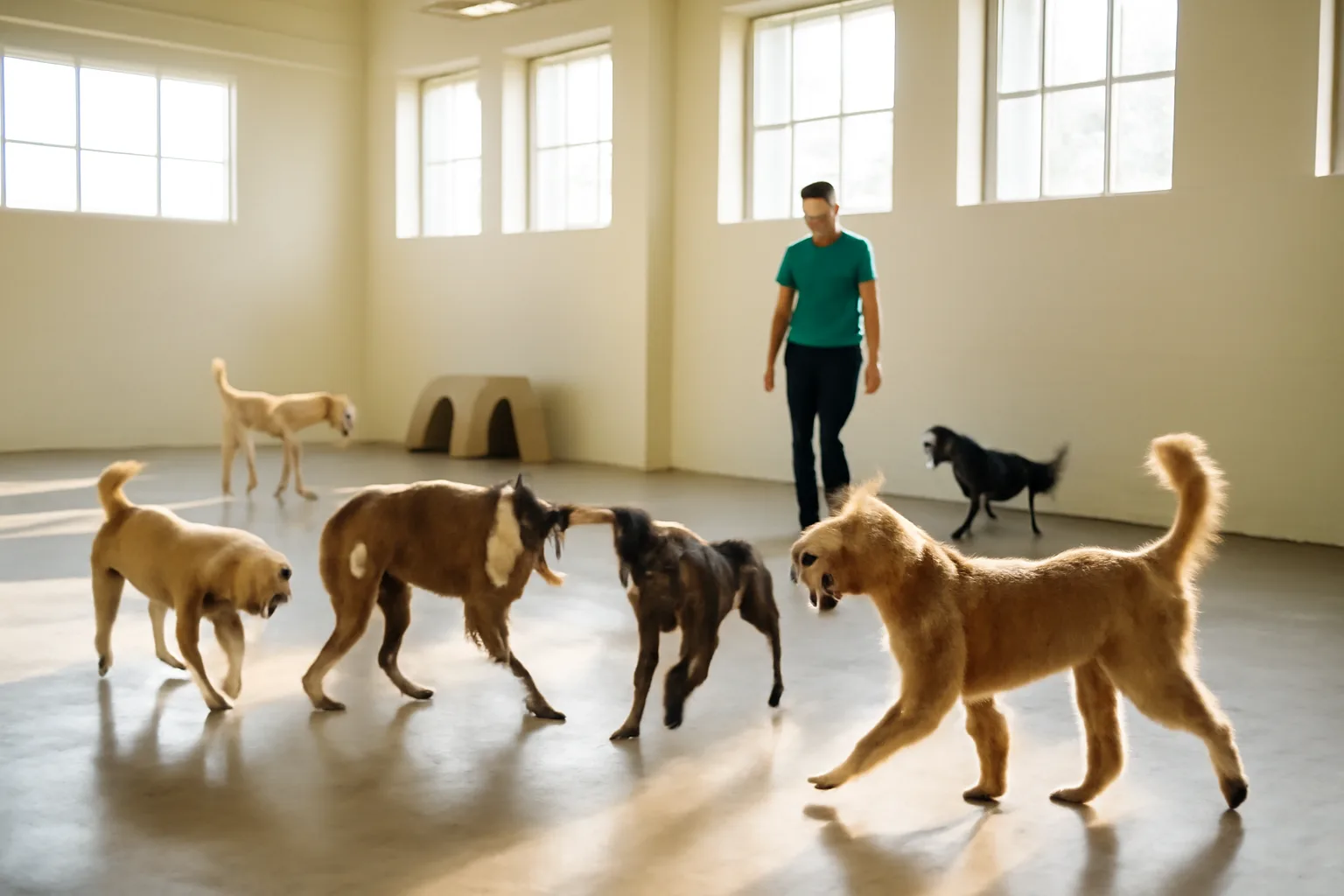
Dogtopia Worcester is a franchised dog daycare and boarding facility in Worcester, Massachusetts. Boarding at daycare chains like Dogtopia typically runs $40 to $75+ per night depending on location and add-ons, daycare runs $25 to $45 a day. Dog licensing is a separate city/town requirement in Massachusetts, done through your local clerk, not through any boarding facility.
What is Dogtopia Worcester and what services does it offer?
Dogtopia is a national franchise chain of dog daycare centers, and the Worcester, Massachusetts location operates under that same franchise model: open-play daycare, boarding, and spa services (baths, nail trims). Like most Dogtopia locations, it requires a temperament evaluation before a dog is admitted to group play, and it typically requires proof of vaccination (rabies, DHPP, bordetella) before enrollment. This article isn't a review of that specific business. It's a reference for two groups of readers who land on searches like this one: pet owners trying to figure out what boarding actually costs and what paperwork their dog needs, and operators who are themselves trying to open or expand a boarding/daycare facility and want to understand licensing, zoning, and the USDA line that turns a hobby breeder into a regulated business. If you're the second kind of reader, the dogtopia hub page on this site covers franchise-style facility standards in more depth, and dog boarding covers licensing basics state by state.
How much does dog boarding cost?
Dog boarding at a commercial daycare/boarding facility (the Dogtopia model, and similar chains like Camp Bow Wow) generally runs $40 to $75+ per night in most U.S. metro areas, with rates varying by region, room type (suite vs. shared), and add-ons like extra playtime or medication administration. Boarding at a traditional kennel without daycare-style play tends to run cheaper, often $25 to $45 a night. In-home boarding through sitter marketplaces (Rover, Wag) often lands in a similar $30 to $60 range but varies enormously by city. Daycare (day use, no overnight stay) is usually $25 to $45 per day at franchise-style facilities, often discounted with multi-day packages (a 10-day pack might knock 10-20% off the per-day rate). None of these numbers are set by any government agency; they're market rates set by each business. If you want an exact quote for a specific location, call the facility directly, since rates change with holidays, staffing, and local demand. The one government-adjacent number worth knowing: USDA's Animal Welfare Act licensing structure applies to breeders and dealers, not to what a daycare or boarding facility charges customers [1]. See pet boarding and dog hotels near me for cost breakdowns by facility type.
How do you register a dog, and how is that different from a license?
"Registering" a dog usually means one of three different things, and people mix them up constantly: municipal dog licensing (a legal requirement), breed registry paperwork (AKC or similar, not legally required), and microchip registration (a database lookup tool, also not legally required but strongly recommended). Only the first one, municipal licensing, is a legal obligation almost everywhere in the U.S. Massachusetts law, for example, requires every dog owner to license their dog annually with the city or town clerk once the dog is six months old, and requires proof of current rabies vaccination to get that license [2]. Worcester's city clerk handles this locally; check the current fee and renewal deadline with the clerk's office directly, since municipalities set and change these fees on their own schedule, not the state. Breed registry paperwork (AKC, UKC) is a private organization's pedigree record, not a government requirement. Microchip registration is just making sure the chip number in a lost-and-found database points to your current contact information. None of these three things substitute for each other, and a boarding facility will typically ask about vaccination records, not registry papers, before accepting your dog.
How do you get a dog license?
Getting a dog license is a local government process, done through your city or town clerk (sometimes the county), not through a vet, a breeder, or a boarding facility. The typical steps: get your dog's rabies vaccination current, bring proof of that vaccination (and often a spay/neuter certificate, since many towns charge less for altered dogs) to the clerk's office, pay the annual fee, and get a tag. Massachusetts General Laws Chapter 140, Section 137 sets the statewide framework requiring dog licensing and rabies vaccination proof as a condition of licensing [2]. Fees vary town to town: some charge under $10 for an altered dog and $15-20 for an unaltered one, others charge more, and a few municipalities charge substantially higher fees for unaltered dogs specifically to encourage spay/neuter. Worcester residents should confirm the current fee schedule with the City Clerk's office directly rather than relying on any third-party number, since these fees change. Most states have some version of this requirement, though the details (age at first license, fee, whether it's annual or one-time) vary by state and even by county within a state. If you're moving or traveling with a dog across state lines, note that dog licensing is separate from any interstate/USDA paperwork; see the USDA section below for when that actually applies.
How do you get papers for a dog, and what does that actually mean?
"Getting papers" for a dog almost always means one of two things: AKC (or other registry) breed registration, or a health/vaccination record for boarding, travel, or vet purposes. Neither is a legal requirement to own a dog. If you got a purebred dog from a breeder who is themselves AKC-registered, the breeder typically provides an AKC registration application at the time of sale (often called a "blue slip" or now handled digitally), which you then submit to AKC with a fee to register the dog in your name. If your dog didn't come with those papers (common with rescues, mixed breeds, or breeders who don't register litters), you generally cannot get retroactive AKC papers for a dog with unknown or undocumented parentage; AKC registration depends on the litter being registered by the breeder, not on the dog's appearance or a DNA test alone [3]. If what you actually need is a health record for boarding, air travel, or interstate transport, that's a vet-issued Certificate of Veterinary Inspection (CVI), not registry papers. Interstate transport of animals regulated under USDA rules, and most airlines, require a CVI, typically issued within 10 days of travel, confirming the animal is healthy and current on required vaccines [4]. This is the paperwork boarding facilities and airlines actually check, not a pedigree certificate.
How to become a dog breeder: what's actually required?
Becoming a dog breeder has no single federal license for small-scale, direct-to-buyer sales. The main legal trigger is scale and sales channel, not the act of breeding itself. Under the federal Animal Welfare Act, USDA APHIS requires a license for breeders who sell dogs sight unseen (online, through a broker, or otherwise without the buyer physically seeing the animal and its living conditions before purchase) and who exceed certain thresholds. The regulatory definitions governing who counts as a "dealer" requiring a license, and the retail pet store exemption, are set out in 9 CFR Part 1 [1]. Breeders who sell exclusively through in-person, face-to-face transactions where the buyer meets the dog before purchase are generally exempt from federal licensing regardless of how many breeding females they keep, under that retail pet store exemption [1]. Beyond the federal threshold, most states and many counties layer on their own requirements: a state kennel or breeder license once you exceed a certain number of adult dogs or litters per year, a local zoning permit if you're running a commercial kennel from residential-zoned property, and sometimes a separate state health/inspection requirement for anyone selling puppies commercially. These vary enormously. A breeder in one state might trigger a state license at 3 litters a year; another state might use a headcount threshold instead. There's no shortcut around checking your specific state department of agriculture's breeder rules and your county zoning office before you sell your first litter. Practically, here's the sequence that avoids problems: confirm your county zoning allows a kennel/breeding operation at your address (this trips up more first-time breeders than any other single issue), get your state's breeder or kennel license if you exceed that state's threshold, and check the USDA sight-unseen threshold if you plan to sell online or ship puppies. If you're already scaling past a hobby operation, our license-packet-builder tool walks through the state and county documents you'll likely need to gather before a zoning hearing or license application; it's a $149 one-time packet, not a guarantee of approval, and it doesn't replace a lawyer or local zoning consultant.
What is the USDA threshold for dog breeders, and when does it actually apply?
The USDA license threshold applies specifically to breeders selling dogs sight unseen (wholesale, online, through pet stores, or via a broker), not to breeders who sell in person. This is the single most misunderstood rule in the breeding world, so it's worth stating plainly. The retail pet store exemption in 9 CFR Part 1 excludes breeders who sell animals only at retail, in person, where the buyer can see the animal before purchase, from the licensing requirement, regardless of how many dogs they keep, because Congress carved that transaction type out of the Animal Welfare Act's licensing scheme [1]. Once a breeder sells even one litter sight unseen, whether through a website, a broker, or shipped without the buyer meeting the dog first, and they keep more than four breeding females, federal licensing generally kicks in. Licensed breeders face facility inspection standards under 9 CFR Part 3, covering things like enclosure size, temperature control, sanitation, and veterinary care, enforced through APHIS inspections [5]. These are real, detailed federal standards, not vague guidance, and failing an inspection can suspend a license. One more wrinkle: even breeders exempt from USDA licensing because they sell in person are not automatically exempt from state or county rules. States can and do regulate at lower thresholds than the federal government. Check both.
How much does dog daycare cost compared to boarding?
| Daycare, drop-in | $25-$45/day | Franchise chains like Dogtopia, Camp Bow Wow | |
|---|---|---|---|
| Daycare, package (10-20 days) | $20-$38/day | 10-20% discount common | |
| Boarding, traditional kennel | $25-$45/night | No group play, basic care | |
| Boarding, daycare-style suite | $40-$75+/night | Includes play, sometimes webcam access | |
| In-home/sitter boarding | $30-$60/night | Varies heavily by city, via Rover/Wag-style marketplaces | These figures reflect general U.S. market ranges, not a specific published survey; actual rates depend heavily on city, facility type, and add-ons (grooming, medication administration, extra play sessions). There's no federal or state agency that tracks or regulates these consumer prices, so treat any number you see online, including these, as a starting point for comparison shopping, not a quote. |
Daycare (dropping a dog off for the day, no overnight stay) generally costs less per visit than overnight boarding, but the per-day math often favors regular daycare packages over drop-in rates. | Service type | Typical price range | Notes |
How do you get papers for my dog if it didn't come with any?
If your dog didn't come with registry papers at the time you got it, in most cases you cannot retroactively obtain AKC (or similar) papers, because registration depends on the breeder having registered the litter, not on the dog's breed appearance or a DNA test. AKC does offer a Purebred Alternative Listing (PAL) program for dogs that appear purebred but lack papers, which allows the dog to compete in some AKC events (agility, obedience) without full registration status, but PAL is not the same as full pedigree registration and doesn't establish breeding rights or verified lineage [3]. If what you actually need isn't a pedigree but proof of health status for boarding, travel, or a new landlord, that's a much simpler fix: a current vaccination record from your vet, and if you're crossing state lines, a Certificate of Veterinary Inspection [4]. Most boarding facilities, including Dogtopia locations, ask for proof of rabies, DHPP, and bordetella vaccination, not breed papers, before they'll accept a dog into their program. Keep that folder of vet records current; it's the paperwork you'll actually be asked for at check-in.
What should operators know before opening a Dogtopia-style facility?
If you're on the operator side of this question, thinking about opening a franchise or independent boarding/daycare business, the real work isn't picking a location, it's clearing three separate regulatory layers before you sign a lease: county zoning, state licensing (varies by state, some states license kennels/boarding facilities directly, others leave it to counties), and, if breeding is part of the business, the USDA threshold discussed above. Zoning is usually the first wall people hit. Commercial kennels, boarding facilities, and daycare operations are frequently restricted to specific zoning districts (commercial or agricultural, rarely residential) and often require a conditional use permit or special exception even in commercial zones, because of noise and animal-density concerns from neighbors. Check with your specific county or city zoning office before signing any lease; a location that looks perfect can be a zoning dead end. State-level facility standards vary too: some states set specific square-footage-per-dog requirements, ventilation standards, or staff-to-dog ratios for licensed kennels, others defer entirely to local ordinance. There's no substitute for pulling your specific state's regulations, and our dog kennels and doggy day care pages break down what to look for state by state. For gathering the actual documents (zoning applications, state license forms, inspection checklists) before a hearing, the license-packet-builder tool is built for exactly that prep work, not for representing you before a board.
What vaccination and health records does a boarding facility require?
Most commercial boarding and daycare facilities require proof of rabies vaccination, DHPP (distemper, hepatitis, parvovirus, parainfluenza), and bordetella (kennel cough) vaccination, and many require a negative fecal test or flea/tick prevention proof as well. These are business policies set by each facility, not government mandates, though rabies vaccination itself is legally required in nearly every U.S. state and is the trigger for getting a dog license, as noted above [2]. Bordetella in particular is worth understanding: it's not always legally required, but it's close to universal as a facility policy because kennel cough spreads fast in group-play and shared-air environments. Ask any facility, including Dogtopia locations, for their specific vaccine and timing requirements (some want bordetella boosters every 6 months rather than annually) before you book, since policies differ by location even within the same franchise.
How do state and county rules differ from what a boarding facility requires?
Dog licensing, breeder registration, and USDA thresholds are government requirements with legal penalties for skipping them. Vaccination requirements at a specific boarding facility are private business policy, even though they often overlap with what's legally required (rabies vaccination, for instance, is both a facility requirement and a legal one in most states). The practical takeaway: don't assume that passing a boarding facility's check-in requirements means you've met your legal obligations, and don't assume that having a state kennel license means a specific boarding facility will accept your dog without its own additional paperwork. They're two separate checklists that happen to overlap on vaccines.
Frequently asked questions
How much does dog boarding cost?
Boarding at daycare-style facilities like Dogtopia typically runs $40 to $75+ per night depending on city, suite type, and add-ons. Traditional kennels without group play often run cheaper, $25 to $45 a night. In-home sitter boarding varies by city, roughly $30 to $60 a night. Always confirm current pricing directly with the facility, since rates shift with season and location.
How do you register a dog with the city or town?
Bring proof of current rabies vaccination to your city or town clerk's office, pay the annual license fee, and you'll receive a dog tag. Massachusetts law (M.G.L. c. 140, §137) requires this annually once a dog turns six months old; fees are set locally, so check with your specific clerk's office for the current amount.
How much is dog boarding at a franchise like Dogtopia?
Franchise daycare/boarding rates generally fall between $40 and $75+ per night, varying by location, room type, and services added (extra play, medication, grooming). Call the specific location for a current quote, since franchise locations set their own local pricing rather than a single national rate.
How do you get a dog papers?
If it means AKC registration, papers come from the breeder at time of sale if the breeder registered the litter; you can't typically get them retroactively without that. If it means health records for boarding or travel, that's a vet-issued vaccination record or Certificate of Veterinary Inspection, not a registry document.
How do you get papers for my dog if the breeder never gave me any?
In most cases you cannot get full AKC registration retroactively, since it requires the original breeder to have registered the litter. AKC's Purebred Alternative Listing (PAL) program lets purebred-looking dogs without papers compete in some events, but it's not full pedigree registration and doesn't establish verified lineage.
How to become a dog breeder legally?
Check your county zoning allows a kennel or breeding operation at your address, check your state's breeder/kennel license threshold (varies by state), and check whether you'll exceed the USDA's sight-unseen sales threshold (more than 4 breeding females selling online or shipped, per 9 CFR). Face-to-face sellers are generally USDA-exempt but not automatically state-exempt.
How to get a dog license?
Get your dog's rabies vaccination current, bring proof to your city or town clerk's office (sometimes county), pay the annual fee, and receive a tag. Requirements and fees are set locally in most states; Massachusetts requires this by state law (M.G.L. c. 140, §137) once a dog reaches six months old.
How to get papers for a dog bought without registration?
If the litter was never registered with AKC or a similar registry by the breeder, there's usually no retroactive path to full papers. Some registries offer alternative listing programs (like AKC PAL) for event participation without full pedigree status. For non-breed purposes, a vet health record serves most practical needs instead.
How can I get papers for my dog for interstate travel?
For travel, you need a Certificate of Veterinary Inspection (CVI) from a licensed vet, usually issued within 10 days of travel, not breed registry papers. Airlines and USDA-regulated interstate commercial transport typically require this document to confirm the dog is healthy and currently vaccinated.
What is the USDA threshold that requires a breeder license?
Under the Animal Welfare Act, breeders who sell puppies sight unseen (online, shipped, through a broker) and keep more than four breeding female dogs generally need a USDA Class A license. Breeders selling only face-to-face, where buyers see the dog before purchase, are generally exempt regardless of dog count under the retail pet store exemption.
Does a boarding facility check my dog's vaccination papers or breed papers?
Boarding facilities check vaccination records (rabies, DHPP, bordetella), not breed registry papers. This is a business policy set by each facility to protect other boarded dogs from disease, separate from any legal licensing requirement for dog ownership.
How much does dog daycare cost per day versus boarding per night?
Daycare drop-in rates typically run $25 to $45 per day, often discounted to $20-$38/day with multi-visit packages. Overnight boarding at daycare-style facilities runs higher, $40 to $75+ per night, since it includes overnight staffing and lodging on top of daytime play.
Sources
- USDA APHIS, Animal Welfare Act regulations, definitions and licensing scope (9 CFR Part 1): USDA regulates breeder/dealer licensing under the Animal Welfare Act, not consumer boarding prices
- Massachusetts General Laws Chapter 140, Section 137: Massachusetts requires annual dog licensing with proof of rabies vaccination
- American Kennel Club, Purebred Alternative Listing (PAL) Program overview: Dogs without registration papers cannot get retroactive full AKC papers but may qualify for PAL
- USDA APHIS, Certificate of Veterinary Inspection requirements, 9 CFR Part 86: Interstate/international travel requires a vet-issued Certificate of Veterinary Inspection, typically within 10 days of travel
- USDA APHIS, Animal Welfare Act regulations, standards for dogs (9 CFR Part 3): Licensed breeders must meet federal facility standards covering enclosure size, sanitation, and veterinary care