Last updated 2026-07-23
TL;DR
A downtown dog resort is a boarding/daycare facility built for dense urban sites, small footprints, ground-floor retail zoning, noise limits. Boarding runs roughly $30-$85/night depending on market. You'll need a business license, a state or county kennel/animal facility permit, and a zoning approval (often a conditional use permit) before you open, not after.
what exactly is a downtown dog resort, and how is it different from a regular kennel
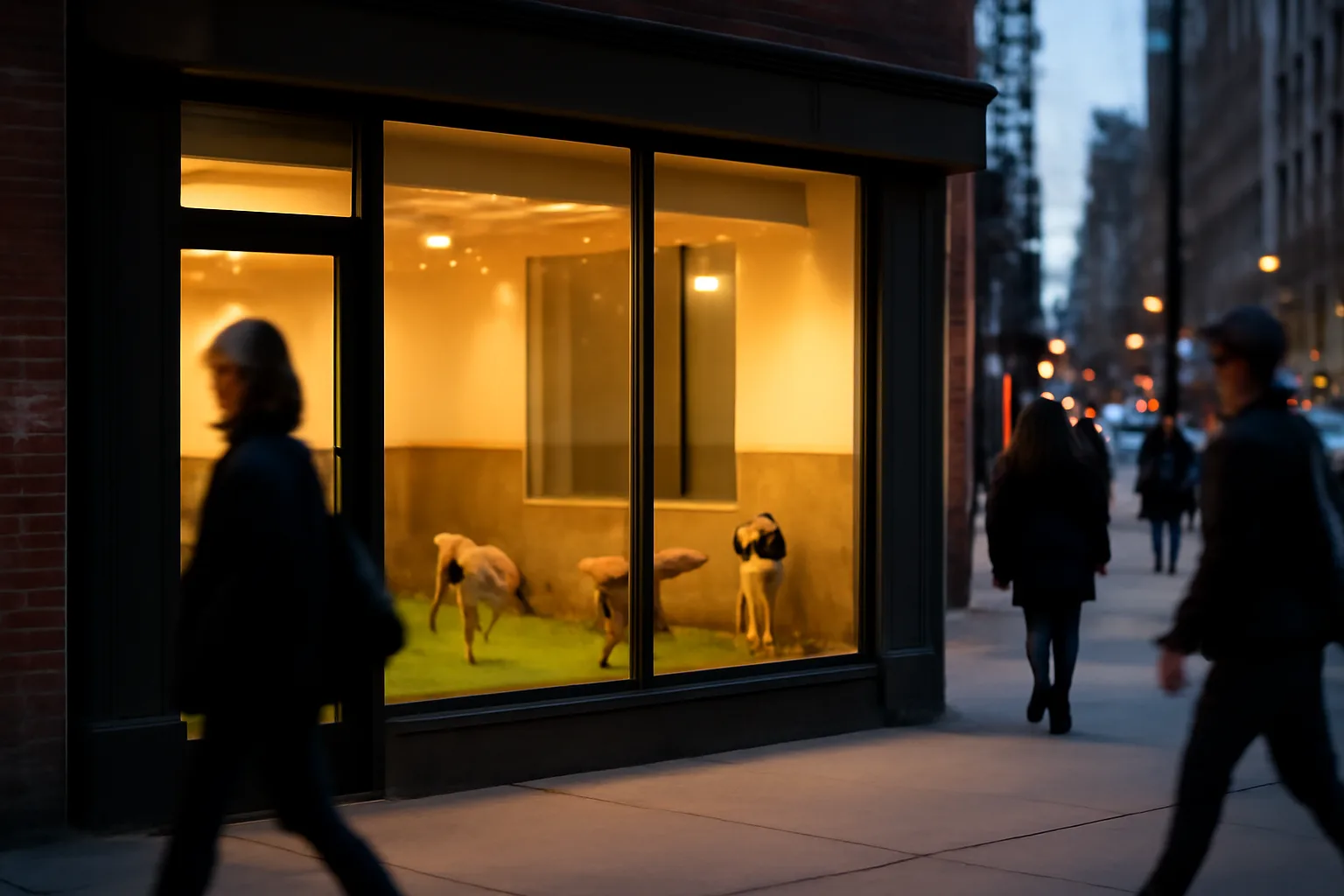
A downtown dog resort is boarding and daycare housed in a dense, mixed-use commercial building instead of a rural kennel with outdoor runs. Think ground-floor retail space, a converted warehouse, or a first floor of a parking garage, with indoor play yards, webcams, and grooming add-ons sold as a lifestyle amenity rather than just a place to drop the dog. The business model is the same as any boarding and daycare operation. What changes is the site. Downtown parcels are usually zoned commercial (C-1, C-2, B-1, whatever your city calls it) or mixed-use, and animal boarding is very often not a permitted-by-right use in those zones. It shows up instead as a conditional use, special exception, or requires a variance, especially once you add overnight boarding, which raises questions about noise, odor, and outdoor relief areas that zoning boards weren't thinking about when they wrote retail rules. That's the core tension of the format: the customer demand is downtown, foot traffic and dual-income professionals with no yard, but the zoning code was written for suburban kennels with acreage. You're not fighting the market. You're fighting a 1970s zoning map. Contact your county zoning office before signing a lease, not after.
how much does dog boarding cost
| Overnight boarding | $30-$50/night | $60-$85+/night | |
|---|---|---|---|
| Daycare (full day) | $25-$40/day | $35-$45/day | |
| Grooming add-on | $15-$50 | $25-$60 | These are market ranges pulled from public boarding/daycare rate surveys and operator pricing pages, not a single federal source; treat them as planning ranges, not guarantees, and check three or four competitors in your actual zip code before you set rates. |
Nightly boarding rates vary a lot by city and by whether the dog gets a private suite, group play, or basic kennel care. National data is thin because most pricing comes from individual operators, not a federal survey, but industry surveys and franchise disclosure documents give a workable range. Expect roughly $30 to $50 a night for standard boarding in a mid-size market, and $60 to $85+ a night in dense urban cores (New York, San Francisco, Chicago, Boston) for suite-style or luxury boarding with webcams, one-on-one playtime, and enrichment add-ons. Daycare runs cheaper, typically $25 to $45 a day, and most downtown resorts sell package bundles (10-day, 20-day passes) at a discount of 10-20% off single-day rates. Add-ons matter more downtown than in suburban kennels because space is expensive and operators need to monetize every square foot. Grooming, nail trims, one-on-one training sessions, and "pupcation" photo/video packages commonly add $15-$60 per stay. If you're modeling a pro forma, don't just multiply nightly rate by kennel count; downtown resorts usually run lower occupancy per square foot than rural kennels because indoor play space eats into revenue-generating kennel footprint, so the real driver is daycare + boarding blended revenue per square foot, not per run. | Service | Typical range (mid-size market) | Typical range (dense urban core) |
what licenses and permits does a downtown dog resort actually need
Layer one is your general business license from the city or county, the same registration any retail storefront needs to operate legally and collect sales tax. Layer two is the animal-specific license, which is where states diverge hard. Some states run kennel licensing through the state department of agriculture, some push it down to the county or city, and some barely regulate boarding at all beyond a basic business license and a local health inspection. There is no single national "dog boarding license." You have to check your specific state department of agriculture page and your county clerk or animal control office. Layer three, and the one most first-time downtown operators underestimate, is zoning. Even if your business license and kennel permit sail through, the city can still say no if the parcel isn't zoned for a kennel or animal boarding use. This is why the order of operations matters: confirm zoning first, get a conditional use permit or variance if needed, then apply for the business and kennel licenses, then sign the lease (or at minimum make the lease contingent on zoning approval). Doing it backward is the single most common and most expensive mistake in this industry: operators sign a five-year commercial lease, then find out at the zoning hearing that boarding isn't allowed on that block.
how do you register a dog
"Registering a dog" usually means one of three different things, and people conflate them constantly: getting a dog license from your city or county, getting the dog's breed papers from a registry like the AKC, or microchip registration. They're unrelated processes. A dog license is a local government requirement, typically annual or multi-year, tied to proof of rabies vaccination. You register at your county clerk, city hall, or county animal control office, pay a fee (commonly $10-$25 for spayed/neutered dogs, sometimes higher for intact dogs), and get a tag. Requirements and fees are set locally, so check your specific county's animal control or clerk page. Breed registration ("papers") is a private club matter, covered below. Microchip registration is with whichever chip company manufactured the chip (HomeAgain, AKC Reunite, etc.) and just links your contact info to the chip number in a database; it has nothing to do with government licensing.
how do you get a dog license
You get a dog license from your city or county government, not the state and not a breed registry. The typical process: bring proof of current rabies vaccination (a certificate from your vet) to the county clerk, county treasurer, or animal control office, pay the licensing fee, and you'll get a tag to put on the collar. Fees and rules vary by jurisdiction, sometimes by city block if you're near a county line. Some counties offer a discount for spayed/neutered dogs and charge more for intact ones; some require renewal annually, others every three years tied to the rabies vaccine cycle. Late fees for unlicensed dogs are common and can run into real money if animal control catches it during a call for something unrelated (a noise complaint, an off-leash incident). If you're running a boarding or daycare facility, this matters two ways: first, make sure your own resident/mascot dogs (if any) are licensed, and second, many jurisdictions require boarding facilities to keep proof of current licensing and rabies vaccination on file for every dog in their care as part of the kennel permit conditions. Check your county animal control page for the specific list.
how do you get papers for a dog, and what does that actually mean
"Papers" means AKC (American Kennel Club) registration or registration with another breed club (UKC, CKC, etc.), and it documents pedigree, not ownership or legality. A mixed-breed dog or a dog without documented parentage simply cannot get AKC papers; there's no application that manufactures a pedigree that doesn't exist. If your dog's parents were both AKC-registered and the breeder registered the litter, you get papers by having the breeder complete an AKC litter registration and then transfer individual puppy registration to you, usually included in the purchase price or handled shortly after the sale. If you own an adult purebred dog without papers (bought from someone who never registered the litter, or a rescue situation), the AKC has a limited path called Purebred Alternative Listing / Indefinite Listing Privilege (PAL/ILP) that lets you compete in some events without full pedigree registration, but it does not create retroactive pedigree papers. There's no way to "get papers" for a dog whose parentage isn't documented. Anyone offering to sell you papers for a dog with unknown or mixed parentage is selling you a worthless piece of paper, and it happens constantly in casual online sales.
how to become a dog breeder (and when USDA licensing kicks in)
Becoming a breeder legally starts at the state and local level, not federal. Most states require a breeder or kennel license once you exceed a certain number of adult dogs or litters per year, and some states have zero breeder-specific licensing beyond general animal welfare law, which is why you have to check your specific state department of agriculture page. Federal law adds another layer through the USDA's Animal Welfare Act, enforced by APHIS (Animal and Plant Health Inspection Service). The trigger that most breeders miss: if you sell puppies sight unseen, meaning the buyer never sees the puppy or the facility in person before purchase (this covers most online and shipped sales), and you have more than four breeding females, you generally need a USDA license as a "retail pet store" under 9 CFR 2.1. The regulation defines this class of dealer and sets the licensing trigger around breeding female count and sight-unseen sales, per the definitions in 9 CFR 1.1 and the licensing requirements in 9 CFR 2.1 [1]. Breeders who sell face-to-face, letting the buyer meet the dog and inspect the premises before the sale, are generally exempt from USDA licensing regardless of how many females they keep, under the retail pet store exemption in the Animal Welfare Act regulations. Getting a USDA license means passing an APHIS inspection covering housing, veterinary care, record-keeping, and space requirements under 9 CFR Part 3, and paying an annual license fee tied to your gross sales tier. This isn't a one-time application; APHIS inspectors do unannounced facility checks, and violations get posted publicly. If you're planning to sell across state lines or ship puppies, budget real time (often months) for the initial inspection and paperwork before you can legally sell that way.
do downtown dog resorts need a USDA license too
Almost never, and this is a common point of confusion. USDA/APHIS licensing under the Animal Welfare Act targets breeders, dealers, exhibitors, and research facilities, not boarding or daycare operations caring for owned pets. A facility that only boards, day-cares, and grooms dogs that customers already own is not regulated by APHIS at all; that's a state/county animal control and business licensing matter, covered in the sections above. The Animal Welfare Act's own statement of purpose, at 7 U.S.C. 2131, describes its scope as regulating the transportation, sale, and handling of animals by dealers, exhibitors, and research facilities, which is why a pure boarding/daycare operation caring only for owned pets falls outside it. The confusion happens because both breeder rules and boarding rules get lumped together as "kennel licensing," but they're legally separate universes: USDA cares about breeding/selling animals across the exemption thresholds, and your state/county cares about care standards for boarding facilities. If your downtown resort also breeds litters on-site and sells sight-unseen above the four-female/$500 threshold, then yes, you'd need both a state kennel license and a USDA license, but that's a dual-business scenario, not the standard boarding/daycare model.
what zoning problems are unique to a downtown location
Noise ordinances hit downtown operators harder than rural ones because neighbors are closer and residential units are often stacked right above or next to commercial space in mixed-use buildings. A conditional use permit for a downtown kennel will almost always come with sound attenuation conditions: acoustic panels, limited outdoor relief hours, or a ban on any outdoor yard entirely. Outdoor relief area is the other big one. Rural kennels have yards. Downtown resorts often have none, meaning dogs relieve themselves on synthetic turf patches indoors or on a rooftop deck, both of which raise odor and drainage questions your local health department will ask about at the hearing. Some cities require a separate rooftop/outdoor amenity permit on top of the kennel license if you're building a rooftop dog run, especially in older buildings not originally engineered for that load or drainage. Parking and loading are a third friction point. Zoning boards reviewing a conditional use application for a downtown site frequently ask about drop-off/pick-up traffic, especially during commute-hour rushes when working owners drop dogs off before work. If your storefront doesn't have dedicated loading, expect a condition requiring a traffic or parking study, which can add weeks and real consulting cost to your approval timeline. Building code is the fourth layer, separate from zoning. Occupancy classification for a kennel with overnight animals is different from retail occupancy, and fire marshals sometimes require sprinkler modifications or a change of occupancy permit before final sign-off, even after zoning approval is granted.
how do you prepare for the zoning hearing itself
Show up with a site plan, more than an idea. Zoning boards want to see where the play yards are, how sound is contained, where waste is stored and how often it's hauled, and how many dogs will be on-site at peak hours. Vague answers at a public hearing are the fastest way to get tabled for a second meeting, which can cost you a month or more of lease payments on a space you can't yet operate in. Read your specific municipal zoning ordinance's definition section before the hearing. Many codes define "kennel" by a specific dog-count threshold (say, four or more dogs not owned by the resident), and a downtown resort boarding a dozen dogs a day will almost certainly trip that definition even if you think of yourself as a "daycare," not a "kennel." Ordinance language, not your business card, decides which use category you fall into. Bring letters or data addressing the concerns boards raise most often: projected noise levels (sometimes requiring an acoustic consultant's estimate), your waste management plan, and hours of operation. Some applicants over-prepare on their business plan and under-prepare on these operational specifics, which is backwards from what the board is actually voting on. If you want a starting framework instead of building every document from scratch, a $149 one-time Kennel License & Zoning Packet walks through the state and county application fields you'll need filled in before a hearing, structured as guided fill-ins rather than guesses, since every jurisdiction's actual forms differ.
how much does it cost to open a downtown dog resort overall
Licensing and permitting costs are usually the smallest line item, typically a few hundred to low thousands of dollars combined for business license, kennel/animal facility permit, and zoning application fees, though some cities charge much more for a conditional use permit application (public notice costs, hearing fees, sometimes $500-$2,000+ just in application fees before you've built anything). Build-out is where downtown format gets expensive fast. Commercial buildout for sound dampening, ventilation upgrades (critical for odor and airborne disease control in a dense space), non-slip flooring, and drainage for wash-down areas commonly runs from $50 to $150+ per square foot depending on the building's existing condition, according to general commercial buildout ranges cited by SBA-affiliated small business resources; a raw shell costs far more to finish than a space with prior pet-service buildout. Don't skip pet insurance and liability coverage in your cost model; downtown facilities boarding higher volumes of dogs in tighter quarters generally carry higher liability premiums than a rural kennel with more physical separation between animals.
how is a downtown resort different from suburban dog boarding or big-box daycare chains
Suburban boarding kennels and rural facilities usually have the advantage of by-right zoning (agricultural or light industrial zones often permit kennels outright) and lower buildout costs per square foot, but they trade that for lower foot traffic and a longer drive for customers. Big-box daycare chains like Dogtopia solve the zoning problem differently: they target strip-mall and light-industrial park locations specifically because those zones already permit commercial kennel/pet-care uses without a conditional use fight, which is part of why the chain model favors those sites over dense downtown storefronts. An independent downtown resort doesn't have that luxury if the market demand and lease economics point toward a dense urban block instead. The practical takeaway: before you fall in love with a downtown storefront, price out the zoning risk against a strip-mall alternative a mile away that's already zoned for pet boarding or a kennel use. Sometimes the downtown foot traffic premium is worth the zoning fight and the higher buildout cost. Sometimes it isn't, and you find that out only after paying for a traffic study you didn't need.
where do you go for the actual rules that apply to you
Every number and rule in this article is a range or a federal baseline, not your specific answer, because licensing and zoning genuinely differ by state, county, and city. Three sources you should check directly before signing a lease or filing anything: your state department of agriculture (for kennel/breeder licensing thresholds), your county or city zoning office (for use classification and conditional use process), and, only if you're breeding and selling above the sight-unseen threshold, the eCFR text of the Animal Welfare Act regulations for federal licensing requirements. If you'd rather not hunt down every state and county form yourself, a Kennel License & Zoning Packet ($149, one-time) gives you a structured starting point built around the actual application fields most jurisdictions ask for, so you're filling in real answers instead of guessing at formats. It's a reference tool, not representation before any board; you'll still file with your actual state and county offices and, if your hearing requires it, appear yourself or hire local counsel. For the surrounding pieces of this decision, see dog kennels for facility-standard basics, doggy day care for the daycare-specific licensing path, and dog hotels near me if you're scoping what competitors in your market already charge and how they're zoned.
Frequently asked questions
How much does dog boarding cost per night?
Roughly $30-$50/night in mid-size markets and $60-$85+/night in dense urban cores like NYC or SF, based on industry rate surveys and operator pricing pages. Suite upgrades, one-on-one play, and grooming add-ons push totals higher. There's no federal price-setting body; rates are purely market-driven, so check three or four local competitors before setting your own.
How do I register a dog with the city?
Bring proof of current rabies vaccination to your county clerk, treasurer, or animal control office, pay the licensing fee (often $10-$25, more for intact dogs), and receive a tag. This is separate from breed registry "papers" and separate from microchip registration; it's strictly a local government requirement tied to rabies compliance.
How do you get papers for a dog?
Papers (AKC or other breed registry documentation) come from the breeder registering the litter and transferring individual registration to you at or after purchase. You cannot retroactively get papers for a dog with undocumented or mixed parentage; no application creates a pedigree that doesn't exist. The AKC's PAL/ILP program allows limited event participation for unregistered purebreds, but it isn't full pedigree registration.
How do you get a dog license?
Visit your county clerk, treasurer, or animal control office with proof of current rabies vaccination and pay the local fee. Renewal cycles (annual or multi-year) and fees vary by county, and many jurisdictions charge less for spayed/neutered dogs. Boarding facilities often must keep current license/vaccination proof on file for every boarded dog under their kennel permit conditions.
How do I become a dog breeder legally?
Start with your state department of agriculture to check breeder/kennel licensing thresholds, since rules vary widely by state. Federally, if you keep more than four breeding females and sell any puppies sight unseen (including online sales), APHIS generally requires a USDA license under the Animal Welfare Act. Face-to-face sellers are typically exempt regardless of female count.
Do dog boarding and daycare facilities need a USDA license?
No. USDA/APHIS licensing under the Animal Welfare Act covers breeders, dealers, exhibitors, and research facilities, not boarding or daycare businesses caring for dogs their owners already own. Boarding and daycare licensing runs through your state department of agriculture or county/city animal control and business licensing instead.
What zoning classification do dog boarding facilities need in a downtown area?
It depends entirely on your city's zoning code, but downtown commercial and mixed-use zones frequently require a conditional use permit or special exception for animal boarding rather than allowing it by right. Check your specific municipal zoning ordinance's definition of "kennel" and its permitted-use table before signing a lease.
How much does a kennel or breeder license cost?
State and county kennel license fees vary widely, commonly ranging from under $50 to several hundred dollars depending on dog count and jurisdiction, with no single national fee schedule. USDA licenses add an annual fee tied to your gross sales tier once you cross the federal breeding/sales threshold. Check your state department of agriculture for exact current fees.
Can I get papers for a mixed-breed or rescue dog?
No. AKC and other breed registry "papers" document verified pedigree from registered parents; a mixed-breed or undocumented-parentage dog cannot receive full registration papers under any process. Some registries offer limited listing programs (like AKC's PAL) for event participation, but these don't create pedigree papers retroactively.
What's the difference between a dog license and breed registration papers?
A dog license is a local government requirement proving rabies vaccination compliance, obtained from your county or city, typically renewed annually. Breed papers are a private club document (AKC, UKC, etc.) proving pedigree, obtained through the breeder at time of sale. They serve completely different purposes and neither substitutes for the other.
How many breeding dogs can I have before I need a USDA license?
APHIS generally requires a USDA license once you have more than four breeding females and sell any puppies sight unseen (including internet sales) in a given year, per 9 CFR Part 2. Breeders who sell face-to-face, letting buyers see the puppy and premises before purchase, are typically exempt from this threshold under the retail pet store exemption.
Why is zoning harder for a downtown dog daycare than a suburban one?
Downtown parcels are usually zoned commercial or mixed-use, where animal boarding often isn't a by-right use, and dense neighboring units make noise, odor, and outdoor relief area issues harder to resolve. Suburban and light-industrial zones more often permit kennels outright, which is one reason chain daycares favor strip-mall locations over downtown storefronts.
Sources
- eCFR, Title 9 Part 2, Subpart A, Section 2.1 - Requirements and application (Animal Welfare Act licensing): Breeders with more than four breeding females who sell sight unseen (including internet sales) generally need a USDA license
- eCFR, Title 9 Part 3, Subpart A - Specifications for the Humane Handling, Care, Treatment, and Transportation of Dogs: Facility housing and care standards for licensed breeders fall under 9 CFR Part 3
- eCFR, Title 9 Part 1, Section 1.1 - Definitions: Retail pet store exemption and breeding female / sight-unseen sale thresholds are defined in 9 CFR Part 1 and Part 2
- American Kennel Club, PAL (Purebred Alternative Listing) Program overview: PAL/ILP allows limited event participation for unregistered purebred dogs without creating retroactive pedigree papers
- Animal Welfare Act, 7 U.S.C. 2131 - Congressional statement of policy: The Animal Welfare Act's stated scope covers dealers, exhibitors, and research facilities, not pure boarding/daycare of owned pets
- USDA APHIS, Animal Welfare Act licensing and registration overview: APHIS guidance on which breeders and dealers need a license, including the sight-unseen sales trigger