Last updated 2026-07-24
TL;DR
Dogtopia Bethesda is a franchised daycare and boarding facility in Montgomery County, Maryland; daycare typically runs $35-50/day and boarding roughly $50-75/night at Dogtopia locations nationally, though exact pricing is location-specific and changes. Montgomery County requires a dog license (about $10-20/year) separate from any facility's own paperwork, and anyone breeding or boarding commercially needs to check county zoning and, above certain sale thresholds, USDA APHIS licensing.
What is Dogtopia Bethesda and what does it offer?
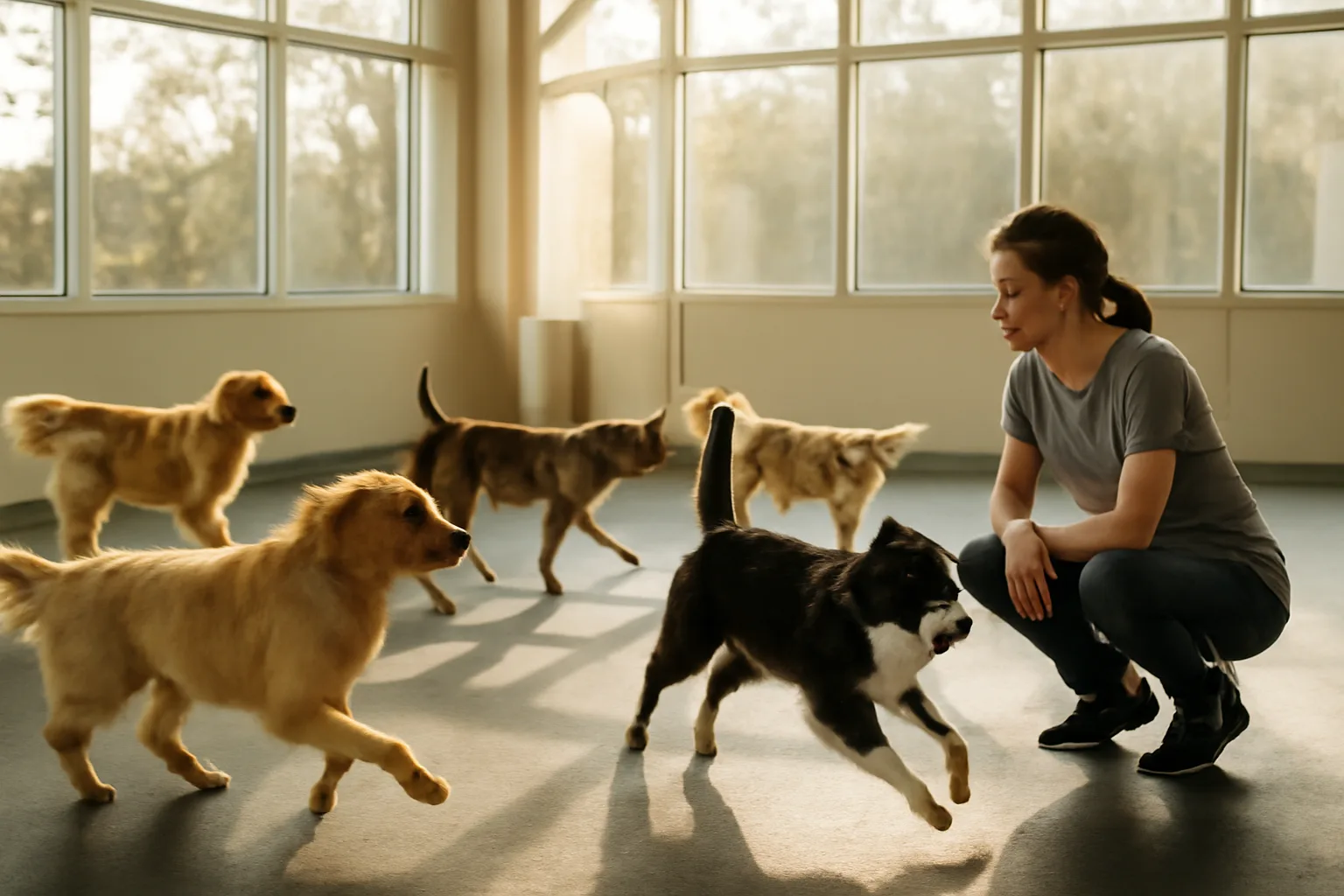
Dogtopia Bethesda is a location of the Dogtopia franchise chain, which operates dog daycare, boarding, and spa services at hundreds of sites across the US and Canada. Like other Dogtopia locations, the Bethesda facility (in Montgomery County, Maryland) generally offers open-play daycare, overnight boarding, grooming add-ons, and sometimes training services. Franchise locations vary in exact hours, pricing, and play-group structure, so the specific policies at the Bethesda site can differ from a Dogtopia in another state. If you're evaluating it as a customer, call the location directly or check its page on the Dogtopia corporate site for current rates and evaluation requirements. If you're evaluating it as a competitor or a prospective operator studying the market, the more useful exercise is understanding what it takes, licensing-wise, to run a comparable dog boarding or doggy day care business in Montgomery County or wherever you're located. Most Dogtopia locations require a temperament evaluation (sometimes called a 'meet and greet') before a dog can join daycare or boarding groups. This is standard across the pet care industry, not unique to Dogtopia, and it's a reasonable practice for any facility mixing unfamiliar dogs in open play.
How much does dog boarding cost?
Dog boarding costs vary a lot by region, facility type, and whether it's overnight boarding versus daycare. Nationally, boarding at commercial facilities (as opposed to informal pet-sitting) commonly runs somewhere between $35 and $85 per night, with upscale 'dog hotel' style operations in expensive metro areas like the DC suburbs often landing at $60-100+ per night, especially with add-ons like extra playtime, grooming, or medication administration. Daycare (no overnight stay) is usually cheaper, often $30-50 per day at full-service chains, sometimes less at smaller independent kennels. Multi-day packages and monthly memberships typically bring the per-day cost down 10-25%. For a specific number for Dogtopia Bethesda, you'll need to check current published rates directly with the location since franchise pricing is set locally and changes over time; we're not going to guess at a number and print it as fact. If you're pricing out your own facility, a reasonable exercise is calling five to eight competitors within a 10-15 mile radius, recording their boarding and daycare rates, and building your own pricing around your actual costs (staff-to-dog ratio, square footage per dog required by your state's facility standards, insurance, and utilities). There is no federal price database for pet boarding; the US Bureau of Labor Statistics tracks the broader 'pet care services' category in its Consumer Expenditure Survey but doesn't break out per-night kennel pricing specifically.
How to register a dog (and how is that different from a kennel license)?
Registering a dog and licensing a kennel or boarding facility are two completely different processes, and a lot of new operators mix them up. Dog registration (sometimes called dog licensing) is a per-pet requirement, usually handled at the county or city level, that applies to any dog owner, more than businesses. Montgomery County, Maryland requires dogs four months and older to be licensed, and the county's animal services rules make current rabies vaccination a condition of licensing. Fees are modest, generally in the range of $10-20 per year depending on whether the dog is spayed/neutered, with reduced or waived fees in some counties for senior citizens or service animals. A kennel or commercial boarding license is a separate, business-level permit. It usually requires zoning approval (confirming the property is in a district that allows a kennel or animal care use), a facility inspection (ventilation, drainage, fencing, noise mitigation), and sometimes a state-level license depending on how your state's agriculture or health department defines 'kennel.' Maryland's state law defines and regulates 'pet dealers' and boarding kennels differently, and county rules in Montgomery County layer on top of state requirements [1]. If you're opening a facility, don't assume that registering the individual dogs in your care (or being asked to show proof of their licenses) satisfies your business license obligation. Those are separate checkboxes.
How do you register a dog step by step?
The basic steps are similar across most US counties, though exact forms and fees differ. 1. Get your dog vaccinated against rabies by a licensed veterinarian; nearly every county requires proof of current rabies vaccination before issuing a license. 2. Find your county or city's animal services or animal control office. Many counties, including Montgomery County, MD, let you apply online, by mail, or in person. 3. Fill out the registration form with the dog's breed, age, color, sex, and spay/neuter status. 4. Pay the licensing fee. Typical ranges nationally run $10-25 per year, with unaltered dogs often charged a higher fee than spayed/neutered dogs as an incentive. 5. Attach the license tag to your dog's collar. Most jurisdictions require the tag be worn whenever the dog is off the owner's property. 6. Renew annually or biennially, depending on your county's cycle; some counties tie renewal to the rabies vaccination expiration date. If you operate a boarding or daycare facility, it's smart practice (and sometimes a legal requirement) to verify that every dog in your care has current license and vaccination records on file, even though the license itself belongs to the owner, not the facility.
How to get a dog license (state and county process)?
Getting a dog license means the same thing as registering a dog in most jurisdictions; the terms are used interchangeably. The specific office and fee schedule depend entirely on where you live. In Maryland, dog licensing is handled at the county level, not the state level. Montgomery County requires dog owners to obtain a license through the county's animal services program, with rabies vaccination as a prerequisite. Other Maryland counties (Prince George's, Howard, Anne Arundel) each run their own separate licensing programs with their own fees, so a license from one county generally doesn't transfer automatically if you move. Some states handle rabies vaccination reporting through a statewide database even though the license fee itself stays local; Maryland's health department publishes rabies control guidance that county licensing offices rely on when verifying vaccination status [2]. If you're a facility operator rather than a pet owner, remember that a dog license has nothing to do with your kennel's zoning approval or business license. Those come from a different office entirely, usually the county zoning or planning department and, in some states, the state department of agriculture.
How do you get papers for a dog, and what does 'papers' actually mean?
'Papers' almost always refers to a purebred dog's registration certificate from a breed registry, most commonly the American Kennel Club (AKC), though other registries exist (United Kennel Club, Continental Kennel Club, and breed-specific registries). Papers are not a government document; they're proof of pedigree issued by a private organization, and they're a completely separate thing from a county dog license. To register a litter with the AKC, the breeder needs the sire and dam to already be AKC-registered, and needs to submit a litter registration application, typically within a defined window after the puppies are born. The AKC's own registration guidance describes the process and required forms, and fees are set by the AKC and change periodically, so check the current schedule directly rather than relying on an old number. If a dog does not have registered parents, there's no way to retroactively get 'papers' for it in the traditional AKC sense. Some owners use ancestry/DNA testing services for informational breed identification, but that is not the same as AKC papers and doesn't confer registry status.
How do you get papers for your dog if you bought it without them?
If you bought a dog described as purebred but it didn't come with registration papers, your options are limited and depend on the situation. If the breeder is AKC-registered and simply hasn't transferred papers yet, contact them directly; sellers sometimes withhold papers until final payment or a spay/neuter agreement is fulfilled, which is a private contract matter, not a licensing one. If the breeder never registered the litter at all, and the parents were themselves unregistered, there is no retroactive registration path. The AKC does run a program for dogs of purebred appearance without documented parentage that allows participation in some non-conformation AKC events (like agility or obedience) without full registration status; details are on the AKC's website under its enrollment programs for dogs without registration papers [3]. A DNA breed test (Embark, Wisdom Panel, and similar) can tell you likely breed composition but does not produce AKC papers and carries no legal registry standing. If someone is trying to sell you 'papers' for a dog with no verifiable breeding records, treat that as a red flag; legitimate pedigree documentation traces back through a registered litter, not an after-the-fact certificate.
How to become a dog breeder legally?
Becoming a legal dog breeder involves stacking requirements from at least three levels: local zoning, state agriculture/animal welfare law, and potentially federal USDA licensing. Start with your county zoning office. Most residential zones cap the number of dogs you can keep before you're classified as a 'kennel' use requiring a special permit or conditional use approval; thresholds commonly run somewhere between 3 and 6 adult dogs depending on the jurisdiction, though this varies widely and you must check your specific county code. Next, check your state's animal welfare or 'commercial breeder' statute. States including Maryland regulate 'pet dealers,' a category that can include breeders selling above a certain number of dogs per year; Maryland's pet dealer law and licensing requirements are administered under the state's agriculture and consumer protection statutes [1]. Finally, check the federal threshold. The USDA's Animal Welfare Act requires a federal license for breeders who sell dogs sight unseen (i.e., the buyer doesn't personally observe the animal, home, and parents before purchase) and who maintain more than four breeding females, among other criteria defined in the Act's regulations [4]. If you plan to breed and sell across state lines or online, read APHIS's licensing regulations closely; the agency has tightened its interpretation of the sight-unseen exemption in recent years, and getting it wrong exposes you to federal enforcement action, more than a local zoning fine [4].
What is the USDA APHIS threshold that triggers a federal breeder license?
The USDA's Animal Welfare Act regulations, administered by APHIS, generally require a license for anyone who breeds and sells dogs at wholesale or who sells to buyers who never see the animal, home, or parent dogs in person before the sale, and who has more than four breeding female dogs, cats, or small exotic or wild mammals [4]. The regulatory definition of a 'retail pet store' under 9 CFR 1.1, which sets the boundary for who is exempt from licensing as a dealer, turns on whether sales happen face to face, with the buyer physically present to observe the animal before purchase [4]. Breeders who fall outside that exemption, meaning they sell sight unseen and keep more than four breeding females, must obtain a Class A or Class B license from APHIS. Below four breeding females, or if every sale happens with the buyer physically present to see the animal, its parents, and the premises before taking possession, a breeder is typically exempt from federal licensing under the 'retail pet store' carve-out, though state and county rules still apply independently. This is a federal floor, not a ceiling. States can and do impose stricter commercial breeder rules with lower thresholds; always check both.
How does zoning affect a dog daycare or boarding facility like a Dogtopia location?
Zoning is usually the single biggest hurdle for opening a facility like Dogtopia Bethesda, bigger than the licensing paperwork itself. Most counties classify dog daycare, boarding, and kennels as a distinct commercial use, separate from general retail or office space, and many require a conditional use permit or special exception even in commercial zones because of noise and animal-waste concerns. Common zoning conditions include a minimum lot size or building setback from residential property lines, a cap on total dog capacity tied to square footage, mandatory sound attenuation (insulated walls, limited outdoor exercise-yard hours), and a waste management plan describing how solid waste is collected and disposed of. Montgomery County, like most Maryland counties, requires zoning compliance review as part of any new commercial animal-care use, handled through its zoning and permitting offices separately from the state's pet dealer statute [1]. Before signing a commercial lease, confirm the specific parcel is zoned for kennel/animal daycare use, more than 'commercial' generally; a strip mall unit can be zoned commercial and still prohibit animal boarding under the county's use table. This is exactly the kind of detail that trips up first-time operators who assume a commercial lease automatically clears them for a pet business. A facility built around the Dogtopia model, with large open-play rooms and sometimes an outdoor yard, tends to draw more zoning scrutiny than a small in-home boarding setup because of the noise and traffic volume, so budget extra time (often 60-120 days depending on the county's hearing calendar) for the zoning review process alone.
What facility standards apply once you're licensed?
Facility standards vary by state, but common threads across most state and county kennel codes include minimum square footage per dog (often 8-12 square feet per animal in a primary enclosure, though this varies significantly by jurisdiction), sanitary drainage and washable flooring, adequate ventilation and temperature control, secure double-door entry systems to prevent escapes, and separate isolation space for sick or aggressive animals. For facilities that also fall under USDA licensing (commercial breeders crossing the federal threshold), APHIS's Animal Welfare Act regulations specify detailed housing standards, including minimum enclosure size formulas based on the dog's length, and required exercise plans; these are published in the Code of Federal Regulations under 9 CFR Part 3, Subpart A, which sets specifications for the humane handling, care, treatment, and transportation of dogs . Daycare and boarding-only operations (no breeding) typically fall under a state or county kennel/animal facility code rather than the federal Animal Welfare Act, since the AWA is primarily aimed at breeders, dealers, exhibitors, and research facilities, not boarding kennels. Check your specific state's code; some states like California and New York have detailed boarding kennel statutes with their own inspection and staffing ratio requirements, while other states leave boarding facility regulation almost entirely to the county level. Getting all these documents (zoning confirmation, state license application, facility inspection checklist) organized before you approach your zoning board saves real time. That's the whole idea behind the $149 one-time Kennel License & Zoning Packet, which walks operators through the state-by-state and county-by-county fill-ins so you're not starting the research from a blank page.
How does a facility like Dogtopia handle inspections and compliance?
Any licensed boarding or daycare facility should expect periodic inspections, though who conducts them depends on your state's regulatory structure. In some states, the department of agriculture handles kennel inspections; in others, it's the county health department or animal control division; and if the facility also breeds dogs above the USDA threshold, APHIS inspectors conduct separate federal inspections under the Animal Welfare Act regulations at 9 CFR Part 3 . Common inspection points include verifying current rabies vaccination records for every animal on-site, confirming staff-to-dog supervision ratios during open play, checking fire and emergency evacuation plans, reviewing sanitation logs, and confirming the facility's zoning approval and business license are current and posted as required. Franchise locations like Dogtopia typically layer corporate brand standards on top of whatever the state and county require, meaning a given location might exceed the legal minimum on things like camera monitoring or staff certification, but that's a corporate policy choice, not a regulatory floor. Don't assume a franchise brand name substitutes for verifying the specific location's current license status with the county; that information is public record and worth checking directly with your county's licensing office before boarding your dog anywhere.
Frequently asked questions
How much does dog boarding cost per night?
Nationally, commercial dog boarding runs roughly $35-85 per night, with upscale facilities in expensive metro areas often charging $60-100+ once you add playtime, grooming, or medication fees. Exact pricing depends heavily on region and facility type; there's no single national average tracked by a government source, so call local facilities directly for current rates.
How much is dog boarding at a place like Dogtopia?
Dogtopia sets pricing at the franchise-location level, so rates differ by city and even by neighborhood. As a general market reference, full-service daycare chains commonly charge $30-50/day and boarding $50-75/night, but you should confirm the current rate directly with the specific Dogtopia location since franchise pricing changes over time.
How do I register a dog?
Get proof of current rabies vaccination from a licensed vet, then apply through your county or city's animal services office (online, by mail, or in person), pay the licensing fee (typically $10-25/year), and attach the issued tag to your dog's collar. Requirements and fees are set locally, so check your specific county's animal services page for exact steps.
How do you get a dog license?
A dog license (also called dog registration) is issued by your county or city animal services office, usually requiring proof of current rabies vaccination and a small annual fee, commonly $10-25 depending on spay/neuter status. It's separate from any commercial kennel or business license and applies to every pet-owning household, more than facility operators.
How do you get papers for a dog?
'Papers' means registration with a breed registry like the AKC, which requires the sire and dam to already be registered and the breeder to submit a litter registration application after the puppies are born. If the parents were never registered, there's no way to retroactively obtain traditional AKC papers for that dog.
How can I get papers for my dog if the breeder never gave them to me?
Contact the breeder first; papers are sometimes withheld until a contract condition (like spay/neuter) is met. If the litter was never registered at all, there's no retroactive path to full AKC registration, though the AKC runs an enrollment program allowing some purebred-appearing dogs without documented parentage to compete in select non-conformation events.
How to become a dog breeder legally?
Check your county zoning code for dog-number limits before you're classified as a commercial kennel, check your state's pet dealer or commercial breeder statute for licensing thresholds, and check whether you cross the USDA's federal threshold (more than four breeding females plus any sight-unseen sales), which requires an APHIS license under the Animal Welfare Act.
What is the USDA threshold for needing a breeder license?
APHIS generally requires a federal license when a breeder has more than four breeding female dogs and sells any animal sight unseen, meaning the buyer never personally sees the animal, its parents, or the premises before purchase. Breeders selling exclusively face-to-face, regardless of how many dogs they keep, typically qualify for the retail pet store exemption defined at 9 CFR 1.1.
Do I need a state license and a federal license to breed dogs?
Possibly both. States like Maryland regulate breeders through pet dealer statutes independent of federal law, so you can owe a state license even if you're below the USDA's four-breeding-female threshold. Always check state agriculture department rules and county zoning separately from the federal APHIS requirement; they don't substitute for each other.
Does a dog license count as papers or registration proof?
No. A dog license is a local government requirement proving rabies vaccination and owner registration with the county; it says nothing about breed or pedigree. AKC or other registry 'papers' are a private organization's pedigree documentation, entirely separate from your county's licensing system.
How long does it take to get zoning approval for a dog daycare or boarding facility?
It varies widely by county, but budget at least 60-120 days if a conditional use permit or special exception hearing is required, which is common for kennel and animal daycare uses even in commercial zones. Simple administrative approvals in already-zoned parcels can move faster; always confirm the timeline with your specific county zoning office before signing a lease.
What's the difference between a kennel license and a dog license?
A dog license is issued per pet to any owner and mainly confirms rabies vaccination status. A kennel license is a business-level permit required to operate a commercial boarding, daycare, or breeding facility, involving zoning approval, facility inspection, and sometimes a separate state agriculture department license.
Sources
- Maryland Annotated Code, Agriculture Article, Title 19 (Pet Dealers): Maryland regulates commercial pet dealers, a category that can include breeders and kennels, under state agriculture law
- Maryland Department of Health, Rabies Prevention and Control: Maryland requires rabies vaccination reporting that underlies county dog licensing verification
- 9 CFR Part 1, Subpart A, Section 1.1 (Animal Welfare Act regulations, definitions): The retail pet store exemption and dealer licensing threshold turn on the regulatory definitions of dealer and retail pet store, including the four-breeding-female and face-to-face sale criteria
- 9 CFR Part 2, Subpart A, Section 2.1 (Animal Welfare Act licensing requirements): Federal regulation requiring a license for dealers and breeders who do not qualify for the retail pet store exemption
- 9 CFR Part 3, Subpart A (Specifications for humane handling, care, treatment, and transportation of dogs): Federal Animal Welfare Act regulations specify housing, space, and exercise standards for licensed dog breeders